 Pod Save America Hosts Call on Democrats to Cut All Israel Military Aid, No Longer Accept AIPAC Funding
 Jews, Israelis Targeted in Austria Amid Surge in Antisemitic Incidents; Local Jewish Community Calls for Action
 ‘All of Our Strength’: Over 1,000 Pro-Israel Activists Gather in DC for Solidarity Conference
 ‘Devastated’: Wesley LePatner, Killed in Manhattan Mass Shooting, Was a Jewish Communal, Philanthropic Leader
 Sen. Angus King Vows to No Longer Vote for Israel Military Aid Until Gaza Conditions Improve
 Europe Won’t Pressure Israel to ‘Commit Suicide’ Amid Gaza Backlash, Palestinian State Push, Says Israeli FM
 Israel’s National Soccer Coach Attacked in Athens Before Soccer Fans Chant ‘F–K Israel, Free Palestine’ at Match
 New York Judge Sentences Neo-Nazi to 5 Years for Livestreaming Bomb Threats Against Jewish Hospitals
 US Pressures Lebanon to Issue Cabinet Decision to Disarm Hezbollah Before Talks Continue
 UK Plans to Recognize Palestinian State in September Unless Israel Meets Conditions, Starmer Says


Deconstructing the Iraq And Syria Conflicts
Error: Contact form not found.
 by Alon Ben-Meir

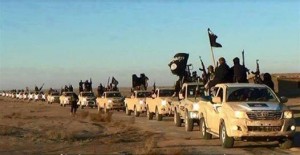
ISIS soldiers in convoy in confiscated trucks in Iraq. Photo: Twitter / nayelshafei.
The current escalating sectarian violence between the Islamic State of Iraq and Syria (ISIS) and Iraqi forces and the unending civil war in Syria are now intertwined and neither can be resolved without the other, which requires a dramatic change in the political and military landscape in Syria and Iraq.
What is happening in Iraq today, and how the unfolding events may play out in the coming months or years, is directly related to three central developments:
First is President Bush’s misguided Iraq war, which has precipitated the violent conflict between the Shiites and the Sunnis in the region. Second is President Obama’s failure to reach a security arrangement with Iraq before the complete withdrawal of American forces and conditioning continued American support of Iraqi Prime Minister Maliki on the establishment of an inclusive government of reconciliation. Finally is the unwillingness of the U.S. to provide the rebels in Syria early on with the kind of military hardware needed to blunt Assad’s onslaught. All combined have brought about the convergence of Al-Qaeda and Islamic jihadist groups into Iraq and subsequently into Syria, causing the unfolding horror we are witnessing today.
There is no clear-cut solution. The bloody conflict in the neighboring countries transcends ISIS’ aspiration to establish an Islamic Sunni state encompassing Iraq and Syria. There will be continuing violence embedded between the Sunnis and Shiites for many years. It has now reached a new peak as Shiite-dominated Iran and Sunni-dominated Saudi Arabia assumed the leadership of their respective sects and are waging a proxy war in both Syria and Iraq, determined to preserve their hegemony if not the survival of their regimes.
For these reasons, the U.S. ought to now pursue a multi-pronged strategy that must first deal with the urgent need to stop the advancement of ISIS toward Baghdad, and then move to the second tier to address the long-term Sunni-Shiite conflict that plagues the region.
In connection with Iraq, the U.S. is left with no choice but to take the lead and orchestrate a military response against ISIS forces. Such an effort must be conditional upon Maliki’s full cooperation on the military front and agreement to form a new government of reconciliation that must include Kurds and Sunnis.
Moreover, to show goodwill and entice Sunni tribal leaders to support the efforts against ISIS, the U.S. must insist that Maliki release thousands of Sunni prisoners who have been incarcerated for years without trial, and stop exhorting (alongside Grand Ayatollah Ali Sistani) young Shiites to form militias against ISIS, which is a recipe for an intensified sectarian war and chaos.
The U.S. should also make every effort to contain the mutual animosity between Iraq and Saudi Arabia, as both governments need to realize that the danger at hand must first be addressed.
As it appears that Obama is seriously considering enlisting Iran politically and militarily to help Maliki stem the advances of ISIS towards Baghdad, the U.S. should keep in mind that in whichever capacity Iran’s involvement in Iraq may be, it will only strengthen its hold on Iraq and further advance its regional ambition to become the dominant power.
As long as the civil war in Syria persists, and even if ISIS is defeated in Iraq and loses much or even all of its territorial gains, it still occupies massive land swaths in Syria to which it can retreat and continue to fight from to realize its goal.
It is also important that while the enmity between Saudi Arabia and Iran is not likely to recede any time soon, there is a temporary common interest between the two. A commitment by Iran to assist in ending the civil war in Syria and eventually allow the emergence of a representative government in Damascus could ease the tension between Saudi Arabia and Iran and de-intensify the Sunni-Shiite divide.
The Saudis are as fearful of the spread of extremist Jihadists and are particularly concerned about ISIS’ intention to target the monarchy as much as Iran is concerned that ISIS’ potential success will lead to the establishment of an extremist Sunni state governed by strict Sharia law next door. These two common concerns may well create a thaw between the two countries.
Finally, the use of American military forces against ISIS is no longer avoidable. Without American military support, Iraq and the entire region will face a long period of violence and instability, which could draw other countries into the conflict with menacing implications.
Being that ISIS is on the move and is adept at guerilla warfare, it will be extremely difficult to bomb ISIS targets particularly because they hide among civilians. This may necessitate some American special forces on the ground, but the bulk of the forces will have to come from the Iraqi military.
Paradoxically, the current conflict in Iraq and the changing geopolitical dynamics could accelerate the process of ending the civil war in Syria. To that end, the U.S. must seize upon this opening and spearhead the delivery of weapons to the rebels to stop Assad from continuing his indiscriminate bombing of rebel hideouts while killing thousands of civilians in the process.
For this reason, once the U.S. commits to preventing ISIS from achieving its goal, it cannot do so incrementally. All countries in the region have a common interest to bring an end to ISIS’ unseemly ambition. They must now set aside their differences and rally under American leadership to achieve their common objective.