 Pod Save America Hosts Call on Democrats to Cut All Israel Military Aid, No Longer Accept AIPAC Funding
 Jews, Israelis Targeted in Austria Amid Surge in Antisemitic Incidents; Local Jewish Community Calls for Action
 ‘All of Our Strength’: Over 1,000 Pro-Israel Activists Gather in DC for Solidarity Conference
 ‘Devastated’: Wesley LePatner, Killed in Manhattan Mass Shooting, Was a Jewish Communal, Philanthropic Leader
 Sen. Angus King Vows to No Longer Vote for Israel Military Aid Until Gaza Conditions Improve
 Europe Won’t Pressure Israel to ‘Commit Suicide’ Amid Gaza Backlash, Palestinian State Push, Says Israeli FM
 Israel’s National Soccer Coach Attacked in Athens Before Soccer Fans Chant ‘F–K Israel, Free Palestine’ at Match
 New York Judge Sentences Neo-Nazi to 5 Years for Livestreaming Bomb Threats Against Jewish Hospitals
 US Pressures Lebanon to Issue Cabinet Decision to Disarm Hezbollah Before Talks Continue
 UK Plans to Recognize Palestinian State in September Unless Israel Meets Conditions, Starmer Says


How Israel Bolsters Trump’s National Security Strategy
Error: Contact form not found.
 by Yoram Ettinger

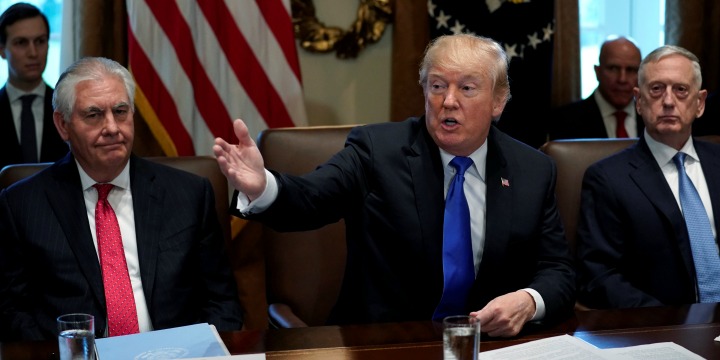
President Donald Trump gestures at a cabinet meeting at the White House, Dec. 20, 2017. Photo: Reuters / Jonathan Ernst.
President Donald Trump’s national security strategy — as enunciated on December 18, 2017 — reflects a realistic assessment of clear and present threats to the US. The document rejects the politically-correct worldview of the foreign policy establishment, which has often crashed against the rocks of reality. It also provides a prescription for the enhancement of the flourishing, mutually-beneficial US-Israel relationship.
Contrary to Western media outlets, academic, and bureaucrats, Trump recognizes the complexity and inherently brutal reality of the Middle East. Trump is aware of the lethal threats posed by Shiite and Sunni terrorism, and the threats posed by the 2015 Iran nuclear deal.
Trump also does not embrace the myth of the Palestinian issue as a core cause of regional instability, a core interest of Arab policymakers, or the crux of the Arab-Israeli conflict.
According to Trump, apologies, appeasement and multilateralism will be replaced by America-first patriotism, the independence of unilateral US military action, the resurgence of the US posture of deterrence, an expanded defense budget and peace-through-strength.
Will Israel leverage these principles in its own battle against Islamic/Arab terrorism, and its public relations posture in the US?
In his document, Trump underlined US national goals, which can be further strengthened through the US-Israel alliance. Some examples include:
1. Improving ballistic missile defense and cyber technologies, with Israel as a top partner;
2. Operational and technological homeland security and counter-terrorism measures developed in Israel that can contribute to the US’ intelligence, training and operations systems; and
3. Building on Israel’s status as a platform of cutting-edge technologies for over 200 US hightech giants, as well as the leading battle-tested laboratory of the US defense industry. The two contains can also work together on research and development, global competitiveness, and strengthening both economies.
Moreover, Israel serves as a strategic deterrent in the Middle East, effectively making Israel “the largest US aircraft carrier” – as suggested by the late General Alexander Haig.
Trump also announced that allies of the US, which benefit from US protection, “should reimburse the United States for the cost of defending them.” However, unlike Germany (70,000 US troops), South Korea and Japan (40,000 troops each), etc., Israel does not require US military bases and/or personnel, on its soil, for its defense.
In fact, Israel constitutes a most effective, reliable, battle-tested and uniquely unconditional US beachhead, stretching the strategic arm of the US in a most critical region.
Now the question is: Will President Trump’s realistic national security talk be matched by effective walk?