 Pod Save America Hosts Call on Democrats to Cut All Israel Military Aid, No Longer Accept AIPAC Funding
 Jews, Israelis Targeted in Austria Amid Surge in Antisemitic Incidents; Local Jewish Community Calls for Action
 ‘All of Our Strength’: Over 1,000 Pro-Israel Activists Gather in DC for Solidarity Conference
 ‘Devastated’: Wesley LePatner, Killed in Manhattan Mass Shooting, Was a Jewish Communal, Philanthropic Leader
 Sen. Angus King Vows to No Longer Vote for Israel Military Aid Until Gaza Conditions Improve
 Europe Won’t Pressure Israel to ‘Commit Suicide’ Amid Gaza Backlash, Palestinian State Push, Says Israeli FM
 Israel’s National Soccer Coach Attacked in Athens Before Soccer Fans Chant ‘F–K Israel, Free Palestine’ at Match
 New York Judge Sentences Neo-Nazi to 5 Years for Livestreaming Bomb Threats Against Jewish Hospitals
 US Pressures Lebanon to Issue Cabinet Decision to Disarm Hezbollah Before Talks Continue
 UK Plans to Recognize Palestinian State in September Unless Israel Meets Conditions, Starmer Says


On the 25th Anniversary of the Oslo Accords
Error: Contact form not found.
 by Eyal Zisser / Israel Hayom / JNS.org

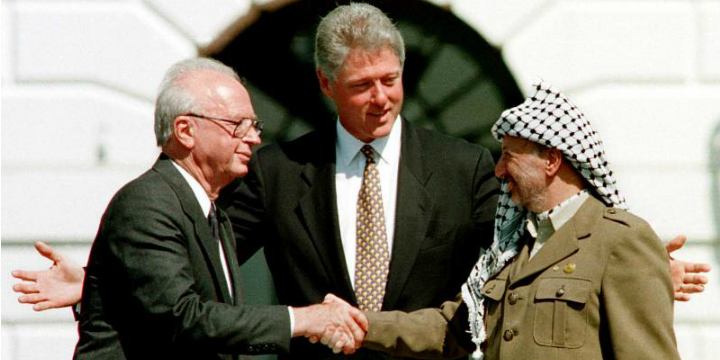
The signing of the Oslo Accords in Washington, DC, Sept. 13, 1993. Photo: Wikimedia Commons.
JNS.org – Monday marks 25 years to the signing of the Oslo Accords between Israel and the Palestine Liberation Organization (PLO). The peace agreement was met with much enthusiasm both in Israel and around the world, and was depicted as a historic breakthrough on the path to Arab-Israeli peace. The agreement earned its signatories a Nobel Peace Prize, but ultimately imploded, leaving Israel to pick up the pieces.
The agreement was secretly signed in Oslo on August 20, 1993, by then-Foreign Minister Shimon Peres and Mahmoud Abbas, PLO leader Yasser Arafat’s representative at the time.
Three weeks after the secret meeting, Prime Minister Yitzhak Rabin and Arafat signed a joint declaration of principles at a festive ceremony on the White House lawn in Washington. With the signing of the joint declaration, PLO leaders returned to Judea, Samaria, and the Gaza Strip, where they established the Palestinian Authority (PA) that governs there to this day.
The Oslo accord was defined as a four-year interim agreement for a transitional stage on the path to finding a permanent solution to the Israeli-Palestinian conflict. But the Israeli authors and proponents of the agreement had a clear idea of what this permanent situation demanded from the outset: Israel’s almost complete withdrawal from a majority of territory in Judea, Samaria, and Gaza; Jerusalem’s division among the Israelis and Palestinians; and finally, a willingness to absorb some of the Palestinian refugees into Israeli territory.
Had they been able to, Israel’s representatives would have signed off on these conditions in Oslo. But they knew the Israeli public, and maybe even many of their colleagues in the Rabin-led government, would find it difficult to agree to such a far-reaching deal.
It was further unclear whether the Palestinians would have agreed to such a move, seeing as even for the Palestinians who took part in the dialogue with Israel and showed a willingness to live alongside it in peace, measures like forgoing the right of return for all Palestinian refugees to Israeli territory, declaring an end to the conflict and recognizing Israel as the state of the Jewish people were seen as painful.
For its initiators, the agreement served as leverage to gradually build trust between the sides. It was designed so that both sides would profit from the agreement and receive compensation that would make continuing the negotiations worthwhile, and was aimed at accustoming both the Israeli and Palestinian public to a path to a resolution of the conflict, as envisioned by its authors.
But the experiment failed. As could be expected, the Palestinian leadership found it difficult — and quite possibly never even intended — to meet the commitments it took upon itself. The PA never tried to prepare the Palestinian public for the concessions that would be necessary in order to make peace. Worse still, it refused to abandon the use of violence and terrorism as a means to achieving its goals, leaving many Israelis skeptical of the plan.
An interview that Mohammed Dahlan, seen by many as a possible successor to Abbas, gave at the height of the Second Intifada illustrates this point quite well. When asked whether the Oslo Accords had been a mistake, Dahlan replied that the agreement had laid the groundwork for the struggle against Israel. As proof, he said hyperbolically, the number of Israelis killed in the Second Intifada was “100 times higher” than the number of Israelis killed in the first. (In fact, it was about three and a half times higher.)
This is all water under the bridge, but from Israel’s standpoint, the problem lies in the reality created by the accord — a reality that, while meant to be temporary in nature, has become permanent. The Palestinian Authority and the Hamas regime in Gaza have become faits accomplis and bones in Israel’s throat. This continues to present endless political and security challenges for Israel.
A quarter of a century after the signing of the Oslo Accords, it seems it would be fitting for Israel to look for out-of-the-box solutions and find a way to escape the uncomfortable reality that it has since found itself in.
Eyal Zisser is a lecturer in the Middle East History Department at Tel Aviv University.