 Pod Save America Hosts Call on Democrats to Cut All Israel Military Aid, No Longer Accept AIPAC Funding
 Jews, Israelis Targeted in Austria Amid Surge in Antisemitic Incidents; Local Jewish Community Calls for Action
 ‘All of Our Strength’: Over 1,000 Pro-Israel Activists Gather in DC for Solidarity Conference
 ‘Devastated’: Wesley LePatner, Killed in Manhattan Mass Shooting, Was a Jewish Communal, Philanthropic Leader
 Sen. Angus King Vows to No Longer Vote for Israel Military Aid Until Gaza Conditions Improve
 Europe Won’t Pressure Israel to ‘Commit Suicide’ Amid Gaza Backlash, Palestinian State Push, Says Israeli FM
 Israel’s National Soccer Coach Attacked in Athens Before Soccer Fans Chant ‘F–K Israel, Free Palestine’ at Match
 New York Judge Sentences Neo-Nazi to 5 Years for Livestreaming Bomb Threats Against Jewish Hospitals
 US Pressures Lebanon to Issue Cabinet Decision to Disarm Hezbollah Before Talks Continue
 UK Plans to Recognize Palestinian State in September Unless Israel Meets Conditions, Starmer Says


Why UNIFIL’s Existence Remains in Israel’s Interest
Error: Contact form not found.
 by Yoav Limor / JNS.org

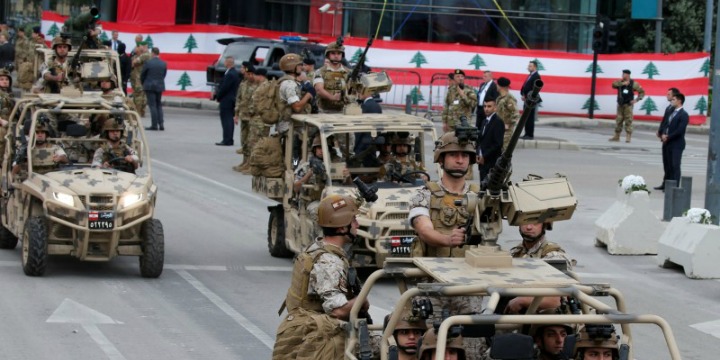
Lebanese army soldiers take part in a military parade to celebrate the 74th anniversary of Lebanon’s independence in downtown Beirut, November 22, 2017. Photo: Reuters / Mohamed Azakir.
JNS.org – Many people in Israel believe that the United Nations Interim Force in Lebanon (UNIFIL) is like the three wise monkeys at the Tosho-gu shrine in Nikko, Japan: it sees no evil, hears no evil, and speaks no evil. This, they claim, is the only way to explain the selective blindness that the UN peacekeeping force has exercised when it comes to Hezbollah’s actions in southern Lebanon since the end of the 2006 Second Lebanon War.
In the 12 years since then, the Shiite terrorist group has turned the villages of southern Lebanon into urban warfare compounds. Prior to the war, Hezbollah operated mainly in open areas. Afterwards, the Iranian-backed group focused on developing its infrastructure in the area’s towns and villages, knowing that in times of war, it would be relatively protected by the inherent complexities of fighting in such a densely populated area.
Israel, which monitors these developments closely, was furious. Israeli intelligence about the scope of Hezbollah’s operations was given to UNIFIL, as was intelligence on the group’s top operatives orchestrating these activities.
UNIFIL did little to counter these developments, especially over the past few years, under the command of former UNIFIL chief Maj. Gen. Michael Beary.
Now, with Maj. Gen. Stefano Del Col leading the international peacekeeping force, Israel hopes things will change. Del Col is unlikely to provoke an overt confrontation with Hezbollah, but he is likely to help Israel neutralize potentially volatile situations, so as to maintain Israel’s principal interest in the northern sector: peace and quiet.
This is why UNIFIL’s existence is, in fact, in Israel’s best interest: While UN troops may hinder the IDF’s operations in times of war, for the most part, UNIFIL is an efficient mechanism and a vital liaison to the Lebanese government — and through it, to the Lebanese army.
This is also why Israel supports keeping the United Nations Disengagement Observer Force (UNDOF) on the Golan Heights border with Syria.
Given the uncertainty on this front, now that Syrian President Bashar Assad has regained control of the area — and especially given Iran’s attempts to entrench itself militarily in southern Syria — UNDOF’s presence can be a calming factor to allow for communications, albeit indirect, with Damascus.
It is highly doubtful that UN peacekeeping troops can actually bring peace, and it is equally doubtful that they would be able to prevent war in the event of a wide-scale escalation in the northern sector, but they can certainly be effective in defusing tensions on both borders.
Yoav Limor is a veteran Israeli journalist and columnist for Israel Hayom.