 Pod Save America Hosts Call on Democrats to Cut All Israel Military Aid, No Longer Accept AIPAC Funding
 Jews, Israelis Targeted in Austria Amid Surge in Antisemitic Incidents; Local Jewish Community Calls for Action
 ‘All of Our Strength’: Over 1,000 Pro-Israel Activists Gather in DC for Solidarity Conference
 ‘Devastated’: Wesley LePatner, Killed in Manhattan Mass Shooting, Was a Jewish Communal, Philanthropic Leader
 Sen. Angus King Vows to No Longer Vote for Israel Military Aid Until Gaza Conditions Improve
 Europe Won’t Pressure Israel to ‘Commit Suicide’ Amid Gaza Backlash, Palestinian State Push, Says Israeli FM
 Israel’s National Soccer Coach Attacked in Athens Before Soccer Fans Chant ‘F–K Israel, Free Palestine’ at Match
 New York Judge Sentences Neo-Nazi to 5 Years for Livestreaming Bomb Threats Against Jewish Hospitals
 US Pressures Lebanon to Issue Cabinet Decision to Disarm Hezbollah Before Talks Continue
 UK Plans to Recognize Palestinian State in September Unless Israel Meets Conditions, Starmer Says


Empty, Haunting Anne Frank House Museum Revamped for New Generation
Error: Contact form not found.
 by Reuters and Algemeiner Staff

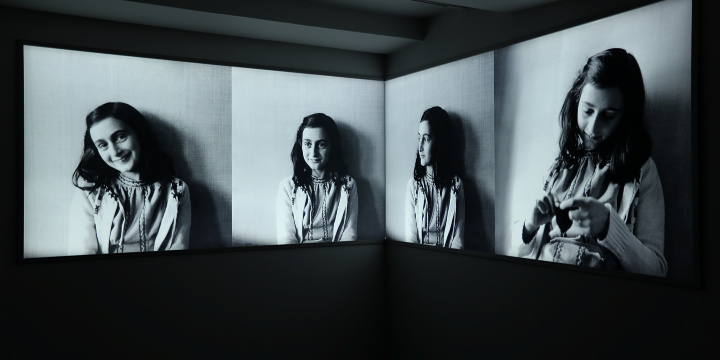
Photos of Anne Frank are seen at Anne Frank House museum in Amsterdam, Netherlands, Nov. 21, 2018. Photo: Reuters / Eva Plevier.
The Anne Frank House Museum, built around the secret apartment where the Jewish teenager and her family hid from the Nazis, has reopened after being renovated to receive a new generation of visitors whose grandparents were born after World War II.
The museum and tiny apartment where Anne wrote her diary — which has become the most widely-read document to emerge from the Holocaust — attract 1.2 million visitors annually.
Anne’s story is told through simple photos, quotes from her diary, and video testimony of survivors. Curators have now added an audio tour.
“We sometimes say that the Anne Frank House Museum is one of the only museums in the world that doesn’t have much more to offer than empty spaces,” said museum director Ronald Leopold.
“An audio tour gave us the ability to give information without disturbing what I think is one of the most powerful elements of this house: its emptiness.”
A trip through the museum, which was reopened by Dutch King Willem-Alexander on Thursday, begins with the history of the Frank family, their flight to the Netherlands after Hitler’s rise to power in Germany, and their decision to go into hiding on July 6, 1942.
Visitors pass through the swinging bookcase that concealed the cramped secret annex above a warehouse where Anne, her sister Margot, her father Otto, mother Edith, and four other Jews hid until they were arrested by German police on August 4, 1944.
The museum then displays the government document registering the Franks’ deportation on a cattle car train to Auschwitz.
Anne was later transferred to the concentration camp at Bergen-Belsen, where she died in early 1945 aged 15, one of the six million Jews who lost their life under the Nazi regime.
Of those that hid in the secret apartment, only Otto survived the war. He was given Anne’s diary, which had been preserved by Miep Gies, a member of the tight circle of Dutch friends that helped the Jews in hiding.
In a film clip, Otto describes reading the diary after a period of grieving.
“I must say I was very much surprised about the deep thoughts there she had; her seriousness, especially her self-criticism. It was quite a different Anne I had known as my daughter,” he said.
“My conclusion is, as I had been on very, very good terms with her, that most parents don’t know — don’t know really — their own children.”
The museum concludes with a simple room where the original red-and-white bound diary — which outgrew its covers — and several additional pages are on display. Photographs are not allowed due to the fragility of the pages.