 Pod Save America Hosts Call on Democrats to Cut All Israel Military Aid, No Longer Accept AIPAC Funding
 Jews, Israelis Targeted in Austria Amid Surge in Antisemitic Incidents; Local Jewish Community Calls for Action
 ‘All of Our Strength’: Over 1,000 Pro-Israel Activists Gather in DC for Solidarity Conference
 ‘Devastated’: Wesley LePatner, Killed in Manhattan Mass Shooting, Was a Jewish Communal, Philanthropic Leader
 Sen. Angus King Vows to No Longer Vote for Israel Military Aid Until Gaza Conditions Improve
 Europe Won’t Pressure Israel to ‘Commit Suicide’ Amid Gaza Backlash, Palestinian State Push, Says Israeli FM
 Israel’s National Soccer Coach Attacked in Athens Before Soccer Fans Chant ‘F–K Israel, Free Palestine’ at Match
 New York Judge Sentences Neo-Nazi to 5 Years for Livestreaming Bomb Threats Against Jewish Hospitals
 US Pressures Lebanon to Issue Cabinet Decision to Disarm Hezbollah Before Talks Continue
 UK Plans to Recognize Palestinian State in September Unless Israel Meets Conditions, Starmer Says


President Trump’s Purim Gift
Error: Contact form not found.
 by Jerold Auerbach

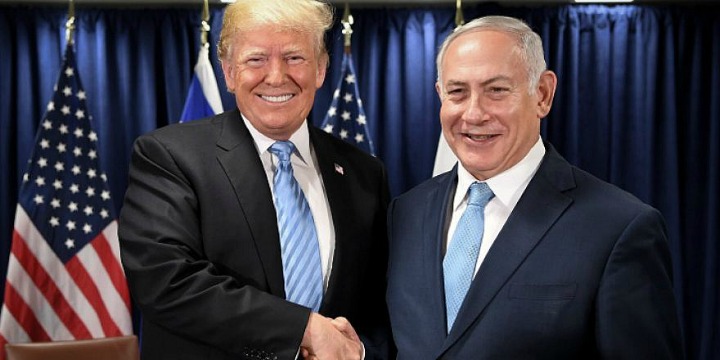
U.S. President Donald Trump meets with Israeli Prime Minister Benjamin Netanyahu at U.N. headquarters in New York on Sept. 26, 2018. Photo: Avi Ohayon/GPO.
President Trump’s stunning and, for many Israelis, long overdue and welcome announcement that “it is time for the United States to fully recognize Israel’s sovereignty over the Golan Heights” predictably rattled critics of the president, Prime Minister Benjamin Netanyahu, and the Jewish state. In its front-page article, with five journalists credited for coverage, The New York Times proclaimed that Trump’s statement “puts him at odds with international law” (although no such law was cited).
As usual, the Times twisted news fit to print into criticism of Israel. Martin Indyk, former American ambassador to Israel (who was inclined to blame the Jewish state for the absence of peace), criticized Trump’s decision as “a truly gratuitous move.” Former Middle East negotiator Dennis Ross, another critic of the presidential announcement, identified the Golan as “Arab land.” The only favorable Times comment, ironically, came (in the concluding paragraph) from Yair Lapid, co-leader of the party seeking to defeat Prime Minister Netanyahu in the forthcoming Israeli election. He identified the Trump announcement as “a dream come true.” Netanyahu, needless to say, was ecstatic.
Historian that I am, I wondered about the Golan in history, long before the Six-Day War. Did Israel conquer “Syrian” territory in 1967 — or did it return, as in Judea and Samaria (Jordan’s “West Bank”) to part of its ancient homeland? According to Deuteronomy 41-43, Bashan (the biblical Golan) is identified as one of three cities designated by Moses as places of refuge for “manslayers” who had accidentally killed another man. The Book of Joshua 21:27 recognizes Golan as a Levitical city and a city of refuge.
After Jews returned to their promised land from Babylonian exile, they renewed Golan settlements, where Judah Maccabee fought valiantly to defend them. Under King Alexander Yannai, the Hasmonean ruler of Judea, Jews rebuilt the Golan cities of Banias and Susita. In the 2nd century war against Rome, Gamla residents, led by Bar Kokhba, fought fiercely against their Roman conquerors.
Further testimony to the ancient Jewish presence in the Golan followed the Six Day War, when Jewish coins were discovered, inscribed: “For the Redemption of Jerusalem.” Israeli archaeologists have found the remains of nearly three dozen ancient synagogues on the Golan, more than sufficient evidence of a Jewish presence there during key periods of Jewish history.
That history notwithstanding, Israeli political leaders during the 1990s were prepared to relinquish the Golan Heights in return for a peace treaty with Syria. To Israel’s considerable benefit, President Hafez Assad refused. His rejection has been embraced by his son and successor Bashar, beholden to Iran and Hezbollah to sustain his precarious rule.
The delight of Israelis with President Trump’s announcement was evident. Haim Rokach, head of the Golan Regional Council, noted that for five decades Golan residents “have been fighting against the intentions of various Israeli governments to withdraw from the territory.” With more ancient synagogues discovered there than anywhere else in Israel, he is convinced that President Trump’s announcement “has put an end to the questions and doubts over whether the Golan is Israeli territory.” Rokach cites an ancient coin found in the Gamla synagogue anticipating the redemption of Jerusalem as evidence of the unbreakable link between the Golan and the ancient — and modern — capital of Israel.
Nearly forty years ago, Prime Minister Menachem Begin canceled Israeli military rule over the Golan Heights, replacing it with Israeli law. It was a prescient decision, now enhanced by President Trump. And the day of his announcement — appropriately — was Purim. As Israeli journalist Boaz Bismuth wrote: on the very day when, according to the Book of Esther, “The Jews had light and gladness and joy and honor,” President Trump bestowed the “wonderful gift” of recognizing the Golan Heights as part of Israel.
First Jerusalem; then the Golan. Can Judea and Samaria be far behind?
Jerold S. Auerbach is the author of Print to Fit: The New York Times, Zionism and Israel 1896-2016, published this month by Academic Studies Press.