 Pod Save America Hosts Call on Democrats to Cut All Israel Military Aid, No Longer Accept AIPAC Funding
 Jews, Israelis Targeted in Austria Amid Surge in Antisemitic Incidents; Local Jewish Community Calls for Action
 ‘All of Our Strength’: Over 1,000 Pro-Israel Activists Gather in DC for Solidarity Conference
 ‘Devastated’: Wesley LePatner, Killed in Manhattan Mass Shooting, Was a Jewish Communal, Philanthropic Leader
 Sen. Angus King Vows to No Longer Vote for Israel Military Aid Until Gaza Conditions Improve
 Europe Won’t Pressure Israel to ‘Commit Suicide’ Amid Gaza Backlash, Palestinian State Push, Says Israeli FM
 Israel’s National Soccer Coach Attacked in Athens Before Soccer Fans Chant ‘F–K Israel, Free Palestine’ at Match
 New York Judge Sentences Neo-Nazi to 5 Years for Livestreaming Bomb Threats Against Jewish Hospitals
 US Pressures Lebanon to Issue Cabinet Decision to Disarm Hezbollah Before Talks Continue
 UK Plans to Recognize Palestinian State in September Unless Israel Meets Conditions, Starmer Says


Yemen’s Houthis Step Up Drone Attacks on Saudi Arabia
Error: Contact form not found.
 by Reuters and Algemeiner Staff

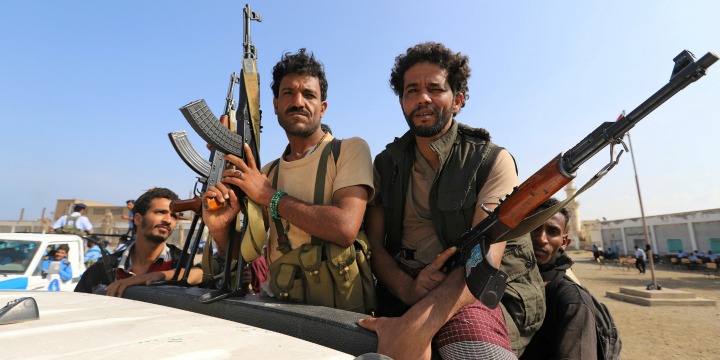
Houthi militants ride on the back of a truck as they withdraw, as part of a UN-sponsored peace agreement signed in Sweden, from the Red Sea city of Hodeidah, Yemen December 29, 2018. Photo: Reuters / Abduljabbar Zeyad / File.
Yemen’s Iran-aligned Houthis have stepped up missile and drone attacks on Saudi Arabia this week in a resurgence of tactics that had largely subsided since late last year amid United Nations-led peace efforts.
The latest hostilities coincide with rising tensions between Iran and Gulf Arab states allied to the United States and come just as a sensitive, UN-sponsored peace deal is being carried out in Yemen’s main port of Hodeidah, a lifeline for millions.
The Houthis, who claimed responsibility for last week’s armed drone strikes on oil assets in Saudi Arabia, said on Tuesday that one of their drones hit an arms depot at the kingdom’s Najran aiport near the Yemeni border, causing a fire.
The Saudi-led military coalition said a civilian facility in Najran province was targeted with an explosive-laden drone.
It said on Monday that Saudi defense forces intercepted Houthi ballistic missiles fired toward Mecca, Islam’s holiest site. The Houthis denied doing so.
On Sunday, the Houthis said they would attack 300 vital military targets in Saudi Arabia, the United Arab Emirates and Yemen.
Saudi Arabia and the UAE head a Western-backed coalition of Sunni Muslim states that intervened in Yemen in 2015 to try to restore the internationally recognized government ousted from power in the capital Sanaa by the Houthis in late 2014.
The movement has during the war repeatedly targeted Saudi cities and vital installations — mostly in border areas, but on several occasions the capital Riyadh as well. The Houthis pledged last November to stop attacks on Saudi Arabia and the UAE at the request of the United Nations.
While attacks on Saudi border areas continued, the Houthis had avoided targeting major cities or infrastructure. There have been no reports of attacks on the capital since last June.
The coalition has in return conducted multiple air strikes on the Houthi-held Yemeni capital Sanaa which it says target military facilities and aim to neutralize the group’s ability to fire missiles and drones.
Riyadh and Abu Dhabi accuse Iran of arming the Houthis, a charge denied by the group and Tehran.
Fragile regional ceasefire
It was not yet clear how the rising tension could impact a regional ceasefire and troop withdrawal deal in Hodeidah — the first major diplomatic breakthrough in a conflict that has pushed Yemen to the brink of famine.
The deal was stalled for months before a unilateral Houthi withdrawal from Hodeidah and two other Red Sea ports 10 days ago. That is meant to lead to a pullback by coalition forces massed on the edges of Hodeidah, the main entry point for Yemen’s commercial and humanitarian aid imports.
Saudi Arabia accused Iran of ordering last week’s drone strikes on two Aramco oil pumping stations, which followed sabotage acts on Saudi oil tankers off the UAE coast. Iran denied being behind the drone attacks.
The UAE has yet to blame anyone for the tanker operation, but two US government sources said last week that US officials believed Iran encouraged the Houthis or Iraq-based Shi’ite Muslim militias to carry it out. Iran distanced itself.
Saudi Arabia will hold an emergency Arab summit in Mecca on May 30 to discuss the implications of the attacks, which came as the United States and Iran spar over US sanctions reimposed on Tehran and over the US military presence in the Gulf.
Yemen’s conflict is widely seen in the region as a proxy war between Saudi Arabia and Iran. The Houthis, who control the biggest urban centers in Yemen, deny being Iranian puppets and say they are waging a revolution against corruption.
The World Food Programme said on Monday it was considering suspending aid deliveries in areas under Houthi control due to fighting, insecurity and interference in its work.
Some 9 million of the 12 million Yemenis whom the WFP is seeking to reach with rations each month live in Houthi-held areas, WFP spokesman Herve Verhoosel said, denouncing diversions of aid supplies especially in areas in Houthi hands.
“All this needs to stop. We are here to save 12 million people — many of them children and women — to save them from famine,” he told a briefing in Geneva.