 Pod Save America Hosts Call on Democrats to Cut All Israel Military Aid, No Longer Accept AIPAC Funding
 Jews, Israelis Targeted in Austria Amid Surge in Antisemitic Incidents; Local Jewish Community Calls for Action
 ‘All of Our Strength’: Over 1,000 Pro-Israel Activists Gather in DC for Solidarity Conference
 ‘Devastated’: Wesley LePatner, Killed in Manhattan Mass Shooting, Was a Jewish Communal, Philanthropic Leader
 Sen. Angus King Vows to No Longer Vote for Israel Military Aid Until Gaza Conditions Improve
 Europe Won’t Pressure Israel to ‘Commit Suicide’ Amid Gaza Backlash, Palestinian State Push, Says Israeli FM
 Israel’s National Soccer Coach Attacked in Athens Before Soccer Fans Chant ‘F–K Israel, Free Palestine’ at Match
 New York Judge Sentences Neo-Nazi to 5 Years for Livestreaming Bomb Threats Against Jewish Hospitals
 US Pressures Lebanon to Issue Cabinet Decision to Disarm Hezbollah Before Talks Continue
 UK Plans to Recognize Palestinian State in September Unless Israel Meets Conditions, Starmer Says


Israeli Army in No Rush to Go Fully Robotic
Error: Contact form not found.
 by Reuters and Algemeiner Staff

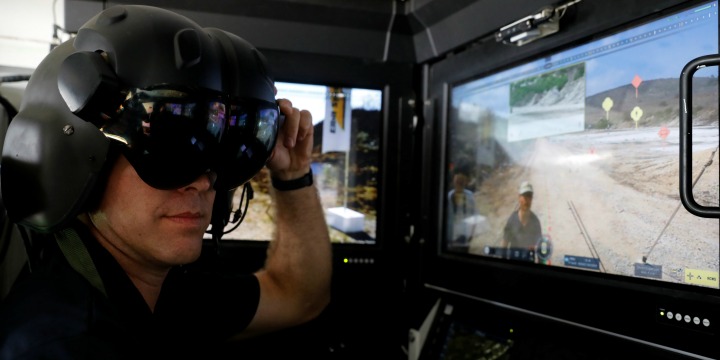
An exhibitor shows the operating suite of an Israeli armored vehicle during a display of future systems at Elyakim Military Base in northern Israel, Aug. 4, 2019. Photo: Reuters / Amir Cohen.
Israel, a world leader in hi-tech, is around 30 years away from its ambition of deploying robot forces, and for now will chose between three prototypes of semi-automated armored vehicles to cocoon its troops in battle, defense officials said on Sunday.
Israel has long eyed a future robot army as a means of reducing the use of soldiers on its combustible fronts with Gaza, Lebanon and Syria, just as its air force has increasingly relied on pilotless drones.
The country draws most of its military personnel from teenage conscripts.
An unveiling of Israel’s newly-developed operating suites for ground fighting vehicles made clear it plans to keep soldiers at the controls, albeit entirely insulated from the outside: Hatches battened, the cabins will have smart-screens, fed by outside cameras and sensors, instead of windows or ports.
“Now the people will be sitting in the tank, it’s closed, they are far better protected, and they can advance without worrying about snipers or other things,” said Brigadier-General Yaniv Rotem, head of the Defense Ministry’s development unit.
The prototype suites, designed by Israel’s top three defense firms as they compete for an army tender, include artificial intelligence systems billed as spotting enemy fighters and directing the vehicle’s counter-fire at them automatically.
Asked why Israel was not eliminating human involvement entirely and operating the vehicles remotely, Rotem told reporters: “At the end of the day, it is the man in the vehicle who takes the decision. You need someone who thinks more than a machine.”
The Defense Ministry, he said, was separately devoting “a lot of discussion” to a potential robot army of the future.
“Our vision (is), 30 years from now, a lot of autonomous capability,” he said.
A second defense official said that while the suites could in theory be remote-operated, disruptions or delays in the signal would potentially impede their effectiveness in battle.
Two of the competing systems appeared inspired by video games and other home technologies, appealing to young soldiers.
State-owned Israel Aerospace Industries’ has Xbox-style controls. Rafael Advanced Defense Systems, also state-owned, has a vehicle simulator with touch-screens and animation whose terrain and characters’ garb recall Afghanistan — a nod to the US Army, whose officers also inspected the display on Sunday.
The third Israeli bidder, Elbit Systems Ltd., came up with adapted air force helmets whose inside visors provide a 360-degree view of the vehicle’s exterior. Rotem said Israel was already incorporating the helmets among its Merkava tank crews.