 Pod Save America Hosts Call on Democrats to Cut All Israel Military Aid, No Longer Accept AIPAC Funding
 Jews, Israelis Targeted in Austria Amid Surge in Antisemitic Incidents; Local Jewish Community Calls for Action
 ‘All of Our Strength’: Over 1,000 Pro-Israel Activists Gather in DC for Solidarity Conference
 ‘Devastated’: Wesley LePatner, Killed in Manhattan Mass Shooting, Was a Jewish Communal, Philanthropic Leader
 Sen. Angus King Vows to No Longer Vote for Israel Military Aid Until Gaza Conditions Improve
 Europe Won’t Pressure Israel to ‘Commit Suicide’ Amid Gaza Backlash, Palestinian State Push, Says Israeli FM
 Israel’s National Soccer Coach Attacked in Athens Before Soccer Fans Chant ‘F–K Israel, Free Palestine’ at Match
 New York Judge Sentences Neo-Nazi to 5 Years for Livestreaming Bomb Threats Against Jewish Hospitals
 US Pressures Lebanon to Issue Cabinet Decision to Disarm Hezbollah Before Talks Continue
 UK Plans to Recognize Palestinian State in September Unless Israel Meets Conditions, Starmer Says


US Will Not Let Iran Buy Arms When UN Embargo Ends: Pompeo
Error: Contact form not found.
 by Reuters and Algemeiner Staff

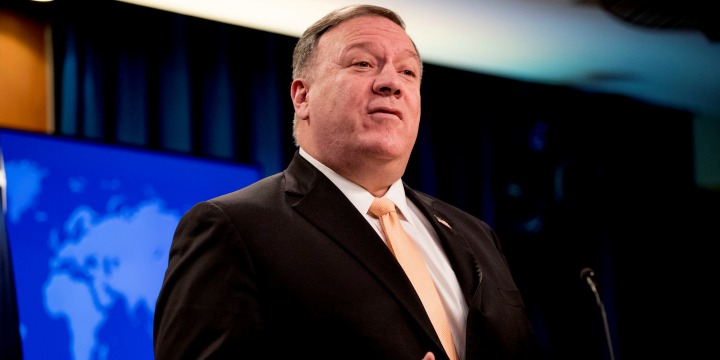
US Secretary of State Mike Pompeo attends a news conference at the State Department in Washington, DC, March 31, 2020. Photo: Andrew Harnik / Pool via Reuters.
The United States will not allow Iran to purchase conventional arms after a UN prohibition on this expires in October, US Secretary of State Mike Pompeo said on Wednesday.
“We’re not going to let that happen,” Pompeo told reporters at a news briefing. “We will work with the UN Security Council to extend that prohibition on those arms sales and then in the event we can’t get anyone else to act, the United States is evaluating every possibility about how we might do that.”
The United States in 2018 withdrew from the Iran nuclear deal that sought to prevent Tehran from developing nuclear weapons in exchange for relief from economic sanctions. As part of that deal, a UN arms embargo on Iran expires in October.
A US-drafted resolution to extend the embargo has been given to Britain, France and Germany, all parties to the nuclear deal, a US official confirmed, but UN diplomats said it has not been shared with the remaining 11 UN Security Council members, including Russia and China. Russia and China, which hold vetoes on the council and are parties to the nuclear deal, are believed to be eager to sell armaments to Iran.
“The failures of the Iran nuclear deal are legion. One of them is now upon us. … where China, Russia, and other countries from around the world can all sell significant conventional weapon systems to the Iranians in October,” Pompeo said.
“We are urging our E3 partners to take action. This is within their capacity to do,” he added, referring to Britain, France and Germany, each of which has the ability to force the “snapback” of all UN sanctions on Iran — including the conventional arms embargo — lifted under the nuclear deal.
Several European diplomats said since Washington has pulled out of the nuclear deal, it may not be able to spark a sanctions snapback, but Pompeo on Wednesday pushed back on that argument.
“The UN Security Council Resolution 2231 is very clear. We don’t have to declare ourselves as a participant…It’s there in the language…It’s unambiguous and the rights that accrue to participants in the UN Security Council resolution are fully available to all those participants,” he said.
Some UN diplomats said that while legal opinions on whether the United States could do this were split, ultimately it would be up to council members to decide whether to accept a US complaint of “significant non-performance” by Iran.