 Pod Save America Hosts Call on Democrats to Cut All Israel Military Aid, No Longer Accept AIPAC Funding
 Jews, Israelis Targeted in Austria Amid Surge in Antisemitic Incidents; Local Jewish Community Calls for Action
 ‘All of Our Strength’: Over 1,000 Pro-Israel Activists Gather in DC for Solidarity Conference
 ‘Devastated’: Wesley LePatner, Killed in Manhattan Mass Shooting, Was a Jewish Communal, Philanthropic Leader
 Sen. Angus King Vows to No Longer Vote for Israel Military Aid Until Gaza Conditions Improve
 Europe Won’t Pressure Israel to ‘Commit Suicide’ Amid Gaza Backlash, Palestinian State Push, Says Israeli FM
 Israel’s National Soccer Coach Attacked in Athens Before Soccer Fans Chant ‘F–K Israel, Free Palestine’ at Match
 New York Judge Sentences Neo-Nazi to 5 Years for Livestreaming Bomb Threats Against Jewish Hospitals
 US Pressures Lebanon to Issue Cabinet Decision to Disarm Hezbollah Before Talks Continue
 UK Plans to Recognize Palestinian State in September Unless Israel Meets Conditions, Starmer Says


The Jews and Prohibition
Error: Contact form not found.
 by Harold Brackman

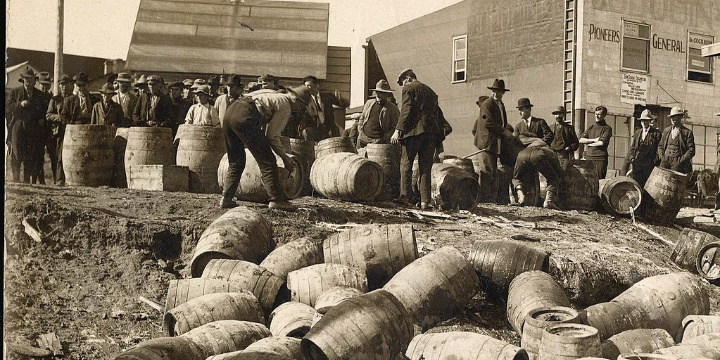
A police raid during Prohibition at Elk Lake, Canada, 1925. Photo: public domain via Wikicommons.
In 1920s New York City, prohibition agents Izzy Einstein and Moe Smith were confronted with an endless number of illegal “speakeasies.” Prohibitionists who were also antisemites like Henry Ford blamed flouting the Volstead Act on a Jewish conspiracy to corrupt American morals, and demanded immigration restriction laws to end the influx of Jewish immigrants.
There was no conspiracy, but a thriving Jewish infrastructure of alcohol entrepreneurs did exist, ranging from neighborhood brewers of bathtub gin, to criminal mob associates Bugsy Siegel and Meyer Lansky, to Samuel Bronfman’s legal Canadian distillery linked to a cross-border network of illegal distributors.
Parts of Prohibition’s folklore are myths. Alcohol consumption actually plummeted as corner saloons shuttered, although more hard liquor was consumed compared to beer. Deaths from alcoholism and cirrhosis of the liver declined faster than fatal alcohol poisoning increased. But there was a correlation between Prohibition and increases in the cigarette habit, especially among women.
Who were Izzy and Moe? Isidor “Izzy” Einstein was a postal clerk with four hungry children to feed who was hired as an enforcement agent for the Federal Prohibition Bureau after the Volstead Act took effect. Born in Austria-Hungary, Izzy spoke six languages, a plus in polyglot New York City. His partner was New York-born Moe Smith, a cigar store proprietor. Izzy was squat and fat, Moe even more corpulent and a little taller. They specialized in disguises, sometimes wearing drag, and used “an artificial gullet,” or rubber tube and bag for pouring liquor down their trousers to save for evidence. They boasted of busting 180 phony rabbis, making 5,000 arrests, and confiscating five million bottles of alcohol. They became newspaper darlings, but were fired in 1925.
Marni Davis’ Jews and Booze (2012) explains special challenges of enforcing Prohibition. One loophole was for medicinal purposes (some phony Jewish pharmacists filled prescriptions). A second loophole was a religious exemption for sacramental wine. The Catholic Church kept a tight rein on priests, but it was easier for a Jew to claim to be a rabbi. Conservative and Orthodox Jews squabbled over which rabbis qualified legitimately for the exemption. Jewish laymen were also permitted to buy up to 10 gallons of kosher wine a year for home consumption. Another question: was it kosher to substitute grape juice for wine? In 1926, the Feds acted to turn off the spigot for Jewish bootleggers; they began inspecting the credentials of questionable “rabbis.”
Historian Harold Brackman is co-author with Ephraim Isaac of From Abraham to Obama: A History of Jews, Africans, and African Americans (Africa World Press, 2015).