 Pod Save America Hosts Call on Democrats to Cut All Israel Military Aid, No Longer Accept AIPAC Funding
 Jews, Israelis Targeted in Austria Amid Surge in Antisemitic Incidents; Local Jewish Community Calls for Action
 ‘All of Our Strength’: Over 1,000 Pro-Israel Activists Gather in DC for Solidarity Conference
 ‘Devastated’: Wesley LePatner, Killed in Manhattan Mass Shooting, Was a Jewish Communal, Philanthropic Leader
 Sen. Angus King Vows to No Longer Vote for Israel Military Aid Until Gaza Conditions Improve
 Europe Won’t Pressure Israel to ‘Commit Suicide’ Amid Gaza Backlash, Palestinian State Push, Says Israeli FM
 Israel’s National Soccer Coach Attacked in Athens Before Soccer Fans Chant ‘F–K Israel, Free Palestine’ at Match
 New York Judge Sentences Neo-Nazi to 5 Years for Livestreaming Bomb Threats Against Jewish Hospitals
 US Pressures Lebanon to Issue Cabinet Decision to Disarm Hezbollah Before Talks Continue
 UK Plans to Recognize Palestinian State in September Unless Israel Meets Conditions, Starmer Says


Syria Seeks Russian Investment as US Sanctions Hammer Economy
Error: Contact form not found.
 by Reuters and Algemeiner Staff

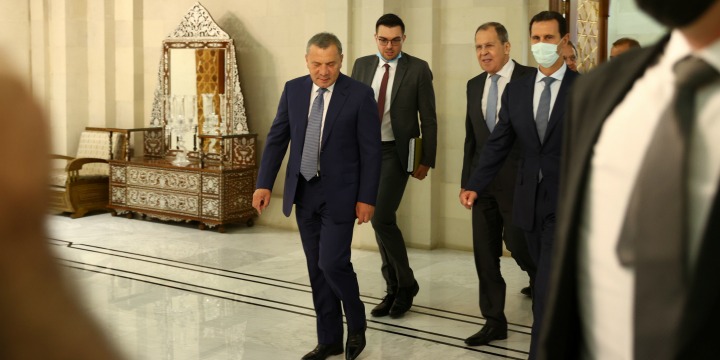
Russian Deputy Prime Minister Yuri Borisov, Russian Foreign Minister Sergei Lavrov, Syrian President Bashar al-Assad and other officials attend a meeting in Damascus, Syria, Sept. 7, 2020. Photo: Russian Foreign Ministry / Handout via Reuters.
President Bashar al-Assad said on Monday he wanted to expand business ties with Russia to help Syria cope with new US sanctions on its already-crippled economy that threaten to undermine military gains Damascus achieved with Moscow’s help.
Assad spoke during a meeting in Damascus with Russian Deputy Prime Minister Yuri Borisov and Foreign Minister Sergei Lavrov.
Lavrov told a news conference Syria needed international help to rebuild its economy. Borisov said Russia was helping Syria to fix its power plants but said oil output could not resume as the fields were in areas outside government control.
Syria and Russia, whose military support since 2015 helped Damascus reverse gains by Islamists and other rebels in an almost decade-long war, had said the two sides planned to boost trade ties and would review energy, mining and power projects.
“The government was determined to continue to work with Russian allies to implement signed agreements and to ensure the success of Russian investments in Syria,” Assad said, according to state media.
Borisov said Moscow had presented proposals in July to expand economic ties and expected an agreement would be sealed in December on his next visit to Syria’s capital. He said Moscow wanted to help Damascus break the blockade of US sanctions.
Syria has pinned hopes on Russia, its main foreign ally, while Western diplomats say Russia’s military involvement in Syria has secured Moscow major regional influence and a bigger foothold in a naval base in Syria’s Tartus port.
“Russia turned the tide for Assad and with the regime now facing its gravest challenges, Moscow is in a better position than any other time to further squeeze Assad,” said one Western diplomat who follows Syria.
Although Assad has now regained most of the territory he had lost in the war, the economy is in tatters, leaving many Syrians in poverty as the currency has lost 80 percent of its value.
Russia has criticized the new US sanctions that took effect in June under the so-called Caesar Act.
Washington says the sanctions, which penalize foreign firms dealing with Syrian government entities, aim to cut revenue for Assad’s government and push him back into UN-led talks to end the conflict.