 Pod Save America Hosts Call on Democrats to Cut All Israel Military Aid, No Longer Accept AIPAC Funding
 Jews, Israelis Targeted in Austria Amid Surge in Antisemitic Incidents; Local Jewish Community Calls for Action
 ‘All of Our Strength’: Over 1,000 Pro-Israel Activists Gather in DC for Solidarity Conference
 ‘Devastated’: Wesley LePatner, Killed in Manhattan Mass Shooting, Was a Jewish Communal, Philanthropic Leader
 Sen. Angus King Vows to No Longer Vote for Israel Military Aid Until Gaza Conditions Improve
 Europe Won’t Pressure Israel to ‘Commit Suicide’ Amid Gaza Backlash, Palestinian State Push, Says Israeli FM
 Israel’s National Soccer Coach Attacked in Athens Before Soccer Fans Chant ‘F–K Israel, Free Palestine’ at Match
 New York Judge Sentences Neo-Nazi to 5 Years for Livestreaming Bomb Threats Against Jewish Hospitals
 US Pressures Lebanon to Issue Cabinet Decision to Disarm Hezbollah Before Talks Continue
 UK Plans to Recognize Palestinian State in September Unless Israel Meets Conditions, Starmer Says


The USSR’s Collapse Was No Catastrophe for Israel
Error: Contact form not found.
 by Ariel Bulshtein / JNS.org

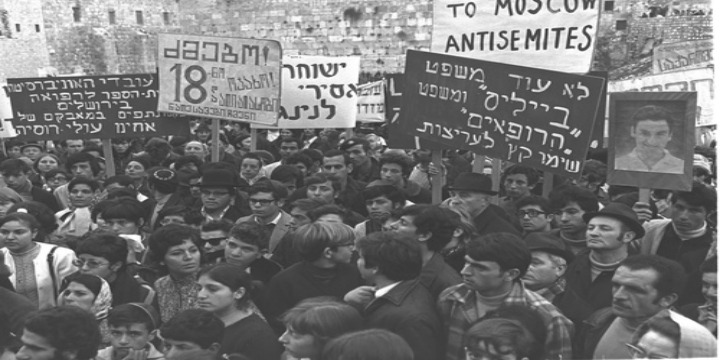
A mass solidarity rally with Soviet Jewry at the Western Wall in Jerusalem on December 20, 1970. Photo: Moshe Milner/GPO.
JNS.org – Russian President Vladimir Putin described the collapse of the former Soviet Union as the “biggest geopolitical catastrophe of the century,” but for Israel, it was a blessing — a rare event whose results were all positive. The final disappearance of the Soviet empire in December 1991 symbolized the exit of a superpower that had been extremely hostile to the Jewish state.
Although the Soviet Union had supported the original UN decision to establish a state for the Jewish people, it wasn’t because it supported the idea of Jewish patriotism, but rather because it wanted to hurry up and oust the British from the Middle East. When the Soviets achieved that goal, and it turned out that despite the socialist leanings of the Jewish Yishuv, Israel would not become a satellite of Moscow, the true face of the “state of workers and farmers” was exposed.
The more time passed, the more hostile the Soviets grew toward Israel, and later, after Israel won the 1967 Six-Day War, hostility became open hatred. The Soviet Union had armed the Arab countries that had tried to annihilate Israel; helped Arab terrorist organizations flourish; and even took direct military action against it in the War of Attrition and on a few other occasions.
If all that wasn’t enough, the Soviets played a key role in forming the lie about a “Palestinian people.” The very idea of moving from pan-Arab arguments to an ideological campaign against Zionism rooted in a new, historically baseless claim that the Arabs of Israel were a separate people who demanded self-definition was conceived and disseminated by the KGB.
This was particularly notable in the Baltic states (Latvia, Lithuania and Estonia), which never hid their admiration for Israel’s survival and success in a hostile environment. But the other republics didn’t take the anti-Israel Soviet baggage with them into their new independence. At worst, they closed themselves off and concentrated on their own problems, like Belarus or Armenia did. At best, they extended their hand to Israel, like Azerbaijan did, and found many channels that would lead to mutual benefit.
Even Russia itself, which had — and still has — difficulty getting over the weight of its Soviet past, dropped the anti-Israel line that characterized its communist predecessor. Putin might miss the dominance of the empire Moscow built around itself, and be recreating many of its elements, but when it comes to Israel, he doesn’t think it’s right to revive the policy of the Soviet Kremlin, because he believes that it wouldn’t be good for his country.
Moreover, the collapse of the USSR finally freed the countries of eastern Europe that were formerly under Soviet rule, and as the years went by most of them turned into important supporters of our country in the international arena. As long as the Soviets imposed their will on the governments of Bulgaria, Poland, Hungary, Romania and the former Yugoslavia and Czechoslovakia, that wasn’t possible. When the communist empire fell apart, Israel and these countries formed friendships the fruits of which we will enjoy far into the future.
This is true in the economic, diplomatic and individual contexts. As you read this article, my friend D. will be making his way to Moscow, as he does about once a month. D. is an Israeli who was born in the Soviet Union and who sought out and found opportunities in the post-Soviet Russian business market. He moved to Moscow for a few years, founded an internet company there, sold it at a large profit and returned home, to Israel. Now he sells Israeli technologies to Russian customers and earns quite a bit of money for his family and his country. Could this have been possible when the Iron Curtain still surrounded the Soviet empire? Obviously not.
The ideology that controlled the USSR could not stand Judaism or any expressions of Jewish patriotism. The Soviet regime oppressed Jewish pride, forbade Hebrew instruction, portrayed Israel as the essence of evil and stopped Soviet Jews from making aliyah to their historic homeland. This, too, changed after the USSR became a chapter in the history books. If this was the biggest geopolitical catastrophe of the century, let’s hope for more just like it.
Ariel Bulshtein is a journalist, translator, lecturer and lawyer.
This article first appeared in Israel Hayom.