 Pod Save America Hosts Call on Democrats to Cut All Israel Military Aid, No Longer Accept AIPAC Funding
 Jews, Israelis Targeted in Austria Amid Surge in Antisemitic Incidents; Local Jewish Community Calls for Action
 ‘All of Our Strength’: Over 1,000 Pro-Israel Activists Gather in DC for Solidarity Conference
 ‘Devastated’: Wesley LePatner, Killed in Manhattan Mass Shooting, Was a Jewish Communal, Philanthropic Leader
 Sen. Angus King Vows to No Longer Vote for Israel Military Aid Until Gaza Conditions Improve
 Europe Won’t Pressure Israel to ‘Commit Suicide’ Amid Gaza Backlash, Palestinian State Push, Says Israeli FM
 Israel’s National Soccer Coach Attacked in Athens Before Soccer Fans Chant ‘F–K Israel, Free Palestine’ at Match
 New York Judge Sentences Neo-Nazi to 5 Years for Livestreaming Bomb Threats Against Jewish Hospitals
 US Pressures Lebanon to Issue Cabinet Decision to Disarm Hezbollah Before Talks Continue
 UK Plans to Recognize Palestinian State in September Unless Israel Meets Conditions, Starmer Says


Kosovo Halts Renovation of House With Ties to Nazi Collaborator During World War II
 by Shiryn Ghermezian

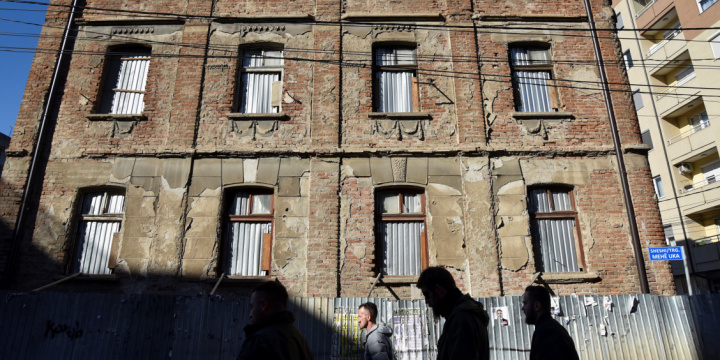
People walk past the former house of Xhafer Deva, the late politician who was an interior minister in a Nazi collaborationist regime during World War II, in Mitrovica, Kosovo, February 10, 2022. REUTERS/Laura Hasani
A project to restore an old house in Kosovo once owned by the family of a Nazi collaborator was suspended on Wednesday following criticism and accusations of “whitewashing” Holocaust history, The Associated Press reported.
The restored property was set to become an event space and center to promote inter-cultural dialogue, but German Ambassador to Kosovo Joern Rohde slammed restoration efforts on Twitter last week, saying, “No history whitewashing! Don’t distort the truth about the Holocaust or war crimes committed by the Nazis and local collaborators.”
Culture Minister Hajrulla Ceku defended the project, saying, “The sole purpose of restoration of this building is to serve the community and not whitewash the history or rehabilitate any historical personality or historical event.” He also rejected the notion that Kosovo was “a denier of (the) Holocaust,” and told the AP, “We as a nation have given numerous historical evidences for sheltering and rescuing Jewish people.”
The three-floor house — located in the city of Mitrovica, 25 miles north of Pristina, Kosovo’s capital — was owned by the family of Xhafer Deva, who served as interior minister in the pro-German Albanian government in 1943 and 1944, according to NBC News. Deva allegedly collaborated with Nazi Germany when it invaded Kosovo and Albania, and was accused of organizing an anti-communist massacre in February 1944 that killed 86 people in Albania, the AP noted.
The family house, built in 1930, is a protected cultural heritage site in Kosovo.
“He is a war criminal, he committed crimes against his political opponents but personally he never agreed to hand over lists of Kosovo Jews despite the persistence of Nazi authorities,” said Durim Abdullahu, a history professor at Pristina state university.
The European Commission, Kosovo’s Culture Ministry and the United Nations Development Program, which the European Union designated to carry out the restoration project, said they will now try to find “alternatives for the future benefit of the local community and inter-community dialogue.”
However, Flori Zevi, a Jewish activist in Pristina, supported the restoration project and said the new cultural center should include a museum that shares information about the at least 100 Jews from Mitrovica who were forcibly taken to Serbia and executed by the Nazis.