 Pod Save America Hosts Call on Democrats to Cut All Israel Military Aid, No Longer Accept AIPAC Funding
 Jews, Israelis Targeted in Austria Amid Surge in Antisemitic Incidents; Local Jewish Community Calls for Action
 ‘All of Our Strength’: Over 1,000 Pro-Israel Activists Gather in DC for Solidarity Conference
 ‘Devastated’: Wesley LePatner, Killed in Manhattan Mass Shooting, Was a Jewish Communal, Philanthropic Leader
 Sen. Angus King Vows to No Longer Vote for Israel Military Aid Until Gaza Conditions Improve
 Europe Won’t Pressure Israel to ‘Commit Suicide’ Amid Gaza Backlash, Palestinian State Push, Says Israeli FM
 Israel’s National Soccer Coach Attacked in Athens Before Soccer Fans Chant ‘F–K Israel, Free Palestine’ at Match
 New York Judge Sentences Neo-Nazi to 5 Years for Livestreaming Bomb Threats Against Jewish Hospitals
 US Pressures Lebanon to Issue Cabinet Decision to Disarm Hezbollah Before Talks Continue
 UK Plans to Recognize Palestinian State in September Unless Israel Meets Conditions, Starmer Says


Iran Puts Second Military Satellite Into Orbit: State Media
Error: Contact form not found.
 by Reuters and Algemeiner Staff

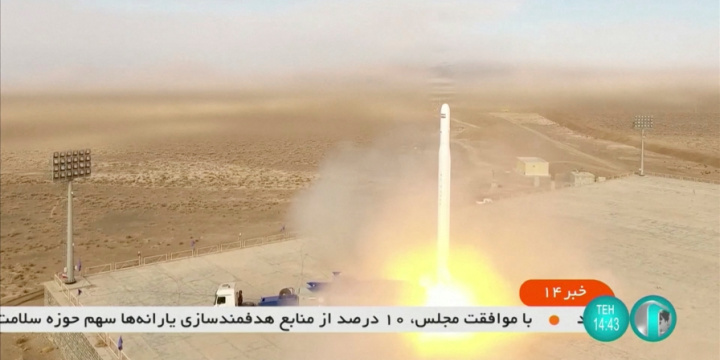
Iran’s Noor 2 satellite is seen travelling after launching into space, in an unidentified location March 8, 2022. WANA via Pool/Handout via REUTERS
Iran’s Islamic Revolutionary Guard Corps (IRGC) has successfully put a second military satellite, the Noor 2, into orbit, the state-media said on Tuesday.
The announcement came as talks held in Vienna to revive an agreement restraining Iran’s nuclear program have reached a critical stage.
Noor 2 is orbiting at an altitude of 311 miles. The first military satellite, launched by the Islamic Republic in April 2020, placed the Noor, or “light” in Persian, at an orbit of 265 miles above the earth’s surface.
Putting a second satellite in space would be a major advance for Iran’s military, raising concerns about the country’s nuclear and missile programs.
Iran will send a series of military satellites into orbit over the coming years, Space Commander of the Revolutionary Guards’ Aerospace Force Ali Jafarabadi said on Tuesday, the semi-official Fars news agency reported.
“We will launch a series of Noor satellites in the coming years. The space program of the country, of which we are a part, is to stabilize various scientific, research and defense satellites in low-earth orbit and then reach orbit of 36,000 kilometers above land,” Jafarabadi said.
The US military says the same long-range ballistic technology used to put satellites into orbit could also allow Tehran to launch longer-range weapons, possibly including nuclear warheads.
Tehran denies US assertions that such activity is a cover for ballistic missile development and says it has never pursued the development of nuclear weapons.
“The IRGC successfully placed Iran’s second military satellite, Noor 2, into orbit 500 kilometers from earth,” the semi-official Tasnim news agency said.
The three-stage Qased, or “Messenger,” carrier launched the Noor 2, from the Shahroud space port, it added. The same type of rockets, which use a combination of liquid and solid fuels, carried the first military satellite.
In December, Iran’s space launch failed to put its three payloads into orbit after the rocket was unable to reach the required speed, a defense ministry spokesman said.
The attempted launch drew criticism from the United States, Germany and France.
Iran, which has one of the biggest missile programs in the Middle East, has suffered several failed satellite launches in recent years due to technical issues.
The United States imposed sanctions on Iran’s civilian space agency and two research organizations in 2019, saying they were being used to advance Tehran’s ballistic missile program.
Tehran denies that its space activity is a cover for ballistic missile development.