 Pod Save America Hosts Call on Democrats to Cut All Israel Military Aid, No Longer Accept AIPAC Funding
 Jews, Israelis Targeted in Austria Amid Surge in Antisemitic Incidents; Local Jewish Community Calls for Action
 ‘All of Our Strength’: Over 1,000 Pro-Israel Activists Gather in DC for Solidarity Conference
 ‘Devastated’: Wesley LePatner, Killed in Manhattan Mass Shooting, Was a Jewish Communal, Philanthropic Leader
 Sen. Angus King Vows to No Longer Vote for Israel Military Aid Until Gaza Conditions Improve
 Europe Won’t Pressure Israel to ‘Commit Suicide’ Amid Gaza Backlash, Palestinian State Push, Says Israeli FM
 Israel’s National Soccer Coach Attacked in Athens Before Soccer Fans Chant ‘F–K Israel, Free Palestine’ at Match
 New York Judge Sentences Neo-Nazi to 5 Years for Livestreaming Bomb Threats Against Jewish Hospitals
 US Pressures Lebanon to Issue Cabinet Decision to Disarm Hezbollah Before Talks Continue
 UK Plans to Recognize Palestinian State in September Unless Israel Meets Conditions, Starmer Says


Israel Prefers Diplomacy on Iran But Could Act Alone, Bennett Tells IAEA Chief
Error: Contact form not found.
 by Reuters and Algemeiner Staff

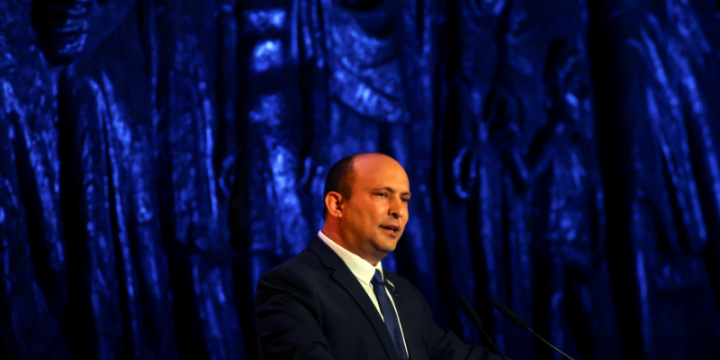
Israeli Prime Minister Naftali Bennett speaks at the Holocaust Martyrs’ and Heroes Remembrance Day opening ceremony in memory of the six million Jewish men, women and children murdered by the Nazis and their collaborators, at Yad Vashem Holocaust Museum in Jerusalem April 27, 2022. Photo: REUTERS/Ronen Zvulun.
Israel told the United Nations nuclear watchdog on Friday it would prefer a diplomatic resolution to the standoff over Iran‘s nuclear program but it could take independent action, reiterating a long-standing veiled threat to launch a preemptive war.
The warning to visiting International Atomic Energy Agency chief Rafael Grossi followed calls by Western powers on the IAEA Board of Governors to rebuke Tehran for failing to answer questions on uranium traces at undeclared sites.
That dispute has further clouded so far fruitless attempts by negotiators to resurrect a 2015 Iran nuclear deal that former US President Donald Trump quit in 2018.
Since Washington’s walkout and its reimposition of sanctions against Iran, Tehran — which says its nuclear designs are peaceful — has stepped up uranium enrichment, a process that could produce fuel for bombs.
Israeli Prime Minister Naftali Bennett “stressed (to Grossi) the importance of the IAEA Board of Governors delivering a clear and unequivocal message to Iran in its upcoming decision,” a statement from Bennett‘s office said.
“While it prefers diplomacy in order to deny Iran the possibility of developing nuclear weapons, Israel reserves the right to self-defense and action against Iran to stop its nuclear program if the international community fails to do so within the relevant time-frame,” it added without elaborating.
Grossi said on Twitter that he had visited Israel at its invitation and “stressed (to Bennett) the importance of IAEA safeguards and the Treaty on the Non-Proliferation of Nuclear Weapons (NPT) for global peace and security.”
The tweet did not explicitly name NPT-signatory Iran. Israel, which is widely assumed to have nuclear weapons, has stayed out of the voluntary pact, which helps signatories pursue civilian atomic energy if they forswear the bomb.
On Thursday, Iran‘s chief nuclear negotiator, Ali Bagheri Kani, told Norway’s NRK that Israel “can only attack Iran in its dreams.”
“And if they do have such a dream, they will never wake up from it,” Iran‘s state-run IRNA news agency quoted Bagheri Kani, who is visiting Norway, as saying.
Israel this week signaled strategic reach by going public with an air force strike exercise over the Mediterranean Sea and the rare maneuvering of a naval submarine in the Red Sea.
But some military analysts question if Israel is capable of delivering lasting damage to Tehran’s distant, dispersed and well-defended nuclear facilities — or of contending with the multi-front fighting with Iranian forces and guerrilla allies that could follow.