 Pod Save America Hosts Call on Democrats to Cut All Israel Military Aid, No Longer Accept AIPAC Funding
 Jews, Israelis Targeted in Austria Amid Surge in Antisemitic Incidents; Local Jewish Community Calls for Action
 ‘All of Our Strength’: Over 1,000 Pro-Israel Activists Gather in DC for Solidarity Conference
 ‘Devastated’: Wesley LePatner, Killed in Manhattan Mass Shooting, Was a Jewish Communal, Philanthropic Leader
 Sen. Angus King Vows to No Longer Vote for Israel Military Aid Until Gaza Conditions Improve
 Europe Won’t Pressure Israel to ‘Commit Suicide’ Amid Gaza Backlash, Palestinian State Push, Says Israeli FM
 Israel’s National Soccer Coach Attacked in Athens Before Soccer Fans Chant ‘F–K Israel, Free Palestine’ at Match
 New York Judge Sentences Neo-Nazi to 5 Years for Livestreaming Bomb Threats Against Jewish Hospitals
 US Pressures Lebanon to Issue Cabinet Decision to Disarm Hezbollah Before Talks Continue
 UK Plans to Recognize Palestinian State in September Unless Israel Meets Conditions, Starmer Says


Kibbutz Orchard Destroyed by Gaza Firebomb Replaced by Garden, Archeological Exhibit
Error: Contact form not found.
 by Algemeiner Staff

An archaeological garden inaugurated at Kibbutz Kfar Aza following the destruction of a local fruit orchard by a kite-bomb from the Gaza Strip in 2018. Photo: Zohar Shefak and Warda Goldstein
A new archeology garden was inaugurated at an Israeli kibbutz near the border with the Gaza Strip, the Israel Antiquities Authority announced Monday, after a local fruit orchard that served as a gathering spot for children was burned down by a kite-bomb launched from the neighboring Palestinian enclave.
Kibbutz Kfar Aza, a small agricultural community situated less than two miles away from the Gaza Strip, was on the frontlines of a new Palestinian tactic introduced in 2018, during the weekly “March of Return” protests supported by Hamas, the Islamist group that controls the Palestinian territory. The tactic includes strapping kites and balloons with incendiary devices and launching them across the border into Israeli territory, setting thousands of acres of farmland ablaze.
A fruit orchard at the kibbutz fell victim to such an attack five years ago. “The destruction was devastating, but the kibbutz members were determined to recreate a new inviting place for the young generation to meet,” IAA said in a statement.
Funds were subsequently raised for a new garden that could serve as a community gathering spot, with the help of a crowdfunding campaign and individual donors. It was erected “in a location in the kibbutz that is more accessible to the kindergarten children, the youth, and families who can relax in the shade of the trees,” said Edna Ayash, the IAA’s exhibition curator. “The garden includes planted flower beds, a spice garden, and many trees that are already growing, as well as a playground and a barbecue area, making it a central inviting spot in the kibbutz.”
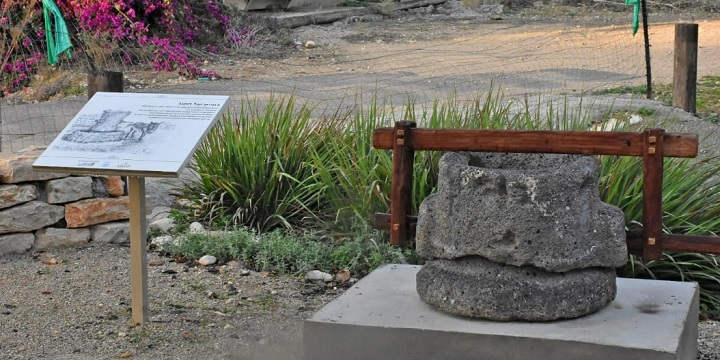
The garden also boasts an archaeological exhibition modeled on the theme of a household courtyard, which in ancient times was the site of daily foods preparation, baking, washing, and animal care, as well as rainwater collection cisterns.
Artifacts from the State Treasure collections, including “water troughs, a water cistern, grain mills, and a roof roller,” were placed along the garden path, in a bid to show visitors how they were utilized in ancient times. It also features exhibits of ancient industries that had a significant local presence, “including grain and olive oil processing, and water collection, all of which were essential components of ancient agriculture in the Land of Israel,” IAA stated.