 Pod Save America Hosts Call on Democrats to Cut All Israel Military Aid, No Longer Accept AIPAC Funding
 Jews, Israelis Targeted in Austria Amid Surge in Antisemitic Incidents; Local Jewish Community Calls for Action
 ‘All of Our Strength’: Over 1,000 Pro-Israel Activists Gather in DC for Solidarity Conference
 ‘Devastated’: Wesley LePatner, Killed in Manhattan Mass Shooting, Was a Jewish Communal, Philanthropic Leader
 Sen. Angus King Vows to No Longer Vote for Israel Military Aid Until Gaza Conditions Improve
 Europe Won’t Pressure Israel to ‘Commit Suicide’ Amid Gaza Backlash, Palestinian State Push, Says Israeli FM
 Israel’s National Soccer Coach Attacked in Athens Before Soccer Fans Chant ‘F–K Israel, Free Palestine’ at Match
 New York Judge Sentences Neo-Nazi to 5 Years for Livestreaming Bomb Threats Against Jewish Hospitals
 US Pressures Lebanon to Issue Cabinet Decision to Disarm Hezbollah Before Talks Continue
 UK Plans to Recognize Palestinian State in September Unless Israel Meets Conditions, Starmer Says


UAE Plans Long-Term Economic Ties with Israel Despite Political Strains
Error: Contact form not found.
 by Reuters and Algemeiner Staff

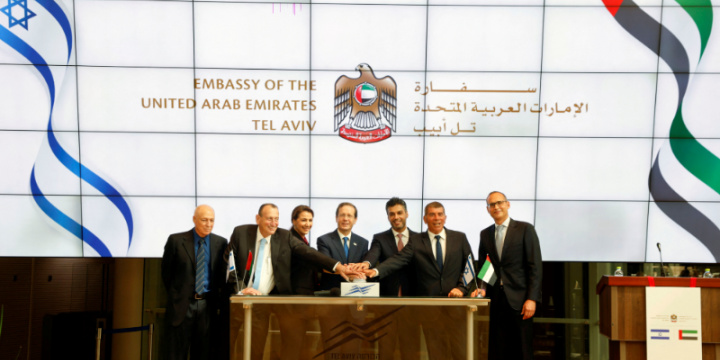
UAE Ambassador to Israel, Mohamed Al Khaja, Israeli President Isaac Herzog, and other officials press a button to start the stock exchange market during the opening ceremony of the Emirati embassy in Tel Aviv, Israel July 14, 2021. Photo: REUTERS/Amir Cohen/File Photo
The United Arab Emirates’ commitment to a long–term strategic relationship with Israel should survive political turbulence, analysts say, after one of the most right-wing governing coalitions in Israel‘s history prompted widespread anger. A series of recent moves and comments by Prime Minister Benjamin Netanyahu’s government has infuriated the public in much of Arab world, and drew condemnation from the UAE, including over Israeli settlement policy in the occupied West Bank.
However, economic and trade cooperation – a key driver of the UAE‘s 2020 normalisation of relations with Israel which broke with decades of Arab policy towards the Palestinian cause – has deepened.
On Saturday a Comprehensive Economic Partnership Agreement (CEPA) between the countries entered into effect, removing or reducing tariffs on more than 96% of products, UAE state news agency WAM said.
Signed in May 2022, and deemed a “historic moment” by the UAE ambassador to Israel, it is Israel‘s first free trade agreement with an Arab state. UAE energy giant ADNOC last week announced it was part of a $2 billion joint bid for half of Israeli offshore natural gas producer NewMed Energy.
This would follow the purchase in 2021 by Abu Dhabi’s Mubadala Energy of a 22% stake in Israel‘s Tamar gas field for about $1 billion.
“(The NewMed Energy bid) demonstrates a long–term investment in Israel‘s energy sector, which shows how strategic the relationship has become,” Neil Quilliam, associate fellow at Chatham House, and co-author of a new report on Israel–UAE normalisation, told Reuters.
“And it ties in UAE interests into European energy security, which will act as a ballast against the EU’s strong push on net zero targets,” he added.
The UAE was the first Arab state to open diplomatic relations with Israel in almost three decades in a U.S.-brokered deal, which also included Bahrain, known as the Abraham Accords. The pact was driven by shared concerns about Iran and is part of a broader regional realignment of alliances. But political developments have tested the diplomatic relationship.
In addition to Israel‘s settlements decision, which the UAE condemned, Israeli Finance Minister Bezalel Smotrich saying there was no such thing as a Palestinian people prompted anger across the Arab world.
This comes against the backdrop of huge domestic strife in Israel over judicial reforms, and Prime Minister Netanyahu, who headed the previous government when the Abraham Accords were signed, has yet to visit the UAE.
The UAE Ministry of Foreign Affairs and International Cooperation did not respond to a request for comment on political strains on the relationship.
Israeli government officials said the bilateral relationship was “growing stronger” and referenced the recent trade deal, when asked why Netanyahu had not yet visited.
COMMERCIAL PUSH
Israel, largely cut off economically and politically from its Middle East neighbours, sees the relationship as a way to access new commercial opportunities in the Gulf and beyond. The UAE is advancing cooperation with Israel in the finance, energy, security, technology, and water security sectors.
Recent moves to push ahead on trade and investment signal to businesses on both sides that political strains should not dampen appetite for economic ties.
Bilateral non-oil trade volumes between the two countries reached over $2.5 billion in 2022 and the UAE hopes to grow this to $10 billion by 2030.
“Israeli politics are definitely difficult and there are a lot of ups and downs. But the Abraham Accord is a strategic decision, it will continue despite whatever goes on in Israel,” Abdulkhaleq Abdulla, a political commentator in the UAE, said.
Dubai International Chamber, which opened a Tel Aviv office in December, says there are already about 1,000 Israeli businesses operating in the UAE.
On Thursday, Israel also announced an additional seven weekly flights between the two countries on top of the dozens already operating. The Israeli CEPA is part of a wider UAE strategy towards global partnerships to bolster and diversify its economy.
A meeting of the strategic I2U2 grouping of India, Israel, the UAE, and the U.S., an economic cooperation group created last year – still went ahead in February in the UAE.
“There are going to be stresses and strains in the relationship and even cause to question its durability,” Chatham House’s Quilliam said.
“No matter how bad things get though, the economic dimension of the partnership will sustain it through rough patches”.