 Pod Save America Hosts Call on Democrats to Cut All Israel Military Aid, No Longer Accept AIPAC Funding
 Jews, Israelis Targeted in Austria Amid Surge in Antisemitic Incidents; Local Jewish Community Calls for Action
 ‘All of Our Strength’: Over 1,000 Pro-Israel Activists Gather in DC for Solidarity Conference
 ‘Devastated’: Wesley LePatner, Killed in Manhattan Mass Shooting, Was a Jewish Communal, Philanthropic Leader
 Sen. Angus King Vows to No Longer Vote for Israel Military Aid Until Gaza Conditions Improve
 Europe Won’t Pressure Israel to ‘Commit Suicide’ Amid Gaza Backlash, Palestinian State Push, Says Israeli FM
 Israel’s National Soccer Coach Attacked in Athens Before Soccer Fans Chant ‘F–K Israel, Free Palestine’ at Match
 New York Judge Sentences Neo-Nazi to 5 Years for Livestreaming Bomb Threats Against Jewish Hospitals
 US Pressures Lebanon to Issue Cabinet Decision to Disarm Hezbollah Before Talks Continue
 UK Plans to Recognize Palestinian State in September Unless Israel Meets Conditions, Starmer Says


German Bank Returns Kandinsky Painting to Heirs of Original Jewish Owners Persecuted by Nazis
 by Shiryn Ghermezian

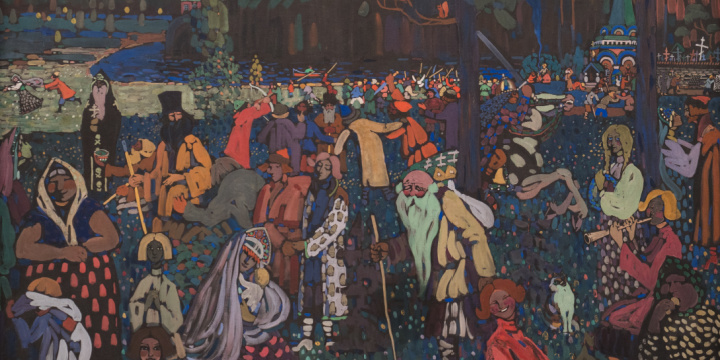
A partial view of The Colorful Life by Wassily Kandinsky. Photo: Ermell via Wikimedia Commons
A state bank in Bavaria, Germany, has agreed to return an artwork by famed Russian painter Wassily Kandinsky to the family of a Dutch Jewish couple who originally owned the painting in the Netherlands, The New York Times reported on Monday.
Bayerische Landesbank (BayernLB) said in a statement that it will follow a recommendation of the German independent advisory commission on Nazi-confiscated cultural property, which advised that the 1907 painting Colorful Life should be returned to the heirs of Hedwig Lewenstein Weyermann and Irma Lewenstein Klein.
“Every restitution is important to the families of persecuted victims as it provides them with a sense of healing, justice and dignity,” James Palmer, who represents the heirs, told The New York Times.
Emanuel A. Lewenstein, an art collector and director of a sewing machine factory, and his wife, Hedwig Lewenstein Weyermann, lived in Amsterdam and purchased Colorful Life in May 1923. Starting in 1933, after her husband’s death, Weyermann loaned the painting to the Stedelijk Museum in Amsterdam. After her death, the painting came into the possession of her son, Robert Gotschalk Lewenstein , and his then-wife, Irma Lewenstein Klein.
The painting was then taken from the museum and sold at auction in Nazi-occupied Amsterdam on Oct. 9, 1940, mere months after the Nazi invasion of the Netherlands. Salomon B. Slijper purchased Colorful Life at that auction and in 1972, BayernLB bought the painting from Slijper’s widow and loaned it to the museum Städtische Galerie im Lenbachhaus in Munich, where it has remained since then. The painting shows a large group of people, dressed in bright and colorful garments, out on a lawn doing a variety of activities such as playing music or dancing.
BayernLB claimed that Klein voluntarily auctioned Colorful Life during her ongoing divorce proceedings with her husband, without being forced due to Nazi persecution. However, the German advisory commission concluded in May that “there are numerous indications that this was a case of a seizure as a result of Nazi persecution,” following the German occupation of the Netherlands began in 1940, and that “arguments put forward by the Bayerische Landesbank are not capable of disproving this.”
The court said any loss of art that Jewish collectors faced after the German invasion of the Netherlands on May 10, 1940, should be considered as a seizure unless proven otherwise.
“This fundamental reversal of the burden of proof in favor of the former owners reflects the pressure exerted on those persecuted by the Nazi regime,” it said, adding that “the systematic exclusion, disenfranchisement and dispossession of the Jewish population of the Netherlands began immediately after the invasion.”
In 2022, another Kandinsky painting was returned to the Lewenstein family titled Painting With Houses, which was also seized by the Nazis and sold at the same auction in 1940.