 Pod Save America Hosts Call on Democrats to Cut All Israel Military Aid, No Longer Accept AIPAC Funding
 Jews, Israelis Targeted in Austria Amid Surge in Antisemitic Incidents; Local Jewish Community Calls for Action
 ‘All of Our Strength’: Over 1,000 Pro-Israel Activists Gather in DC for Solidarity Conference
 ‘Devastated’: Wesley LePatner, Killed in Manhattan Mass Shooting, Was a Jewish Communal, Philanthropic Leader
 Sen. Angus King Vows to No Longer Vote for Israel Military Aid Until Gaza Conditions Improve
 Europe Won’t Pressure Israel to ‘Commit Suicide’ Amid Gaza Backlash, Palestinian State Push, Says Israeli FM
 Israel’s National Soccer Coach Attacked in Athens Before Soccer Fans Chant ‘F–K Israel, Free Palestine’ at Match
 New York Judge Sentences Neo-Nazi to 5 Years for Livestreaming Bomb Threats Against Jewish Hospitals
 US Pressures Lebanon to Issue Cabinet Decision to Disarm Hezbollah Before Talks Continue
 UK Plans to Recognize Palestinian State in September Unless Israel Meets Conditions, Starmer Says


Here Is What the Torah Tells Us About the Land of Israel
Error: Contact form not found.
 by Jeremy Rosen

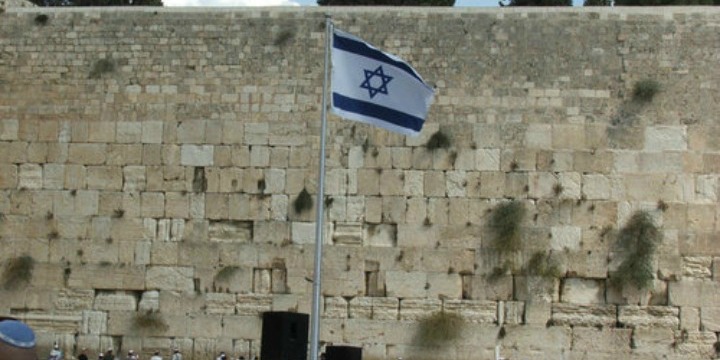
The Israeli flag at the Western Wall in Jerusalem. Photo: Hynek Moravec via Wikimedia Commons.
When you enter the land that your God is giving you as a heritage, and you possess it and settle in it, you shall take the first fruit of the soil, which you harvest from the land that your God giving you, and put them in a basket and go to the place that God chooses and to the priest in charge at that time and say to him, “I acknowledge this day before your God that I have entered the land that swore to our fathers to assign us.” ( Deuteronomy 26:1-2).
This law underlines the link between the physical land of Israel and its produce on the one hand, and the spiritual heritage of the Jewish people on the other. But does this law of the “first fruits” imply a religious obligation to settle in the Land of Israel? And what does it say about the nature of the land? Is it holy and to what degree? And can we detach the idea of Israel as a country from the Jewish religion?
These are issues that Jews have always been divided over, and still are to this day.
Maimonides did not include the mitzvah of settling the Land of Israel as a Biblical obligation, whereas Nachmanides includes settling the Land of Israel as one of the Biblical commandments. But he also says that the obligation to observe all of the Torah only applies in the Land of Israel itself; outside it is only mandated rabbinically as preparation for entering the land. He moved to the Holy Land after he was expelled from Spain, and died there in 1270.
In those days, the idea of a Jewish state was simply not dreamed of, even though Jews kept on going to and from the Land of Israel when they could. The modern State of Israel has created many new challenges. Most of the founders were overwhelmingly secular socialists who wanted Israel to break from pure religious control. On the other extreme, some Haredi movements were opposed to any idea of a Jewish state prior to the Messiah altogether. And Israel has absorbed a huge range of different ethnic and religious immigrants.
All of this is bound to cause conflict and dissonance, and only compromise can make life livable.
An ongoing moral and religious issue is the conquest of the land. The Torah is also very clear that the tribes had an obligation to conquer the land. Where does that leave us today? Is it still binding? Some avoid this issue by saying we must not take up arms altogether until the Messiah comes. Some say we have a religious obligation to conquer or settle our ancient lands. Others take the moderate view that we should settle our national heritage, but that life is more important than land, and we should be prepared to compromise for the sake of peace.
Politically we are divided. Some on the left want a coup d’etat. Some on the right want to force their views on everyone else. And there are all shades of opinions in between.
Religiously and culturally, Israel has never been stronger or more vibrant than it is today. Yet there is talk about Israelis leaving the Holy Land. In the early days of the state, Yerida, leaving Israel, was almost considered a crime, but that’s no longer the case.
Ever since the founding of the ancient kingdoms, Jews have lived outside of Israel, both willingly and forcibly, and Jewish law specifically allows one to leave the land of Israel if necessary, as much as it encourages Jews to live there. Living in Israel is not easy. The Talmud says it can only be achieved through suffering. But where one chooses to live depends on many circumstances and choices. And if some prefer to live in the Diaspora that is their choice.
As for Israel itself, the prophets called for a just and caring society, committed to its land and faithful to its religious tradition, and that is the message of the Torah this week.
The author is a writer and rabbi, currently based in New York.