 Pod Save America Hosts Call on Democrats to Cut All Israel Military Aid, No Longer Accept AIPAC Funding
 Jews, Israelis Targeted in Austria Amid Surge in Antisemitic Incidents; Local Jewish Community Calls for Action
 ‘All of Our Strength’: Over 1,000 Pro-Israel Activists Gather in DC for Solidarity Conference
 ‘Devastated’: Wesley LePatner, Killed in Manhattan Mass Shooting, Was a Jewish Communal, Philanthropic Leader
 Sen. Angus King Vows to No Longer Vote for Israel Military Aid Until Gaza Conditions Improve
 Europe Won’t Pressure Israel to ‘Commit Suicide’ Amid Gaza Backlash, Palestinian State Push, Says Israeli FM
 Israel’s National Soccer Coach Attacked in Athens Before Soccer Fans Chant ‘F–K Israel, Free Palestine’ at Match
 New York Judge Sentences Neo-Nazi to 5 Years for Livestreaming Bomb Threats Against Jewish Hospitals
 US Pressures Lebanon to Issue Cabinet Decision to Disarm Hezbollah Before Talks Continue
 UK Plans to Recognize Palestinian State in September Unless Israel Meets Conditions, Starmer Says


Another ‘Arab Spring’? Is the Mideast Headed for More Unrest?
Error: Contact form not found.
 by James M. Dorsey

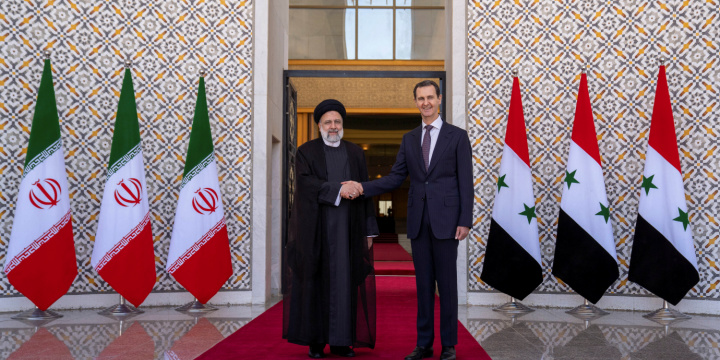
Syria’s President Bashar al-Assad stands with Iranian President Ebrahim Raisi in Damascus, Syria, in this handout released by SANA on May 3, 2023. Photo: SANA/Handout via REUTERS
Protesters in Syria, Bahrain, Libya, Iran, and Israel are dashing autocratic and authoritarian hopes of a prolonged Winter.
In response, Arab autocrats are scrambling to squash what they fear could evolve into a third wave of protests in little more than a decade. The autocrats have deployed tools ranging from cracking down on street protests to increased repression, engaging in perfunctory dialogue, making concessions, and offering economic aid to defuse exploding and potential future powder kegs.
In the early 2010s, the United Arab Emirates, Saudi Arabia, and Egypt relied on security force violence, military interventions, and support for conservatives and rebel militias to roll back the achievements of the 2011 popular revolts that toppled the long-standing autocratic leaders of Tunisia, Egypt, Libya, and Yemen.
A combination of autocratic political maneuvering and the COVID-19 pandemic sabotaged uprisings in 2019 and 2020 in Algeria, Iraq, Lebanon, and Sudan, often with devastating consequences.
Analysts, journalists, and academics argued that counterrevolutionary measures had replaced the 2011 Arab Spring with a pro-longed Arab Winter. The latest protests suggest the winter’s snow may be melting.
This month, Iran braces for the September 16 first anniversary of Masha Amini’s death. Amini died under suspicious circumstances in the custody of Iran’s religious police, who detained her for allegedly wearing her headscarf loosely.
Her death sparked months of street protests in which security forces reportedly killed 530 people and arrested more than 22,000. Since then, popular defiance has turned businesses, cultural events, courthouses, and religious ceremonies into protest and civil disobedience venues.
“Wrong decisions may have painful consequences for the establishment. People cannot take more pressure. If it continues, we will witness street protests again,” a former government official warned.
In Syria, almost two weeks of sustained mass anti-government protests in the Druze-populated southwest province of Suwayda, long a pro-government stronghold, demanding the fall of President Bashar al-Assad, are resonating in the neighboring Sunni region of Daraa and Assad’s Alawite stronghold of Latakia.
“Initially, Assad probably thought, ‘I have won and we can let this happen; we can let the Druze let off some steam. It turned out to be a mistake from the Assad point of view, and Assad’s military will have to keep him in power,” said Syria expert Joshua Landis.
Authorities in Bahrain have so far failed to end a widening more than three-week-long hunger strike by 800 prisoners, or at least 20 percent of the Gulf state’s prison population, by acceding to some demands for improved incarceration conditions.
Libyan security forces were recently deployed on the streets of the capital, Tripoli, to prevent renewed protests against a meeting between since dismissed Foreign Minister Najla al-Mangoush and her Israeli counterpart, Eli Cohen. The protests heaped pressure on Libya’s internationally recognized interim national unity government to step down and make way for a new administration.
Arab and Turkmen protesters opposed to a Kurdish political presence in the disputed multi-ethnic city of Kirkuk clashed with Kurds this weekend, suggesting Iraq could possibly rejoin the list of Middle Eastern countries experiencing social unrest. Authorities initially imposed a curfew in Kirkuk after four people were killed in the protests.
In Egypt, supporters of President Abdul Fatah al-Sisi, including the UAE, worry that the African nation could witness a renewed wave of protests.
“There’s a feeling people aren’t comfortable with anything right now. There’s a debt crisis, prices of everything, and inflation has gone up dramatically. People’s lives and situations go from bad to worse. Their willingness to stay quiet has disappeared. You’re more likely to hear about the discontent openly in the streets,” said Egyptian-Canadian journalist Karim Zidan days after arriving in Cairo for a visit last month.
In an article entitled “Egypt’s Sisi Rules by Fear—and Is Ruled by It,” Egypt expert Steven A. Cook added, “There is a large, growing, and noticeable divergence between what the government promises Egyptians and how they experience everyday life.”
Fear of renewed protests in Egypt, set to become the world’s largest importer of wheat for the fiscal year 2023-2024, was likely one reason why the Abu Dhabi Export Office (ADEX) and UAE-based agribusiness Al Dahra last month agreed to provide Egypt for the next five years with $100 million a year worth of imported milled wheat “at competitive prices.”
The fear of protests, even in countries like Saudi Arabia with a low risk of discontent spilling into the streets, may also explain out-of-proportion repressive measures like the kingdom’s recent sentencing to death of Muhammad al-Ghamdi, a 54-year-old teacher and brother of a dissident Islamist scholar, for his activity on X, formerly known as Twitter.
In a just-published book, author Robert D. Kaplan noted that Vladimir Lenin, a founder of the Soviet Union, understood “that it was necessary to murder and incarcerate the innocent. For how else could a dictator inculcate total fear in the population? To punish only the guilty would provide the innocent, who constitute most of the population, with peace of mind. And that, of course, would undermine the sort of control that Lenin believed was necessary.”
Dr. James M. Dorsey is an Honorary Fellow at Singapore’s Middle East Institute-NUS, an Adjunct Senior Fellow at Nanyang Technological University’s S. Rajaratnam School of International Studies, and the author of the syndicated column and podcast, The Turbulent World with James M. Dorsey.