 Pod Save America Hosts Call on Democrats to Cut All Israel Military Aid, No Longer Accept AIPAC Funding
 Jews, Israelis Targeted in Austria Amid Surge in Antisemitic Incidents; Local Jewish Community Calls for Action
 ‘All of Our Strength’: Over 1,000 Pro-Israel Activists Gather in DC for Solidarity Conference
 ‘Devastated’: Wesley LePatner, Killed in Manhattan Mass Shooting, Was a Jewish Communal, Philanthropic Leader
 Sen. Angus King Vows to No Longer Vote for Israel Military Aid Until Gaza Conditions Improve
 Europe Won’t Pressure Israel to ‘Commit Suicide’ Amid Gaza Backlash, Palestinian State Push, Says Israeli FM
 Israel’s National Soccer Coach Attacked in Athens Before Soccer Fans Chant ‘F–K Israel, Free Palestine’ at Match
 New York Judge Sentences Neo-Nazi to 5 Years for Livestreaming Bomb Threats Against Jewish Hospitals
 US Pressures Lebanon to Issue Cabinet Decision to Disarm Hezbollah Before Talks Continue
 UK Plans to Recognize Palestinian State in September Unless Israel Meets Conditions, Starmer Says


Reuters Blames Israel for Oslo Accords Failure, Ignores Palestinian Terrorism
Error: Contact form not found.
 by Rinat Harash

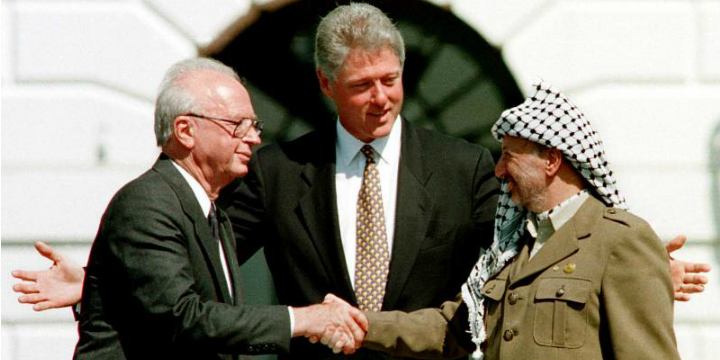
The signing of the Oslo Accords in Washington, DC, Sept. 13, 1993. Photo: Wikimedia Commons.
When the world’s largest news agency produces a piece looking back at one of the Middle East’s historic events, you’d expect the news outlet to be as careful as possible in maintaining its standards of impartial reporting.
Reuters, however, failed miserably at this during a recent podcast episode aimed at analyzing “the legacy of the Oslo Accords,” marking 30 years since they were signed.
One must hear it to believe it, but this is how the host summarizes their failure:
Cheers from the White House lawn in 1993 as Israeli Prime Minister Yitzhak Rabin and PLO chairman Yasser Arafat shake hands.
But immediate protests back home and Rabin — who was awarded the Nobel Peace Prize with Arafat in 1994 — was assassinated the following year by a far right Jewish Israeli opposed to the deal.
Not a word about thousands of Israelis who were killed during and after the Oslo process by Palestinian terrorists (more than 100 Israelis were murdered in March 2002 alone, which saw almost daily attacks and suicide bombings in Israeli cities).
There is also not a word about Arafat consistently refusing generous offers for the creation of a Palestinian state, and or masterminding the terror campaign against Israelis, known as the Second Intifada.
Only extremist Israelis are to blame according to Reuters’ twisted narrative.
But it gets even worse.
The host, worried about the future of the two-state solution, asks a Reuters correspondent in Jerusalem for an explanation. What follows is oversimplified reporting, blaming everything on Israeli settlements while making the Palestinians look like they just want equal rights.
If an uninformed person listened to this piece with the genuine intent of learning something about the Israeli-Palestinian conflict, he or she would think the entire problem comes down to evil Jews who shattered hopes for peace and have been continuously oppressing innocent Palestinians ever since.
Almost half of the entire podcast is dedicated to the problem of Israeli settlements, as the correspondent says they:
Have really the appearance of an actual city… of huge houses sometimes high rises that were going up. When you look at them and you think about how difficult it would be to withdraw from those settlements.
The correspondent failed to mention that under the Oslo Accords, the major settlement blocs (those with the seemingly disturbing high rises), were meant to remain permanently under Israeli control. Those blocs, mostly located near the Green Line, are home to the majority of the settler population (as opposed to settler hilltop outposts). They are considered as “consensus” settlement blocs by many Israelis.
But Reuters is not alone in blaming Israel for the demise of the Oslo Peace Accords.
The AFP followed suit in a piece detailing Palestinian water woes (while also ignoring Egypt’s blockade of Gaza):
The ultimate goal for many was the creation of a Palestinian state whose people would one day live freely and peacefully alongside Israel.
Instead, three decades on, Israeli settlements have mushroomed across the occupied West Bank, deadly violence has flared, and the blockaded Gaza Strip is littered with the ruins of several wars.
The last sentence, which avoids identifying the perpetrators of “deadly violence” (who are overwhelmingly Palestinian), refers to Israeli settlements as “mushrooms.” Is it an acceptable term in a news agency text? Is it not loaded with critical, negative, and biased judgment?
It’s no surprise when publications like The Middle East Eye or Arab News make similar distortions. But wire services, that are heavily relied upon by media outlets and news consumers worldwide, must do a better journalistic job in reporting the facts. Or at least not distorting them.