 Pod Save America Hosts Call on Democrats to Cut All Israel Military Aid, No Longer Accept AIPAC Funding
 Jews, Israelis Targeted in Austria Amid Surge in Antisemitic Incidents; Local Jewish Community Calls for Action
 ‘All of Our Strength’: Over 1,000 Pro-Israel Activists Gather in DC for Solidarity Conference
 ‘Devastated’: Wesley LePatner, Killed in Manhattan Mass Shooting, Was a Jewish Communal, Philanthropic Leader
 Sen. Angus King Vows to No Longer Vote for Israel Military Aid Until Gaza Conditions Improve
 Europe Won’t Pressure Israel to ‘Commit Suicide’ Amid Gaza Backlash, Palestinian State Push, Says Israeli FM
 Israel’s National Soccer Coach Attacked in Athens Before Soccer Fans Chant ‘F–K Israel, Free Palestine’ at Match
 New York Judge Sentences Neo-Nazi to 5 Years for Livestreaming Bomb Threats Against Jewish Hospitals
 US Pressures Lebanon to Issue Cabinet Decision to Disarm Hezbollah Before Talks Continue
 UK Plans to Recognize Palestinian State in September Unless Israel Meets Conditions, Starmer Says


Can Sukkot This Year Be a Time of Jewish Unity?
Error: Contact form not found.
 by Jeremy Rosen

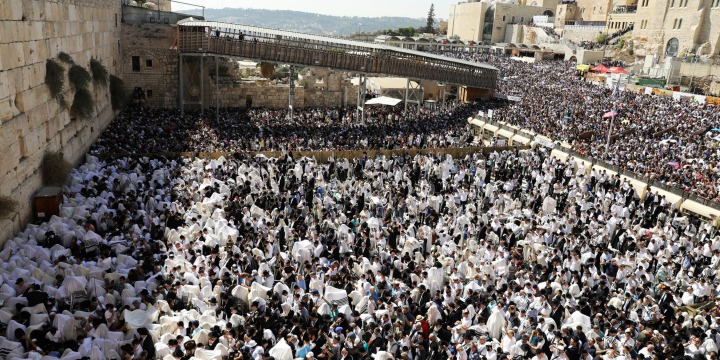
A general view shows thousands of Jewish worshipers attending the priestly blessing on the Jewish holiday of Sukkot at the Western Wall in Jerusalem’s Old City, Sept. 26, 2018. Photo: Reuters / Ammar Awad.
Sukkot is the most innovative and multifaceted of all our festivals. Coming after the solemn High Holy Days, it is also the most fun.
Most important, it concludes with a day of national unity — something that seems as unlikely and remote now, as it ever did.
Sukkot’s origins lie in the pagan world, which celebrated the final harvest of the year. Judaism added its monotheistic character, and many new features not mentioned in the Bible — including use of the flute, human singers, public parties, bonfires, and more.
“Whoever has not seen it has never seen real joy in their lives,” says the Talmud. Perhaps that’s why they introduced Hoshana Raba on the sixth day to atone once more for any overindulgence. The last day, Shmini Atzeret, ended the festival with prayers for rain and a gathering of all the people, to hear and recommit to the Torah. Eventually, it merged (in Israel) with Simchat Torah to celebrate the end of the annual cycle of reading the Torah.
What fun it must have been in Jerusalem in those days — everyone coming together from Israel and the Diaspora and celebrating as one people. It seems very different to protest demonstrations in Tel Aviv today.
But there were conflicts then, too. When the kingdoms split, the North refused to allow its citizens to go south to join in the celebrations, and posted guards on the borders. Later, the Samaritans rejected mainstream traditions and instead of waving the Arba Minim (the Four Plants) they used them only for roofing the Sukkah.
Why, I wonder, is Sukkot nowhere near as popular or observed with such devotion by most Jews, as Yom Kippur? Is it because guilt is more powerful? Is it just religious fatigue? Or is it simply that there are so many more readily available sources of entertainment and distraction now? Organized religion in general is just less attractive to the average person.
Originally, Sukkot was the festival of unity. But our modern emphasis on rights and individuality has both liberated us and emphasized our differences.
Two thousand years ago, the Jewish people were divided over how to respond to Rome. Bar Kochba, although reputedly not particularly religious, advocated force and strength. He was supported by Rabbi Akiva. Most of the other rabbis followed Rabbi Yochanan Ben Zakkai, who sought accommodation and compromise. Bar Kochba lost, and for 2,000 years the Jews suffered exile and oppression.
Then came political Zionism, and this time the fighters succeeded. But the rupture emerged between messianism and militarism (not to mention religion and secularism). Today, so many factions are at war with each other.
Can we ever be united? At the moment it seems not. But I do not despair. Policies and ideas are important, and of course we should assert our individual opinions. But life matters more. We Jews can and will survive as a people wherever we are. But if we want to survive as a nation, we have to find a way of coming together and compromise.
Ideologies and politics always lead to conflict and violence when the sides try to impose their views on each other. But if we put humans first, we can try to get on with each other despite our differences.
The author is a writer and rabbi, currently based in New York.