 Pod Save America Hosts Call on Democrats to Cut All Israel Military Aid, No Longer Accept AIPAC Funding
 Jews, Israelis Targeted in Austria Amid Surge in Antisemitic Incidents; Local Jewish Community Calls for Action
 ‘All of Our Strength’: Over 1,000 Pro-Israel Activists Gather in DC for Solidarity Conference
 ‘Devastated’: Wesley LePatner, Killed in Manhattan Mass Shooting, Was a Jewish Communal, Philanthropic Leader
 Sen. Angus King Vows to No Longer Vote for Israel Military Aid Until Gaza Conditions Improve
 Europe Won’t Pressure Israel to ‘Commit Suicide’ Amid Gaza Backlash, Palestinian State Push, Says Israeli FM
 Israel’s National Soccer Coach Attacked in Athens Before Soccer Fans Chant ‘F–K Israel, Free Palestine’ at Match
 New York Judge Sentences Neo-Nazi to 5 Years for Livestreaming Bomb Threats Against Jewish Hospitals
 US Pressures Lebanon to Issue Cabinet Decision to Disarm Hezbollah Before Talks Continue
 UK Plans to Recognize Palestinian State in September Unless Israel Meets Conditions, Starmer Says


Israel, Hamas & International Law: A Guide
Error: Contact form not found.
 by Chaim Lax

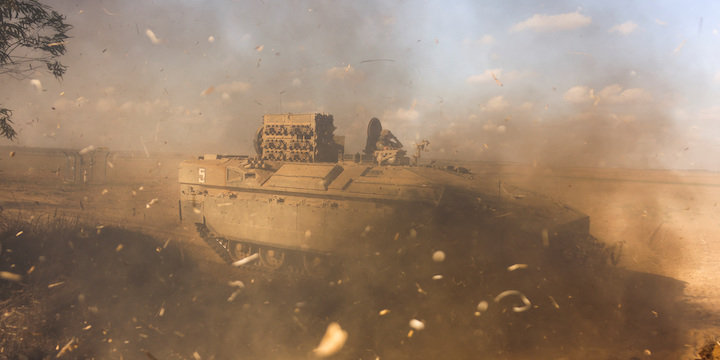
An Israeli Armored Personnel Carrier (APC) is obscured as it whips up dust near Israel’s border with the Gaza Strip, in southern Israel October 15, 2023. Photo: REUTERS/Ronen Zvulun
In response to Hamas’ brutal invasion of Israel on October 7, 2023, which included massacres of Israeli civilians and the kidnapping of over 200 Israelis into Gaza, the Israeli military has been conducting daily targeted strikes within Gaza against Hamas terrorists and infrastructure.
Since the start of Israel’s campaign against Hamas, anti-Israel figures have accused the IDF of “war crimes.” Numerous mainstream media organizations have also published pieces questioning whether all of Israel’s actions are justified under international law.
With headlines such as “Experts say Hamas and Israel are breaking international law, but what does that mean?” (France24, October 21), “Are Israel’s military tactics abiding by the laws of war?” (PBS, October 23), and “Is Israel acting within the laws of war?” (The Economist, October 14), it is important to understand what the rules of war are and how the Israeli military’s actions abide by them.
Four points of international law that have garnered the most focus in recent analyses are:
- Distinction (military v civilian targets)
- Proportionality
- Efforts to avoid civilian casualties
- Laws of siege warfare
Even wars have rules, the most important of which is that combatants must always distinguish between civilian and military targets.
In the case of Israel vs. Hamas, only one party is adhering to them.
🧵Let’s break down the rules of war. pic.twitter.com/fdNSECDVDt
— HonestReporting (@HonestReporting) October 18, 2023
The Principle of Distinction: Military v. Civilian Targets
One of the major tenets of the rules of war is the principle of distinction: All parties to a conflict must distinguish between civilians and combatants by separating military infrastructure from civilian areas, wearing clothing that distinguishes combatants, and ensuring that civilians are not deliberately targeted in attacks.
However, as part of its terrorist modus operandi, Hamas purposefully embeds itself within the civilian population of Gaza, digging tunnels beneath homes, firing rockets from within civilian areas, and using civilian infrastructure (such as hospitals, mosques, and schools) as munitions depots and bases for its terrorists.
How is Israel supposed to retaliate against Hamas when the Palestinian terror group does not observe the principle of distinction?
Per international law, once a civilian object is used for military purposes, it loses its protected status and becomes a legitimate military target.
According to David French, a columnist for The New York Times and former judge-advocate in the American military, the civilian object used by Hamas not only becomes a legal target, but Hamas is culpable for any damage done to the civilian object as well as any civilian loss of life during the attack.
Is Hamas turning mosques, schools, and hospitals into military targets?
Yes. @PhilipIngMBE explains why on @SkyNews 👇 pic.twitter.com/amEisuNhv5
— HonestReporting (@HonestReporting) October 17, 2023
The Principle of Proportionality: Is Israel’s Response Disproportionate?
With more than 1,400 Israelis killed during the Hamas atrocities and subsequent rocket attacks, and more than 6,000 Palestinians allegedly killed in Israeli retaliatory strikes according to the Hamas-run Ministry of Health (though President Biden himself says those numbers have no credibility), some commentators and activists have claimed that Israel’s response is disproportionate.
However, this stems from a fundamental misunderstanding of what proportionality means within international law.
In brief, the principle of proportionality dictates that civilian casualties (both killed and injured) cannot be excessive in relation to the military advantage that would be gained directly from an attack.
For every strike that Israel undertakes against Hamas, it calculates the potential harm to civilians against the weight of the military advantage to be gained from the attack and determines whether the attack is proportionate.
Even when Hamas is cynically using Palestinian civilians as unwitting human shields, those civilians are included in the IDF’s assessment of the attack’s proportionality.
Proportionality in international law is not about equality of death or civilian suffering, or even about firepower returned being equal in sophistication or lethality to firepower received.
So what is it?
Read on to find out.https://t.co/QXJWzC0GM7
— HonestReporting (@HonestReporting) March 6, 2019
According to Pnina Sharvit Baruch, the former head of the international law division of the IDF’s Military Advocate General (MAG), the concept of “military advantage” is also dependent on the circumstances of each war and the nature of the enemy.
Thus, in this war, due to the exceptional brutality of the Hamas attack, which proved the Palestinian terror group to be much more dangerous and impervious to the fate of civilians than previously thought, the military advantage may be given more weight than in other military operations that Israel has undertaken against Hamas.
French also notes that proportionality also does not require the military to respond with the “same degree of force” that was used by the enemy. Thus, the Israeli response to Hamas rifle fire with fire from a tank or to Hamas rocket fire with a targeted airstrike is allowed under international law, and is not considered to be a disproportionate response.
It should also be noted that according to Dr. Aurel Sari, an assistant professor of international law at the University of Exeter, the assessment of whether an attack was proportional can only be determined based on the intelligence that the military had on hand at the time of the attack and cannot be based on hindsight.
Israel’s Efforts to Avoid Civilian Casualties
At the same time that Israel is working to fulfill its stated goal of destroying Hamas, it is also seeking to limit innocent civilian casualties among the population of Gaza.
One of the main ways is by encouraging the inhabitants of northern Gaza, where the vast majority of Israeli strikes have been located and where a future ground incursion would likely take place, to evacuate to southern Gaza.
By doing this, Israel has fulfilled the legal requirement of taking “feasible precautions” to minimize harm to the civilian population.
There is a lot of misinformation about the evacuation of civilians in Gaza.
Here are 3 myths we break down: pic.twitter.com/w8WG5iYoJs
— Israel Foreign Ministry (@IsraelMFA) October 17, 2023
While some human rights organizations have criticized Israel’s warning to the residents of northern Gaza and consider it to be tantamount to “forced displacement,” a variety of legal scholars have observed that Israel’s actions fall within the parameters of international law.
Michael Schmitt, a scholar of international law at the West Point Military Academy, deemed it “bewildering” that human rights organizations were not assisting with the evacuation of civilians, and noted that, per the rules of the International Committee of the Red Cross (ICRC), it’s not considered to be “displacement” if it is necessary for the safety and security of civilians.
Similarly, Amichai Cohen, a professor of international law at Ono College in Israel, notes that Israel’s warning to Gazan civilians to evacuate the north was in line with the ICRC rules, as the evacuation order did not threaten the civilians with the loss of protective status if they chose to stay (rather, that it would be safer to move to the south).
As Israel has also been evacuating its own citizens from areas adjacent to the Gaza and Lebanon borders, it is clear that Israel’s evacuation warning to Gaza’s civilians is for their own benefit, fulfills Israel’s responsibility to take feasible precautions to protect civilians, and is in line with international law.
The Siege of Gaza: Its Parameters Within International Law
Soon after the Hamas attack on October 7, Israeli Defense Minister Yoav Gallant declared a total siege of the Hamas-controlled Gaza Strip, cutting off all supplies of water, fuel, food, and medicine.
While Israel has allowed for the limited flow of water and aid convoys to the Strip since then, it is important to analyze the parameters for a siege within international law.
French notes that the rules of siege warfare are a matter of dispute among legal scholars, which is why some have opposed Israel’s siege while others have defended it.
Must-read speech on the legality of Israel’s fight against Hamas, delivered in 🇬🇧 House of Lords yesterday by Lord Guglielmo Verdirame KC, professor and barrister in public international law:
“There has been a lot of talk about proportionality in the law on self-defence. I refer…
— Hillel Neuer (@HillelNeuer) October 25, 2023
Since ancient times, a siege has been considered an accepted form of warfare. However, the question is, what are the besieging party’s (i.e. Israel’s) responsibilities to the non-combatants left within the besieged area (i.e. Gaza)?
Both the Fourth Geneva Convention and the later Additional Protocol call for both parties to reach an agreement on the evacuation of certain classes of vulnerable civilians as well as to endeavor to reach an agreement on the flow of humanitarian relief to besieged civilians.
However, per Article 23 of the Fourth Geneva Convention, the relief should only be granted if both parties are satisfied that it will not get into the hands of the enemy combatants.
Without these guarantees and without an agreement between the two warring parties, the law does not require the besieging party to allow for humanitarian relief to the besieged territory.
As British international law expert Natasha Hausdorff observed, the provision of relief to Gaza by Israel “isn’t viable during a military campaign where Hamas exploits these transfers, stealing supplies, and penetrating humanitarian organizations to mask its terror operations…”
Thus, while Israel has allowed for a limited amount of relief to arrive in Gaza, it is not obliged by international law (according to one school of legal thought) to do so as long as Hamas continues to exploit the humanitarian relief convoys and usurp the aid intended for Palestinian civilians for its own nefarious purposes.