 Pod Save America Hosts Call on Democrats to Cut All Israel Military Aid, No Longer Accept AIPAC Funding
 Jews, Israelis Targeted in Austria Amid Surge in Antisemitic Incidents; Local Jewish Community Calls for Action
 ‘All of Our Strength’: Over 1,000 Pro-Israel Activists Gather in DC for Solidarity Conference
 ‘Devastated’: Wesley LePatner, Killed in Manhattan Mass Shooting, Was a Jewish Communal, Philanthropic Leader
 Sen. Angus King Vows to No Longer Vote for Israel Military Aid Until Gaza Conditions Improve
 Europe Won’t Pressure Israel to ‘Commit Suicide’ Amid Gaza Backlash, Palestinian State Push, Says Israeli FM
 Israel’s National Soccer Coach Attacked in Athens Before Soccer Fans Chant ‘F–K Israel, Free Palestine’ at Match
 New York Judge Sentences Neo-Nazi to 5 Years for Livestreaming Bomb Threats Against Jewish Hospitals
 US Pressures Lebanon to Issue Cabinet Decision to Disarm Hezbollah Before Talks Continue
 UK Plans to Recognize Palestinian State in September Unless Israel Meets Conditions, Starmer Says


Finland Considers Boycott of Eurovision Due to Israeli Participation; Irish PM Supports Israel’s Inclusion
 by Shiryn Ghermezian

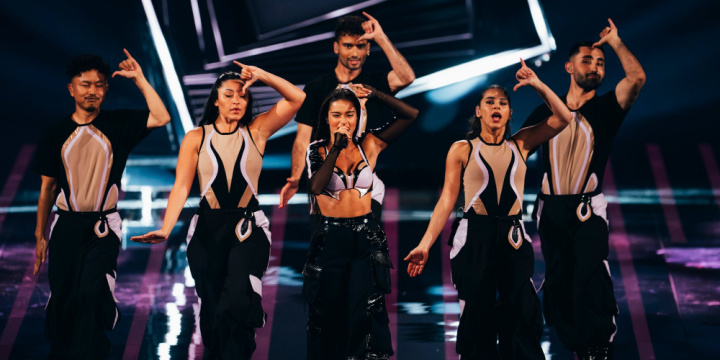
Noa Kirel performing “Unicorn” for Israel at the first semifinal at the 2023 Eurovision Song Contest. Photo: Sarah Louise Bennett/EBU
The controversy around Israel’s inclusion in next year’s Eurovision Song Contest rages on as more countries are speaking out about Israel’s participation in the international competition due to its military campaign against Hamas terrorists in the Gaza Strip.
Uuden Musiikin Kilpailu (UMK), the Finnish singing competition that selects Finland’s representation for the Eurovision Song Contest — which will be held in Malmö, Sweden, in May — said last week that it remains unclear if Finland will participate in next year’s singing competition because of the Israel-Hamas war.
“The situation in the Middle East is worrying and serious, and it worries us as well. Finland’s pre-contest has become an important event that is held regardless of Finland’s participation in Eurovision,” UMK wrote in an Instagram Story, which is also saved on its Instagram highlights. “Regarding Eurovision, the management of the Finnish Public Broadcasting is receiving updates on the situation and discussing it with the European Broadcasting Union and other Nordic countries.”
The Finnish representative will be one of seven artists who will revealed on Jan. 10, while the UMK contest announcing the winner will be held on Feb. 10.
Ireland’s national broadcaster RTE has received hundreds of emails urging a boycott of the Eurovision if Israel participates because of the latter’s war in Gaza and an Irish Labour Party politician called for Ireland to pull out of the Eurovision because of Israel’s inclusion.
However, Ireland’s Prime Minister Leo Varadkar, and Deputy Prime Minister and Foreign Minister Micheal Martin said during a recent press briefing that they do not support boycotting the singing competition just because of Israel.
“For us to unilaterally boycott something – whether it’s Eurovision, whether it’s the Olympics, whether it’s boxing, whether it’s cycling – just because Israel is there, to me that’s biting off your nose to spite your face,” said Varadkar. “I don’t think a unilateral boycott by Ireland of any sporting event or any musical event or competition is the right way to go.”
Varadkar added that isolating Israel from the international community and banning the Jewish state from an international competition like the Eurovision could be detrimental to peace efforts in the Middle East. He said Israel includes liberals “who do not necessarily support their government, who would like to see a two-state solution, and the difficulty, I think, with boycotts is that you can end up ostracizing and alienating the people who we actually need to engage with.”
Martin echoed similar sentiments, saying that he believes boycotting Israel from the Eurovision Song Contest could “potentially have a counterproductive impact” to ending the Israel-Hamas war. “Diplomacy is the only way we’re going to get this brought to an end,” he said in part. “And that’s working with our neighboring states in the Middle East also.”
Meanwhile the singer Ruslana Stepanivna Lyzhychko, known simply as Ruslana, who won the Eurovision Song Contest in 2004 on behalf of Ukraine, recently told the Israeli website Euromix that she stands in solidarity with Israel following the Hamas terrorist attacks that took place on Oct. 7 in the Jewish state. The singer, a former politician and activist who was the first winner of the Eurovision contest for Ukraine, also drew parallels between the terrorism Israelis faced in October with what Ukrainians are experiencing following Russia’s invasion of their country.
“I dream of the day when no alarms will be sounded, of the day when no missiles will be launched and no weapons will be used,” she told the Israeli publication.
“I have performed many times in Israel, [but] I will never forget my 2005 performance at the Eurovision Song Contest [the national final],” she added. “I have a lot friends in Israel and I also cross my fingers about the situation in Israel. I was in Tel Aviv when you hosted the Eurovision [ in 2019]… it was an amazing moment.”
Other campaigns throughout European countries have pushed to limit Israel’s participation in Eurovision.
In Iceland, the Association of Composers and Lyricists of Iceland (FTT) released a statement on Dec. 11 that calls on the Icelandic National Broadcasting Service (RÚV) to refrain from participating in Eurovision unless Israel is disqualified from the competition because of its war in the Gaza Strip.
Eurovoix News, a popular Eurovision fan media outlet, announced in November that it will “substantially restrict” its coverage of Israel in the Eurovision competition, and invited other journalists and media outlets to follow suit.
The Algemeiner previously reported that the singer chosen to represent the United Kingdom in next year’s Eurovision Song Contest signed an open letter that accuses Israel of genocide, ethnic cleansing, and “crimes against humanity.”
The European Broadcasting Union (EBU), which organizes the international singing contest, has rejected demands to boycott Israel in a released statement and confirmed that the country will in fact in participatie in the competition.