 Pod Save America Hosts Call on Democrats to Cut All Israel Military Aid, No Longer Accept AIPAC Funding
 Jews, Israelis Targeted in Austria Amid Surge in Antisemitic Incidents; Local Jewish Community Calls for Action
 ‘All of Our Strength’: Over 1,000 Pro-Israel Activists Gather in DC for Solidarity Conference
 ‘Devastated’: Wesley LePatner, Killed in Manhattan Mass Shooting, Was a Jewish Communal, Philanthropic Leader
 Sen. Angus King Vows to No Longer Vote for Israel Military Aid Until Gaza Conditions Improve
 Europe Won’t Pressure Israel to ‘Commit Suicide’ Amid Gaza Backlash, Palestinian State Push, Says Israeli FM
 Israel’s National Soccer Coach Attacked in Athens Before Soccer Fans Chant ‘F–K Israel, Free Palestine’ at Match
 New York Judge Sentences Neo-Nazi to 5 Years for Livestreaming Bomb Threats Against Jewish Hospitals
 US Pressures Lebanon to Issue Cabinet Decision to Disarm Hezbollah Before Talks Continue
 UK Plans to Recognize Palestinian State in September Unless Israel Meets Conditions, Starmer Says


Why Confronting Iran Should Be a Major Priority for the Trump Administration
Error: Contact form not found.
 by Hany Ghoraba

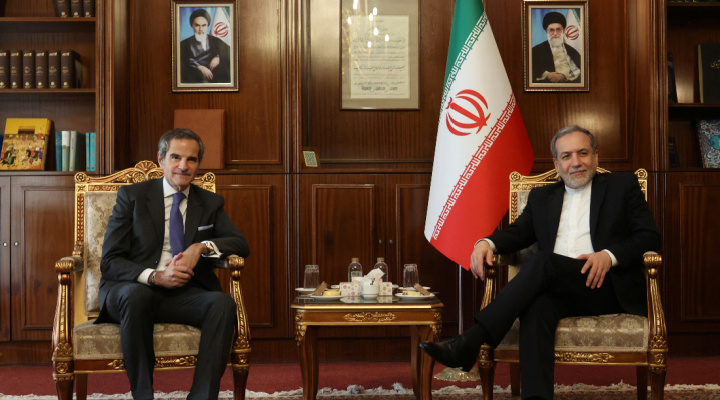
International Atomic Energy Agency (IAEA) Director General Rafael Grossi meets with Iran’s Foreign Minister Abbas Araqchi in Tehran, Iran, Nov. 14, 2024. Photo: Majid Asgaripour/WANA (West Asia News Agency) via REUTERS
Following Donald Trump’s major victory in the 2024 US presidential elections, the new administration is facing a number of international crises that extend from the Korean Peninsula, the Russian invasion of Ukraine, and last but not least, the escalating war in the Middle East ignited by the Hamas terrorist attack on Oct. 7, 2023 on Israel. It doesn’t require a political expert to figure out that Iran’s unconditional support to Hamas and Hezbollah are behind the current 14-month regional crisis.
In the past year, Hamas and Hezbollah received a heavy beating by Israeli attacks on their strongholds in Gaza, southern Lebanon and Syria, especially with the elimination of both terrorist groups’ leaders Yahya Sinwar and Hassan Nasrallah. Even with the fall of the longstanding Assad regime in Syria on December 8th, Iran remains the catalyst and purveyor of chaos in the region.
Americans who lost family members during the Oct. 7, 2023, terrorist attack on Israel filed lawsuits in November against Iran, presenting new evidence that Iran was involved in the terrorist attacks which claimed the lives of 46 American citizens — in addition to the 1,200 Israeli civilians and soldiers — while other Americans were among the more than 250 taken hostage.
Four Americans remain in Hamas captivity according to former hostage Aviva Siegel. Hamas released a video titled “Time is running out” on Dec. 1, 2024, of 20-year-old Edan Alexander who is still being held hostage in Gaza.
Iran endorsed the terrorist attack, and its Supreme leader, Ali Khamenei, lauded the attacks and applauded his Hamas allies.
President-elect Trump vowed on Dec. 2 that there will be “hell to pay” if the hostages in Gaza are not freed before his inauguration.
Iranian Regime’s Threats and Abysmal Human Rights Record
Hardly a week passes without an Iranian leader or commander issuing threats against another country, but these are not empty threats, as some may claim or estimate. Iran has been vehemently working on destabilizing other countries in the Middle East, threatening Israel with annihilation and nearing the completion of a nuclear military program that turn its threats into a nuclear one.
In the span of less than five decades, the Iranian regime created a bizarro world of its own within the country and has been vehemently attempting to export its twisted state model across the Middle East through what it calls “Exporting the Revolution.” The Islamic revolution in Iran of 1979 that toppled the reigning Iranian Shah (emperor) Mohammad Reza Pahlavi shook the foundations of the Middle East, as it initiated a new grim chapter of extremism and terrorism.
Nowadays, Iran is a country producing ballistic missiles that it would launch indiscriminately on enemy militaries and citizens alike, case in point the barrage of over 300 ballistic missiles on Israel last October. At the same time, Iranian citizens are living in an archaic world that belongs to medieval times where adulterers are publicly flogged. Even young women such as Kurdish-Iranian Roya Heshmati are not spared from these punishments simply for appearing on social media without hijab. Barbaric punishments such as public executions using cranes, remain a common scene in Iranian streets and the regime uses them to send warning messages to dissidents.
Women’s rights in the country can only be compared to the same rights women had millennia ago. Iran’s abysmal record of women rights was condemned by every human rights NGO including the United Nations.
Following the September 2022 uprising in Iran, triggered by the death of 22-year-old Jina Mahsa Amina in police custody, the repression of women has increased with new measures like the inhumane Noor Plan.
Though mass protests have subsided over the past two years, the ongoing defiance of women and girls remains a stark reminder that they continue to live in a system that relegates them to second-class status. The regime doesn’t even attempt to cover these abuses; they happen in broad day light and the videos of them have gone viral across the Internet. Nationwide protests for Mahsa’s death resulted in 551 deaths, including 49 women and 68 children, according to a United Nations report.
Roots of Religious Extremism of the Iranian Regime
The Iranian regime represents Shi’a Islam’s most extreme sect which is called the Twelver Shiism. The current Supreme Leader Ali Khamenei is the earthly representative of the last Imam or the Twelfth Imam and hence his word trumps all others in importance. The Twelver Shiism doctrine was adopted following the Islamic revolution in Iran in 1979, and is used to suppress opposition.
According to the doctrine, an army of believers must be formed which is called the Al Mahdi Army which would be tasked to fight all the other faiths and nations around them to restore justice and equity in the world after it became a place of violence and corruption.
One can only imagine what would happen if the Al Mahdi army was armed by a nuclear arsenal to complete its “holy mission.”
Following the Islamic revolution, the regime believes and endorses the aforementioned set of beliefs as a creed. It is a cult-like doctrine that imposes an inevitable war with everyone who doesn’t believe in it.
The Iranian regime repeatedly stresses that it is the Middle East’s Shia Muslims who are defenders of the faith and protectors from the tyranny of the region’s regimes against them.
Nuclear Threats to the Middle East
Last month, during nuclear program negotiations with Britain, France, and Germany, Iran vehemently repeated the message it has been peddling for years — that its nuclear program is for peaceful and civilian purposes even as it brazenly produces far more fissionable material than would be required for military purposes. Nevertheless, Iran repeatedly threatens to convert its “peaceful” program into a military one or change its nuclear doctrine if it feels threatened. This redundant message is always in the form of threats to annihilate Israel and the United States.
Western countries and politicians who ignore the atrocities of the Iranian regime and seek rapprochement at any cost, are precisely the ones the regime welcomes, However, these politicians are doing a disservice to their countries, as Iranian regime behavior towards anything Western is characterized by disdain and haughtiness.
“The European Union must stop its “arrogant and irresponsible behavior,” said Iranian deputy foreign minister for legal and international affairs Kazem Gharibabadi on November 29th.
He added that “Europe should not project its own internal issues, particularly those surrounding the Ukraine war onto others.”
Earlier in November Iranian authorities threatened to turn their nuclear program into a military one in case of further threats or pressures.
“If an existential threat arises, Iran will modify its nuclear doctrine. We have the capability to build weapons and have no issue in this regard,” said Kamal Kharrazi, an adviser to Supreme leader Ayattolah Khamenei on November 2nd.
This threat was reiterated on Nov. 28th by Iranian Foreign Minister Abbas Araghchi who was more direct in his threats of militarizing the nuclear program and changing Iran’s nuclear doctrine if his country remains subjected to “pressure.”
Europe imposed further sanctions on Iran last month as a result of its continuous military involvement and support to Russian aggression in Ukraine by supplying a range of its drones and ballistic missiles. These sanctions were added to previous sanctions imposed in response to its abysmal human rights record and its nuclear program.
Continued Financing and Political Support of the Three H’s (Hamas, Hezbollah, and Houthis)
It is safe to say that without Iranian funding, training and political support none of the three above mentioned perennial global terrorist threats would have ever existed in the first place. Yet, this fact seems to elude most politicians namely Western liberal ones when addressing the issue of Iran.
Hezbollah was founded in 1982 in Lebanon through political and financial support just three years after the Islamic revolution overtook Iran.
The Yemeni Houthi movement is a Shiite terrorist group that was founded in northern Yemen in the 1990s. Funding and support from Iran eventually enabled it to overtake the country in 2014 after a decade of fighting with the Sunni-majority government. The Houthis now represent the most dangerous terrorist group threatening the naval supply line.
Last but not least in terrorist impendence is the Palestinian terrorist group Hamas, which was formed in 1987 as an offshoot of the global Muslim Brotherhood. Hamas leaders have been and still pledge allegiance to Iran openly.
If Trump’s upcoming second term will be deemed a successful one four years from now, a lot of that success will be measured on how his administration will firmly deal with an Iranian regime that has been a menace to the world and namely America for over four decades. Taking down or neutralizing the Iranian regime may prove to be a gargantuan task for Trump, but if Trump is unable to do it, then it seems unlikely that any other American president or Western leader will be to do it in the foreseeable future.
This is not simply about a regime comprised of lunatics who call America the “Great Satan” or antagonize it with every political decision or speech. As explained above, it goes much further than that — to world security.
Investigative Project on Terrorism (IPT) Senior Fellow Hany Ghoraba is an Egyptian writer, political and counter-terrorism analyst at Al Ahram Weekly and a regular contributor the BBC. He is the author of Egypt’s Arab Spring: The Long and Winding Road to Democracy He is a writer and contributor for over a dozen international outlets, periodicals and networks including Newsmax, OANN, BBC Radio, CSP, MEF, American Spectator, American Thinker, Arab Weekly and Al Arabiya News. A different version of this article was originally published by IPT.