 Pod Save America Hosts Call on Democrats to Cut All Israel Military Aid, No Longer Accept AIPAC Funding
 Jews, Israelis Targeted in Austria Amid Surge in Antisemitic Incidents; Local Jewish Community Calls for Action
 ‘All of Our Strength’: Over 1,000 Pro-Israel Activists Gather in DC for Solidarity Conference
 ‘Devastated’: Wesley LePatner, Killed in Manhattan Mass Shooting, Was a Jewish Communal, Philanthropic Leader
 Sen. Angus King Vows to No Longer Vote for Israel Military Aid Until Gaza Conditions Improve
 Europe Won’t Pressure Israel to ‘Commit Suicide’ Amid Gaza Backlash, Palestinian State Push, Says Israeli FM
 Israel’s National Soccer Coach Attacked in Athens Before Soccer Fans Chant ‘F–K Israel, Free Palestine’ at Match
 New York Judge Sentences Neo-Nazi to 5 Years for Livestreaming Bomb Threats Against Jewish Hospitals
 US Pressures Lebanon to Issue Cabinet Decision to Disarm Hezbollah Before Talks Continue
 UK Plans to Recognize Palestinian State in September Unless Israel Meets Conditions, Starmer Says


A Corridor for Peace: Connecting the Middle East, India, and Europe
Error: Contact form not found.
 by Nir Levitan, Arie Reich, and Jonathan Rynhold

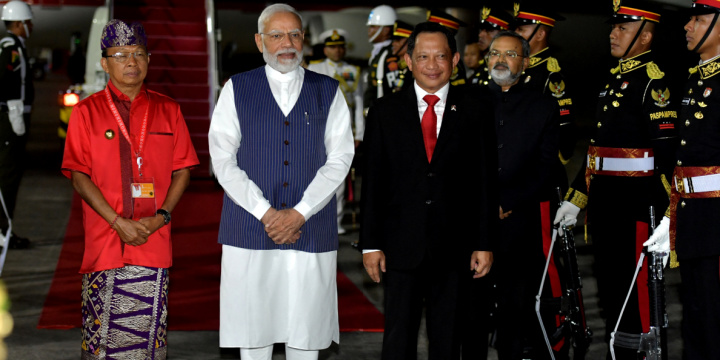
Bali Governor I Wayan Koster (left) with Indian Prime Minister Narendra Damodardas Modi and Indonesian Home Minister Tito Karnavian ahead of the G20 Summit in Bali, Indonesia November 14, 2022. Photo: Fikri Yusuf/G20 Media Center/Handout via REUTERS
In September 2023, the IMEC initiative was announced. IMEC is an economic corridor that will connect India, the Middle East and Europe, with the support of the United States. This initiative has the potential to change the face of global trade and transportation.
The corridor is expected to strengthen economic, transportation and energy ties among the countries and serve as a digital bridge between continents. IMEC offers Israel a strategic opportunity to position itself as a transit hub between Asia and Europe and strengthen its regional ties — but the initiative faces geopolitical challenges that require strategic planning and smart regional cooperation.
In September 2023, at the G20 Summit in New Delhi, India, an ambitious initiative was announced: to establish the “India-Middle East-Europe Corridor” (IMEC), an economic corridor supported by the United States. The initiative aims to connect India, the Middle East, and Europe through advanced transport and energy infrastructure and strengthen cooperation in the fields of trade, economy, energy and security among all partner countries.
European Union Commissioner Ursula von der Leyen said the corridor is “more than ‘just’ a railway or a cable car, it is a green and digital bridge across continents and cultures.”
The IMEC economic corridor is expected to generate significant economic benefits and improve geopolitical ties among the participating countries. For Israel, it represents an important opportunity to position itself as a strategic bridge between Asia and Europe and to exploit the advantages inherent in the project.
Israel’s integration into the corridor will allow it to upgrade its transportation and logistics infrastructure, become a major transit hub between Asia and Europe, strengthen ties with the Gulf states, expand its circle of economic partners, and reduce its dependence on limited markets and its status as an “island economy” and “energy island.”
However, the success of the project depends on regional cooperation that requires political stability and regulatory adjustments. Geopolitical tensions between the great powers could spark competition for areas of influence, especially in the face of initiatives such as China’s “New Silk Road” (the Belt & Road Initiative, or BRI). In addition, although the project is not conditional on full normalization between Israel and Saudi Arabia, effective cooperation will require ongoing coordination between those countries.
The economic corridor and regional potential
In light of the profound and dramatic changes in the region, the time is ripe to launch initiatives for regional cooperation between Israel and the moderate Arab states as an important step towards consolidating Israel’s status and independence.
At the time of writing, some of the conflicts are waning, with the collapse of the Shiite axis and the disintegration of the “ring of fire” that was part of Iran’s overt strategy in recent years. With Trump’s second term, discussions are resurfacing about possible normalization between Israel and Saudi Arabia through American mediation. Indeed, the prolonged war emphasizes the importance of achieving military goals and implementing initiatives to promote regional stability.
Under the first Trump administration, important agreements were signed between Israel and the United Arab Emirates, Bahrain, Sudan, and Morocco. These agreements, known as the “Abraham Accords,” built on the earlier peace treaties with Egypt and Jordan and are part of Israel’s quiet diplomacy with its neighbors to expand peace since its founding.
The corridor is expected to increase Israel’s trade volumes with new markets in the Gulf, India and Europe, thereby reducing its dependence on traditional trading partners. Investment in expanding seaports (mainly in Haifa Bay) and infrastructure along the railway line (the Valley Railway) could make Israel a vital trade hub while encouraging foreign investment and establishing free trade zones along the corridor, especially near the border with Jordan.
In addition, integration into the project will provide opportunities for innovation in the fields of logistics and technology, including the integration of artificial intelligence and automation into transportation and management processes on the Israeli side towards Europe.
IMEC also constitutes a platform for the development of the green energy sector, including connection to green hydrogen and solar energy infrastructure. This could position Israel as a major player in the field of renewable energy and energy supply to Europe. It could also help achieve the government’s renewable energy goals (77% of electricity production by 2050).
Against this backdrop, it is necessary to examine how the processes of connectivity between Israel and the moderate axis among its neighbors can be strengthened through the ambitious initiative. In the past decade, goods from Europe have reached Saudi Arabia and other Arab countries through the port of Haifa, from where they made their way to the Israeli-Jordanian border crossing at Sheikh Hussein while maintaining the secrecy of their passage through Israel. This secrecy serves all parties by shortening transportation routes and may now receive further impetus in the renewed initiative supported by the current administration.
The IMEC initiative is largely based on a revolutionary rail connection project, “Railways for Regional Peace”, that was proposed in 2018. This project aims to connect Israel, the United Arab Emirates, Jordan, and Saudi Arabia via high-speed rail. The planned land bridge is intended to streamline the passage of goods between the East and Europe by shortening transportation times, bypassing the Suez Canal, and promoting essential infrastructure for maximum utilization of existing transportation lines.
The project is divided into two main phases. The first involves constructing a railway connecting Israel and Jordan in the Beit Shean area. This phase requires the construction of tracks that will link the new private docks at Haifa Port to the Jordanian border, as well as a rail connection from the Sheikh Hussein border crossing to Irbid in Jordan. These links will accommodate the different rail standards of Israel and Jordan and overcome significant elevation differences between the two sides. The second phase focuses on establishing a direct railway line that will connect Israeli ports to the Persian Gulf via Jordan and Saudi Arabia, including the establishment of extensive trade zones — that is, land ports — for unloading and transporting cargo.
While the exact route of the IMEC project has not yet been revealed, it is expected to combine land rail corridors with shipping lanes. One option is for cargo shipments to depart from major ports in western India, such as Mumbai. The shipments would then be unloaded at ports in the Persian Gulf, including the port of Dammam in Saudi Arabia and various ports in the United Arab Emirates and Bahrain. From there, the goods would be transported by high-speed rail through northern Saudi Arabia and Jordan, finally reaching Israel via the Sheikh Hussein crossing.
Following the outbreak of war in 2023, a private pilot was conducted to examine a land transport route for trucks through the ports of Dubai, Saudi Arabia and Jordan that are unloaded using the Back to Back Trucking method at the border crossings with Israel, as was already done unofficially after the signing of the Abraham Accords. The public debut trip included ten trucks that traveled the long land route from the ports of the Persian Gulf to Israel.
The successful trip reflected the cooperation between the Gulf states, Saudi Arabia and Jordan — an essential factor due to the blockade imposed by the Iran-backed Houthis in the Bab al-Mandab Straits.
The India-Europe Economic Corridor through the Middle East is also expected to include the laying of communication cables and electricity connections that rely on existing networks, as well as pipelines for exporting gas, mainly green hydrogen (i.e., hydrogen produced using renewable energy, such as solar energy) from India and the Gulf countries to Europe. This way, gas can be stored in designated facilities that have already been successfully tested in Israel and other countries.
Israel is also cooperating with Egypt, Cyprus and Greece on offshore gas reserves. IMEC could become an export corridor for energy from those countries to Europe, which needs to reduce its dependence on Russian gas. This need arose mainly as a result of the war in Ukraine and the disruption of Russian gas transit through Ukrainian territory to Western Europe. The Great Sea Interconnector, which will be based on infrastructure for an undersea power cable to connect Israel with the Greek-Cypriot-European cable, could become an important energy source for Europe.
Current challenges
This ambitious plan has great potential in terms of the export of gas from Israel to European countries and the expansion of the existing infrastructure for energy transit within and outside Israel. However, the development of port connections, railways and other infrastructure necessary for the establishment of IMEC will require significant investment.
The first phase is estimated to cost about $8 billion, which will have to include private investments. Saudi Arabia has committed to an investment of $20 billion for IMEC, but this is only a tiny fraction of the $600 billion the G7 aims to raise for projects that will compete with the Chinese initiative by 2027. Furthermore, none of the member states has made formal financial commitments to IMEC, which leaves much of the financing outlook unclear.
The economic obstacle of attracting investment from India, the Gulf states and the European Union is just one hurdle. The war imposed on Israel since October 2023 and the continuation of the regional war against it have led to the suspension of normalization talks between Israel and Saudi Arabia, and public opposition from Arab countries to regional infrastructure initiatives with Israel, thus posing significant challenges to IMEC.
In parallel with the challenges associated Israel-Saudi normalization, Jordan is facing significant economic difficulties beyond the political and internal tensions arising from its relations with Israel. These difficulties are reflected, among other things, in the freezing of the joint electricity project with Israel and delays in obtaining financing to upgrade the railways in its territory. In light of the war in Gaza, relations between Israel and Egypt are also under great strain.
Another obstacle at the international level is the geopolitical competition between the United States and China. In the face of this initiative, which grew out of discussions at the I2U2 forum involving India, Israel, the United Arab Emirates and the United States, China embarked on an early and ambitious infrastructure program that has increased its influence in the region. Given that China has invested in regional infrastructure development projects, such as Etihad Rail, it may try to block regional projects that would harm its status or reduce its influence.
Saudi Arabia (which joined the China-led BRICS organization in August 2023 as an official member) and the UAE also cultivate deep ties with China and have become its strategic trade partners while maintaining their place within the Belt and Road initiative. The Gulf states’ involvement in IMEC could be a means of spreading risk and boosting leverage for negotiations with the Western partners. Turkey’s plans to establish an energy corridor through the Arab gas pipeline in Syria or through a corridor from Qatar and its connection to the existing network in Syria and Turkey could be realized more quickly, and undermine India’s route to transfer energy through Israel.
Practical suggestions
To make the agreement a reality and attract private and governmental investment, several initial steps are required, including the creation of a multilateral agreement to establish an institutional framework for a structured and systematic dialogue between the participating countries.
Another obstacle in the normalization process between Israel and Saudi Arabia, mediated by the United States, stems from difficulties in reaching long-term arrangements. One possible means of alleviating public opposition to normalization between Israel and Saudi Arabia is the vision of railways for regional peace published by the Israeli government, a vision that includes the Valley Railway line for exporting and importing Palestinian goods to the Gulf states and Europe via the border crossing.
This may ease the opposition of the leaders of the hawkish line in the Saudi Kingdom against Israel and give the upper hand to the moderate camp, which supports promoting open relations between the countries. There is already economic and civilian cooperation, sometimes through a third party, as well as cooperation on the security front, with the two countries operating under the umbrella of United States Centcom command. This cooperation led to joint warnings and interceptions during the Iranian attacks on Israel. This is in addition to the opening of the airspace of Saudi Arabia, Oman, and the Gulf states to Israeli companies on their way to Asia in recent years.
To realize the economic potential of IMEC and reduce the political and economic barriers associated with it, a dedicated body should be established to attract private investment and promote infrastructure development among the participating countries. This body would allow private companies to take part in the project on the basis of private investment and the transportation of goods, thereby creating a model that would provide participants with economic incentives for the project’s success. In addition, the involvement of private initiatives could give the project broader public legitimacy, especially among the Arab countries, thereby easing political pressure on the region’s rulers and contributing to private-sponsored cooperation.
For Israel, participation in the IMEC project offers significant economic and geopolitical opportunities. Integration into the corridor will allow it to upgrade its existing transportation and logistics infrastructure on the Valley Line, greatly develop the ports of Haifa and the Gulf, and become a major transit hub between Asia and Europe. The corridor will allow Israel to fulfill its objectives in the field of renewable energy, expand its circle of economic partners, especially with India and European countries, and reduce its dependence on limited markets.
The IMEC economic corridor initiative faces significant political and geopolitical challenges that will require strategic planning and smart regional cooperation, but it has the potential to change the face of global trade and transportation — and it offers Israel a chance to position itself as a major player in the international arena.
Dr. Nir Levitan is a researcher at the BESA Center at Bar-Ilan University and at the Center for Cold War Studies at the University of Southern Denmark.
Prof. Arie Reich is Vice Rector and Jean Monnet Chair in Law and European Union Institutions, Faculty of Law, Bar-Ilan University.
Prof. Jonathan Rynhold is head of the Department of Political Studies at Bar-Ilan University and a senior research fellow at the Begin-Sadat Center for Strategic Studies.
A version of this article was originally published by The BESA Center.