 Pod Save America Hosts Call on Democrats to Cut All Israel Military Aid, No Longer Accept AIPAC Funding
 Jews, Israelis Targeted in Austria Amid Surge in Antisemitic Incidents; Local Jewish Community Calls for Action
 ‘All of Our Strength’: Over 1,000 Pro-Israel Activists Gather in DC for Solidarity Conference
 ‘Devastated’: Wesley LePatner, Killed in Manhattan Mass Shooting, Was a Jewish Communal, Philanthropic Leader
 Sen. Angus King Vows to No Longer Vote for Israel Military Aid Until Gaza Conditions Improve
 Europe Won’t Pressure Israel to ‘Commit Suicide’ Amid Gaza Backlash, Palestinian State Push, Says Israeli FM
 Israel’s National Soccer Coach Attacked in Athens Before Soccer Fans Chant ‘F–K Israel, Free Palestine’ at Match
 New York Judge Sentences Neo-Nazi to 5 Years for Livestreaming Bomb Threats Against Jewish Hospitals
 US Pressures Lebanon to Issue Cabinet Decision to Disarm Hezbollah Before Talks Continue
 UK Plans to Recognize Palestinian State in September Unless Israel Meets Conditions, Starmer Says


What Happens to Holocaust Memory When There Are No Living Survivors?
Error: Contact form not found.
 by Jacob Sivak

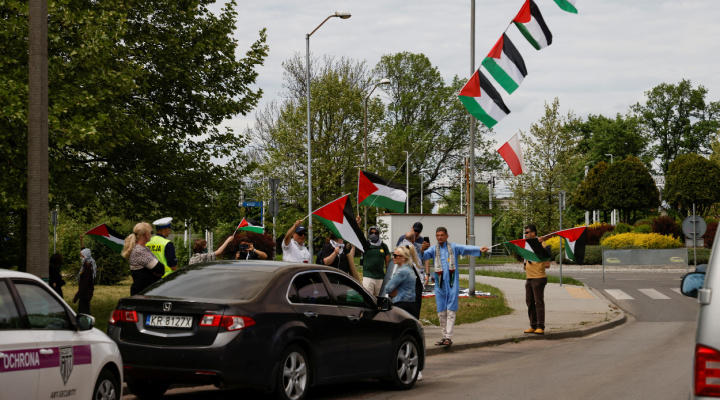
Anti-Israel protesters hold flags on the route of the annual International March of the Living, outside former Auschwitz Nazi German death camp, in Oswiecim, Poland, May 6, 2024. Photo: REUTERS/Kuba Stezycki
It was reported in The Times of Israel that 70% of the 200,000 Holocaust survivors alive today will be gone in the next 10 years. How will the Holocaust be remembered when there are no survivors? Two recent experiences have given me a sobering glimpse of possible answers.
I live in a city in Canada, with a diverse Jewish community. Every Passover, Chabad organizes the delivery of a box containing three hand-made Shmurah Matzahs to every Jewish household in the area. The matzahs come in a handsome box with the picture of a matzah on the top, and the three things Jews are obliged to explain during the Passover Seder: Pesach (the Passover offering), Matzah, and Bitter Herbs.
This Passover, I noticed that the information on the side of the box indicates the matzahs were made in Dnepr, Ukraine. The street address caught my attention — Bogdan Khmelnitsky (also spelled Bohdan Khmelnytsky) Street.
Dnepr is a city of about one million people in eastern Ukraine, about 75 miles from the frontline of the ongoing war instigated by Russia. Although a very large number of Ukrainian Jews immigrated to Israel after the demise of the Soviet Union, a substantial and active Jewish community remains in Dnepr, centered around a large multifunction Jewish community center, the Menorah Center. It is located on Sholom-Aleikhema (Shalom Aleichem) Street.
However, the matzah factory, a large enterprise a few miles away, is located on Bogdan Khmelnitsky Street.
Bogdan Khmelnitsky is Ukraine’s national hero. Khmelnitsky led a Cossack rebellion against Ukraine’s Polish rulers in the mid-17th century. While successful initially, the revolt ended with an exchange of Polish rule for Russian domination. Today, monuments to Khmelnitsky are found throughout Ukraine, and streets named after him are a feature of most Ukrainian cities. Yet, to Jews his name is an abomination.
As is often the case in Jewish history, the Jews of Ukraine were scapegoats in the Khmelnitsky uprising. Thousands (estimates of Jewish deaths range to 100,000) were slaughtered alongside Poles. In Sabbatai Ṣevi, Gershom Scholem attributes the widespread rise of messianic fervor among Jews at this time to the sense of vulnerability induced by the Khmelnitsky massacres.
Khmelnitsky was not the last Ukrainian leader to receive the adulation of his compatriots and the condemnation of Jews. Symon Petlura was a Ukrainian military commander during the Russian civil war following World War I. The Jews of Ukraine suffered from pogroms carried out by all sides. However, the largest number of deaths (the total number of Jews killed is estimated to be well over 100,000 — see Jeffrey Veidlinger, In the Midst of Civilized Europe) were by Ukrainians under Petlura.
Sholom Schwarzbard, a Jew, assassinated Petlura in Paris in 1926 to avenge their deaths. He was acquitted after a trial that included testimony from witnesses of the massacres. Nevertheless, Petlura’s exploits are the subject of several Ukrainian folksongs and a number of Ukrainian cities have erected monuments to him.
(Remarkably, the current Ukrainian hero, to Ukrainians and many others, is a Jew, Volodymyr Zelenskyy.)
Ukrainians are not unique when it comes to collective memory loss in relation to Jewish calamities. At about the same time that I was thinking about Khmelnitsky, it was reported in Haaretz that the Prosecution Office of the Republic of Latvia had decided to close the investigation into the Latvian Nazi collaborator Herberts Cukurs for lack of legal evidence of war crimes or genocide.
Cukurs’ active role in the killing of thousands of Jews in Latvia in late 1941 is indisputable. He was the deputy commander of the infamous Arajs Kommando, an auxiliary military force created by the Germans to assist in the rounding up and murder of Jews and other undesirables, including assisting in the slaughter of most of the Jews of Riga at Rumbula Forest outside Riga.
Nazi hunter Ephraim Zuroff, writing in response to earlier Latvian efforts to sanitize Cukurs’ story, describes the evidence against Cukurs in detail, including sworn testimony from witnesses in Yad Vashem archives, noting that Cukurs personally tortured and murdered Jewish men, women, and children.
The effort to revise Cukurs’ (and Latvia’s) role in the Holocaust may be a harbinger of more to come. Recently, Zuroff was cited in an article on Holocaust memory in The Media Line saying, “there are no more trials coming. All we have left is memory — and even that is under siege.”
There have been extensive efforts made to perpetuate the memory of the Holocaust by way of museums, monuments, and recordings by survivors. Is it enough? Will the Holocaust continue to be viewed as a unique and tragic event specific to the Jewish people, or will the fading memory of the Holocaust be distorted and manipulated to suit the stories told by others?
Jacob Sivak, a Fellow of the Royal Society of Canada, is a retired professor, University of Waterloo.