 Pod Save America Hosts Call on Democrats to Cut All Israel Military Aid, No Longer Accept AIPAC Funding
 Jews, Israelis Targeted in Austria Amid Surge in Antisemitic Incidents; Local Jewish Community Calls for Action
 ‘All of Our Strength’: Over 1,000 Pro-Israel Activists Gather in DC for Solidarity Conference
 ‘Devastated’: Wesley LePatner, Killed in Manhattan Mass Shooting, Was a Jewish Communal, Philanthropic Leader
 Sen. Angus King Vows to No Longer Vote for Israel Military Aid Until Gaza Conditions Improve
 Europe Won’t Pressure Israel to ‘Commit Suicide’ Amid Gaza Backlash, Palestinian State Push, Says Israeli FM
 Israel’s National Soccer Coach Attacked in Athens Before Soccer Fans Chant ‘F–K Israel, Free Palestine’ at Match
 New York Judge Sentences Neo-Nazi to 5 Years for Livestreaming Bomb Threats Against Jewish Hospitals
 US Pressures Lebanon to Issue Cabinet Decision to Disarm Hezbollah Before Talks Continue
 UK Plans to Recognize Palestinian State in September Unless Israel Meets Conditions, Starmer Says


Here’s What’s Happening in Gaza Right Now
Error: Contact form not found.
 by Eado Hecht

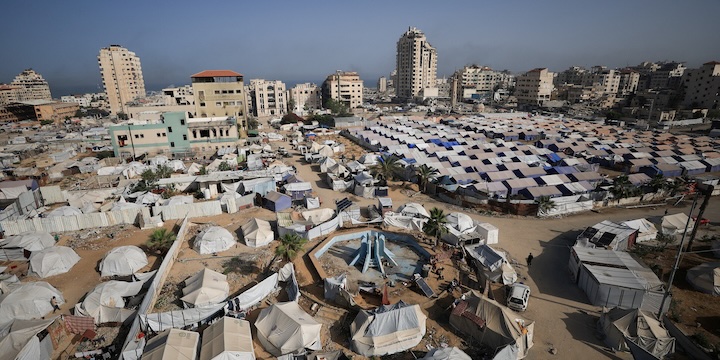
Palestinians displaced by the Israeli military offensive, shelter in tents, in Gaza City May 11, 2025. REUTERS/Dawoud Abu Alkas
Negotiations have continued to end the Gaza war, with no result. Hamas is still refusing to relinquish its hold on Gaza and demanding that a ceasefire include its continued governance, the total withdrawal of Israeli forces from Gaza, and the rebuilding of Gaza at the expense of the international community.
Israel is demanding the return of all the remaining hostages, the removal of Hamas from Gaza, and the complete demilitarization of the area. The Israelis offered a partial agreement that Hamas refused. In a gesture to President Trump, Hamas released a hostage who has dual American and Israeli citizenship.
On Monday, after several weeks of gradually taking more ground and intensifying aerial operations against Hamas and other terrorist personnel, Israel declared the beginning of a new escalated ground operation. Five divisions are now simultaneously attacking different localities in Gaza. The official objective is to capture most if not all the territory of Gaza.
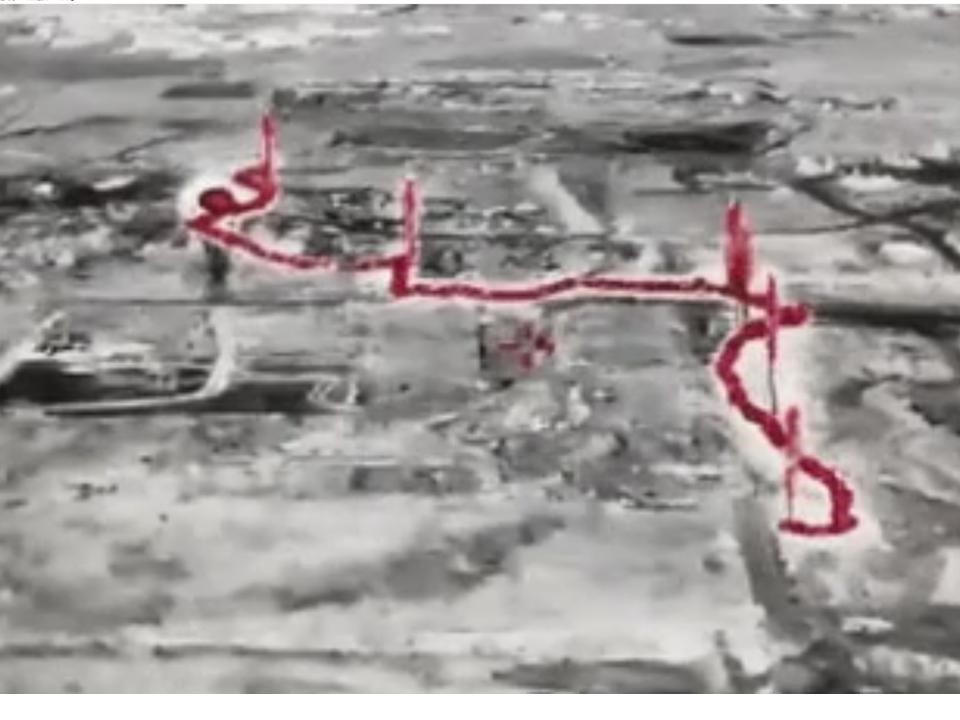
Detonation of a tunnel: The red line emphasizes its route – the red plumes are from ventilation shafts.
In the run-up to the ground operation, the Israeli Air Force intensified its airstrikes on commanders, command centers and Hamas fighting positions. Many of these strikes required pinpoint accuracy, with small bombs or missiles sent into specific rooms Hamas had commandeered inside hospitals and schools. Others required heavier bombs to penetrate underground facilities.
Among the targets was the current Hamas chief, Mahmoud Sinwar (who replaced his brother Yahya Sinwar, killed in October 2024), and one, perhaps two, Hamas brigade commanders (those of the Rafah and Khan Yunis brigades) and several of Sinwar’s staff. It is unclear whether or not they were killed. A Saudi report claims that the bodies of Sinwar and at least 10 of his assistants were recovered, but Hamas has not officially admitted this.
Publicized details of the IDF’s new offensive show a different approach from previous operations. This time, there will be a simultaneous offensive throughout Gaza rather than a sequential one. The territory taken will be held and cleared.
Also, a different approach is planned for managing the civilian population. Previously, civilians were ordered to evacuate each area where the Israelis were operating and told to stay outside that area until the Israelis had withdrawn. This time, the plan is to set up humanitarian enclaves in areas taken by the Israeli forces, and supplies entering Gaza will be sent exclusively to those locations. The population will then be instructed to move to those enclaves via filtration points to ensure that Hamas and other terrorist personnel do not join them.
The civilian and humanitarian management of the enclaves will be in the hands of a new international organization, the US-based Gaza Humanitarian Foundation, set up specifically for this purpose. The UN, UNRWA, and other pro-Hamas NGOs will not be involved. To no one’s surprise, the UN establishment is criticizing this approach.
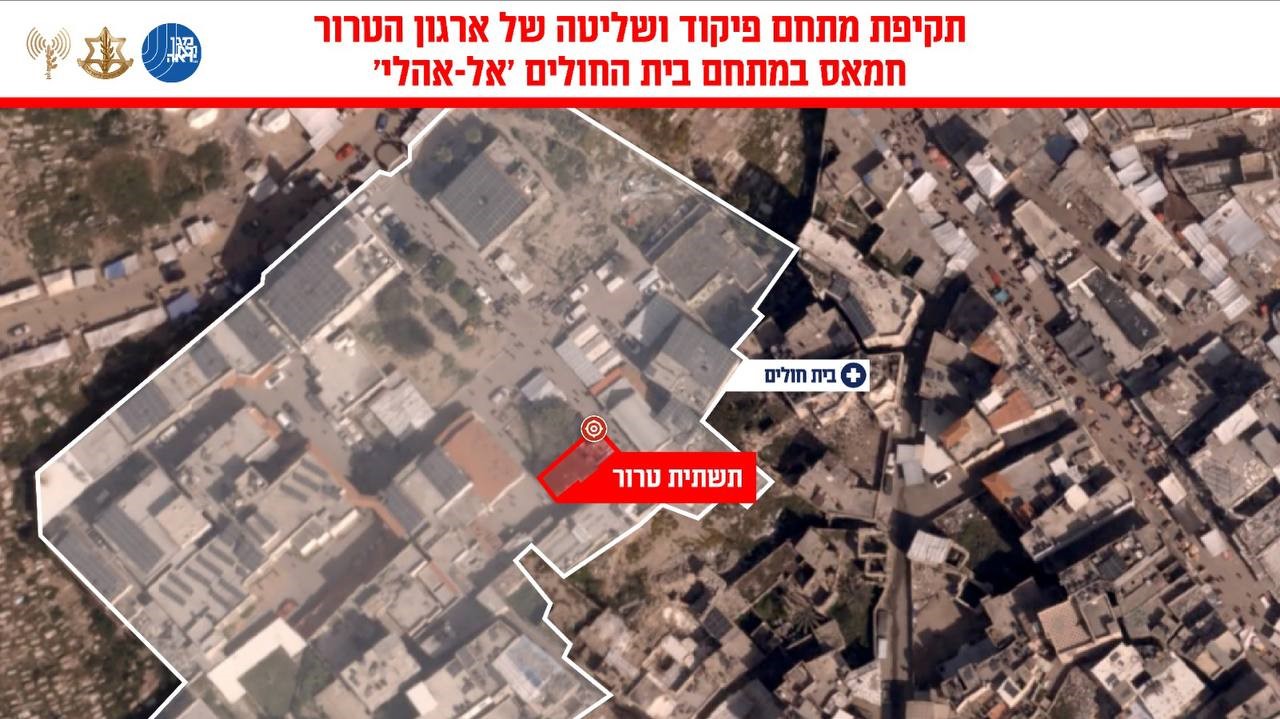
The location of an attacked Hamas post (marked in red) inside the compound of al-Ahali hospital (the white boundary).
More and more people in Gaza are allowing themselves to openly criticize Hamas, though the initial wave of public demonstrations appears to have abated after several participants were killed by Hamas. There have also been many more posts by Gazans who say they would leave Gaza permanently if they were allowed to do so.
While the number of such posts is increasing, it is still relatively small, and we don’t know how deep this sentiment is — are these people exceptions, or do they represent a much larger portion of the population? On several occasions, crowds have broken into storage sites where Hamas has been hoarding humanitarian aid. In one case, a local merchant’s warehouse was ransacked after it was published that he was hoarding food rather than selling it in anticipation of higher prices.
The Hamas Ministry of Health’s latest casualty update from May 17 claims approximately 54,000 killed and 120,000 wounded. Hamas still does not differentiate between combatants and non-combatants. According to the IDF, in January 2025 these included a verified total of more than 20,000 Hamas personnel and at least 3,000 personnel of other terrorist organizations. Since the resumption of fighting in March, many more terrorists have been killed, but no specific number has been provided. The number of wounded terrorists is not known but is probably at least similar to the number killed. And we have no way to know if any of Hamas’ numbers are accurate.
Another Israeli soldier died earlier this week in Gaza, bringing the total number of casualties since October 8 to 420.
Israeli offensive operations continue in the West Bank, though their intensity has diminished. Resistance to Israeli operations is also waning. Those killed are usually commanders who refuse to surrender or who are in the middle of conducting attacks on the Israelis.
Hamas has attempted to galvanize the population to join the fighting against the IDF, but with virtually no response so far. In fact, the frequency of terrorist attacks against Israelis has gone down considerably. Since the last update, it has reached one of its lowest levels in many years.
The Fatah-controlled security forces of the Palestinian Authority have continued their operations against their Hamas and Palestinian Islamic Jihad rivals in areas where the Israelis are not operating. They have arrested several hundred.
Dr. Eado Hecht, a senior research fellow at the BESA Center, is a military analyst focusing mainly on the relationship between military theory, military doctrine, and military practice. He teaches courses on military theory and military history at Bar-Ilan University, Haifa University, and Reichman University and in a variety of courses in the Israel Defense Forces. A version of this article was originally published by The BESA Center.