 Pod Save America Hosts Call on Democrats to Cut All Israel Military Aid, No Longer Accept AIPAC Funding
 Jews, Israelis Targeted in Austria Amid Surge in Antisemitic Incidents; Local Jewish Community Calls for Action
 ‘All of Our Strength’: Over 1,000 Pro-Israel Activists Gather in DC for Solidarity Conference
 ‘Devastated’: Wesley LePatner, Killed in Manhattan Mass Shooting, Was a Jewish Communal, Philanthropic Leader
 Sen. Angus King Vows to No Longer Vote for Israel Military Aid Until Gaza Conditions Improve
 Europe Won’t Pressure Israel to ‘Commit Suicide’ Amid Gaza Backlash, Palestinian State Push, Says Israeli FM
 Israel’s National Soccer Coach Attacked in Athens Before Soccer Fans Chant ‘F–K Israel, Free Palestine’ at Match
 New York Judge Sentences Neo-Nazi to 5 Years for Livestreaming Bomb Threats Against Jewish Hospitals
 US Pressures Lebanon to Issue Cabinet Decision to Disarm Hezbollah Before Talks Continue
 UK Plans to Recognize Palestinian State in September Unless Israel Meets Conditions, Starmer Says


Iran Warns It Will Respond to Reimposition of UN Sanctions
Error: Contact form not found.
 by Reuters and Algemeiner Staff

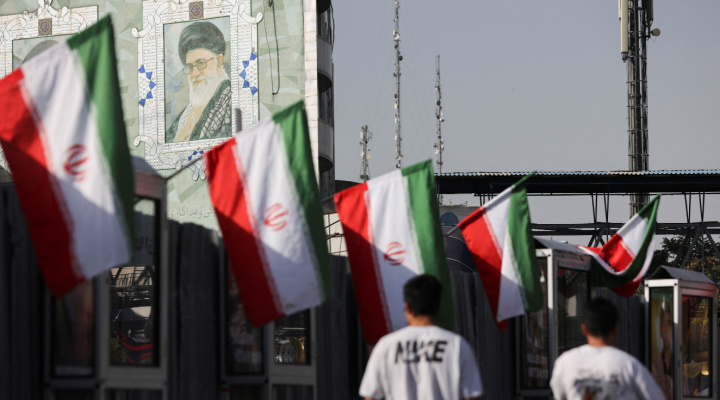
People walk near a mural of Iran’s Supreme Leader, Ayatollah Ali Khamenei, amid the Iran-Israel conflict, in Tehran, Iran, June 23, 2025. Photo: Majid Asgaripour/WANA (West Asia News Agency) via REUTERS
Iran will react to any reimposition of United Nations sanctions over its nuclear program, the country’s foreign ministry spokesperson said on Monday, without elaborating on what actions Tehran might take.
A French diplomatic source told Reuters last week that European powers would have to restore UN sanctions on Iran under the so-called “snapback mechanism” if there were no nuclear deal that guaranteed European security interests.
The “snapback mechanism” is a process that would reimpose UN sanctions on Tehran under a 2015 nuclear deal that lifted the measures in return for restrictions on Iran‘s nuclear program.
“The threat to use the snapback mechanism lacks legal and political basis and will be met with an appropriate and proportionate response from the Islamic Republic of Iran,” Foreign Ministry spokesperson Esmaeil Baghaei told a press conference, without giving further details.
The 2015 deal with Britain, Germany, France, the US, Russia, and China – known as the Joint Comprehensive Plan of Action (JCPOA) – states that if the parties cannot resolve accusations of “significant non-performance” by Iran, the “snapback mechanism” process can be triggered by the 15-member UN Security Council.
“The European parties, who are constantly trying to use this possibility as a tool, have themselves committed gross and fundamental violations of their obligations under the JCPOA,” Baghaei said.
“They have failed to fulfill the duties they had undertaken under the JCPOA, so they have no legal or moral standing to resort to this mechanism.”
Western countries accuse Iran of plotting to build a nuclear weapon, which Tehran denies.
The United States pulled out of the deal in 2018 under the first administration of President Donald Trump, who called the agreement “weak.”
Trump, whose second presidency began in January, has urged Tehran to return to nuclear negotiations on a new deal after a ceasefire was reached last month that ended a 12-day air war between Iran and Israel.
When asked if Iranian Foreign Minister Abbas Araqchi would meet with Trump’s Middle East envoy, Steve Witkoff, Baghaei said no date or location had been set for resuming the US-Iran nuclear talks.





