 Pod Save America Hosts Call on Democrats to Cut All Israel Military Aid, No Longer Accept AIPAC Funding
 Jews, Israelis Targeted in Austria Amid Surge in Antisemitic Incidents; Local Jewish Community Calls for Action
 ‘All of Our Strength’: Over 1,000 Pro-Israel Activists Gather in DC for Solidarity Conference
 ‘Devastated’: Wesley LePatner, Killed in Manhattan Mass Shooting, Was a Jewish Communal, Philanthropic Leader
 Sen. Angus King Vows to No Longer Vote for Israel Military Aid Until Gaza Conditions Improve
 Europe Won’t Pressure Israel to ‘Commit Suicide’ Amid Gaza Backlash, Palestinian State Push, Says Israeli FM
 Israel’s National Soccer Coach Attacked in Athens Before Soccer Fans Chant ‘F–K Israel, Free Palestine’ at Match
 New York Judge Sentences Neo-Nazi to 5 Years for Livestreaming Bomb Threats Against Jewish Hospitals
 US Pressures Lebanon to Issue Cabinet Decision to Disarm Hezbollah Before Talks Continue
 UK Plans to Recognize Palestinian State in September Unless Israel Meets Conditions, Starmer Says


The Emptying of Yemen
Error: Contact form not found.
 by Daniel Pipes

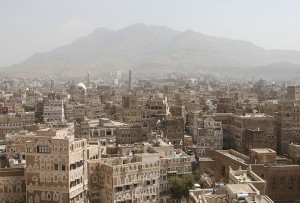
The Yemeni capital, Sana'a. Photo: Ferdinand Reus.
For the first time in its exceedingly long history, Yemen now threatens the outside world. It does so in two principal ways.
First, even before the current political upheaval began there on January 15, violence out of Yemen already impinged on Westerners. As President Ali Abdullah Saleh’s weak government controlled only a small part of the country, violence had emerged both near to Yemen (such as attacks on American and French ships) and distant from it (Anwar al-Awlaki’s incitement to terrorism in Texas, Michigan, and New York). With Saleh’s apparent abdication on June 4, when he traveled to Saudi Arabia for medical treatment, the central government’s writ will further diminish, leading to yet more attacks being planned inside Yemen for execution outside the country.
But it’s the second danger that staggers my mind: an unprecedented emptying out of Yemen, with millions of unskilled and uninvited refugees, first in the Middle East, then in the West, many of them Islamist, demanding economic asylum.
The problem begins with an increasingly cataclysmic water shortfall. Gerhard LichtenthÄler, a specialist this topic, wrote in 2010 how, in many of the country’s mountainous areas,
available drinking water, usually drawn from a spring or a cistern, is down to less than one quart per person per day. Its aquifers are being mined at such a rate that groundwater levels have been falling by 10 to 20 feet annually, threatening agriculture and leaving major cities without adequate safe drinking water. Sanaa could be the first capital city in the world to run dry.
And not just Sanaa: as a London Times headline put it, Yemen “could become first nation to run out of water.” Nothing this extreme has happened in modern times, although similar patterns of drought have developed in Syria and Iraq.
Scarce food resources, columnist David Goldman points out, threaten to leave large numbers of Middle Easterners hungry and one-third of Yemenis faced chronic hunger before the unrest. That number is growing quickly.
The prospect of economic collapse looms larger by the day. Oil supplies are reduced to the point that “Trucks and buses at petrol stations queue for hours, while water supply shortages and power blackouts are a daily norm.” Productive activity is proportionately in decline.
If water and food were not worrisome enough, Yemen has one of the highest birthrates in the world, exacerbating the resource problem. With an average of 6.5 children per woman, almost 1 in 6 women is pregnant at any given time. Today’s population of 24 million is predicted to double in about 30 years.
Politics exacerbate the problem. If Saleh is history (too many forces have arrayed against him for him to return to power, plus the Saudis may not let him leave), his successor will have difficulty ruling even the meager portion of the country that he controlled.
Because many factions with diverse aims are competing for power – Saleh’s allies, Houthi rebels in the north, a secessionist movement in the south, Al-Qaeda-style forces, a youth movement, the military, certain tribes, and the Ahmar family – they will not coalesce into a neat two-way conflict. Anarchy, in other words, looks more probable than civil war; Somalia and Afghanistan could be models.
Yemeni Islamists range from members of the Islah Party, which competes in parliamentary elections, to the Houthi rebels fighting Saudi forces, to Al-Qaeda in the Arabian Peninsula. Their growing power boosts the Iranian-backed “resistance bloc” of states and organizations. If Shi’ites prevail over Sunnis in Yemen, Tehran will gain all the more.
In combination, these several crises – ecological, economic, political, ideological – could prompt a mass, unprecedented, and tragic exodus out of Yemen, leading to an epic anti-Yemeni backlash.
On a personal note: I was fascinated by Yemen on a visit as a student in 1972. A land so difficult of access that colonial powers only lapped at its edges, it managed to keep its customs, including a spectacular style of architecture and a distinctive culture of dagger-wearing men and most adults chewing qat.
Can the outside world prevent catastrophe? No. Yemen’s terrain, culture, and politics all render a military intervention untenable; and who, at this time of deficits and austerity, will subsidize its dismal and failing economy? Nor will states volunteer to take in millions of refugees.
In this darkest hour, Yemenis are on their own.
Mr. Pipes (www.DanielPipes.org) is president of the Middle East Forum and Taube distinguished visiting fellow at the Hoover Institution of Stanford University.