 Pod Save America Hosts Call on Democrats to Cut All Israel Military Aid, No Longer Accept AIPAC Funding
 Jews, Israelis Targeted in Austria Amid Surge in Antisemitic Incidents; Local Jewish Community Calls for Action
 ‘All of Our Strength’: Over 1,000 Pro-Israel Activists Gather in DC for Solidarity Conference
 ‘Devastated’: Wesley LePatner, Killed in Manhattan Mass Shooting, Was a Jewish Communal, Philanthropic Leader
 Sen. Angus King Vows to No Longer Vote for Israel Military Aid Until Gaza Conditions Improve
 Europe Won’t Pressure Israel to ‘Commit Suicide’ Amid Gaza Backlash, Palestinian State Push, Says Israeli FM
 Israel’s National Soccer Coach Attacked in Athens Before Soccer Fans Chant ‘F–K Israel, Free Palestine’ at Match
 New York Judge Sentences Neo-Nazi to 5 Years for Livestreaming Bomb Threats Against Jewish Hospitals
 US Pressures Lebanon to Issue Cabinet Decision to Disarm Hezbollah Before Talks Continue
 UK Plans to Recognize Palestinian State in September Unless Israel Meets Conditions, Starmer Says


The Israeli Street: A Time Line
Error: Contact form not found.
-avatar.jpg) by Maxine Dovere
by Maxine Dovere

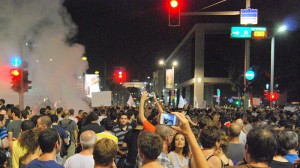
2011 housing protests in Israel. Photo: Eli Berckovitz.
In Paris, almost 250 years ago, a revolution took to the streets on July 14. Little remained the same in France after that day. In Tel Aviv, almost 250,000 took to the streets July 14, 2011. No arms, this time, just many citizens. On the anniversary of the fall of the infamous Bastille, throughout the country, Israelis “took to their tents” to protest what people consider economic imprisonment. Housing has become unattainable for many; out of control costs are forcing thousands to seek opportunities outside of the country.
Since its initiation, the agenda of the protestors has grown from a simple protest against high prices to the wider demand for “Social justice for the people” and even “Revolution.” Signs saying “People before profits” “Rent is not a luxury,” and “Working class heroes” have appeared throughout the crowds.
It’s not subsiding. During the first week of August, conservative columnist (JPost) Caroline Glick’s cynical “news” report joked that 250,000 protestors were in the “Street” as part of its “humor.” By August 6, 270,000 were – in fact – taking part in the protest. Young people, especially young couples unable to find affordable housing, were aamong the leaders of the demonstrations. Many middle class, working professionals, despite what appears to be an economic boom, who want to remain in the Tel Aviv, Jerusalem or other “city” areas, find themselves unable to afford homes or apartments.
The protests grew – and grew some more. Thousands joined in Jerusalem, additional thousands poured into the streets in cities throughout the country. In Tel Aviv, National Union of Students chairman Itzik Shmuly said “We know that we cannot achieve everything, but living here has become impossible, and we will not accept it.” Party lines were crossed and the movement gained momentum.
Directors of the Joseph Bau Museum, Hadasa Bau and Cecila Bau Cohen told the Algemeiner “You should see what is going on here, it is amazing!” “The tents are just beside our museum. We are there almost every day, and people are coming to us. Yesterday (Saturday) was the biggest protest ever – 300.000 people.” (Joseph Bau is the graphic artist who was saved by Otto Schindler, and was characterized in ‘Schindler’s List.’)
The popular protest movement has crossed traditional Israeli political lines. Similar to Egypt’s Tahrir Square demonstrations, the call to pitch tents along Rothschild Boulevard came via social media, in this case Facebook. Thousands soon gathered in Tel Aviv; smaller groups have pitched their tents in parks throughout the country.
While blaming the “monopolies and cartels” for the crisis, Prime Minister Benjamin Netanyahu has done little to loosen – let alone break – their hold on working Israelis. The Prime Minister, despite his history of bold actions while Finance Minister, is considered to be a friend of big business. The protests have been fueled by the economic devastation of Israel’s working middle classes, which faces rising costs for basics like housing, food and gasoline, and are burdened by high taxation. At the same time, the country’s social services have been shrinking, and there is a growing gap between the rich and poor.
Under pressure, Mr. Netanyahu announced a series of reforms meant to alleviate the housing shortage. Organizers have called them insufficient. Mr. Netanyahu proposed a committee of senior officials and experts to enter into dialogue with the protest leaders. So far, too little, too late.
The protests have been comparatively quiet. However, after more than two weeks of virtual camaraderie and fellowship, the jigsaw pieces of the Israeli protest segments have begun to grate against one another. By Saturday, shoving and fighting had engulfed some groups. Settlers and supporters found themselves in a shoving match, and two of their tents were dragged into the streets.
As Tisha B’Av approached, Nachi Eyal of the Legal Forum for the Land of Israel called for protesters to “abide by city bylaws pertaining to religious day of mourning.” Tel Aviv Mayor Ron Huldai was asked to enforce city bylaws to assure that the commemoration of the holiday would be “one of the most significant symbols of the State of Israel’s Jewish nature.” Eyal said “the City is morally obligated to protect public sensitivities.”