 Pod Save America Hosts Call on Democrats to Cut All Israel Military Aid, No Longer Accept AIPAC Funding
 Jews, Israelis Targeted in Austria Amid Surge in Antisemitic Incidents; Local Jewish Community Calls for Action
 ‘All of Our Strength’: Over 1,000 Pro-Israel Activists Gather in DC for Solidarity Conference
 ‘Devastated’: Wesley LePatner, Killed in Manhattan Mass Shooting, Was a Jewish Communal, Philanthropic Leader
 Sen. Angus King Vows to No Longer Vote for Israel Military Aid Until Gaza Conditions Improve
 Europe Won’t Pressure Israel to ‘Commit Suicide’ Amid Gaza Backlash, Palestinian State Push, Says Israeli FM
 Israel’s National Soccer Coach Attacked in Athens Before Soccer Fans Chant ‘F–K Israel, Free Palestine’ at Match
 New York Judge Sentences Neo-Nazi to 5 Years for Livestreaming Bomb Threats Against Jewish Hospitals
 US Pressures Lebanon to Issue Cabinet Decision to Disarm Hezbollah Before Talks Continue
 UK Plans to Recognize Palestinian State in September Unless Israel Meets Conditions, Starmer Says


Forbes Reporter Takes Media to Task for Biased Reporting on Gaza War
Error: Contact form not found.
 by Steven Emerson

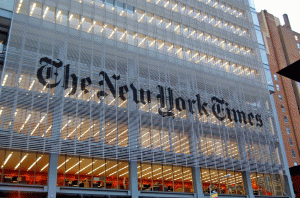
Office of The New York Times. Photo: Wiki Commons.
You may have seen some critical assessments of media coverage during the ongoing Gaza war, but you haven’t seen anything like investigative reporter Richard Behar’s comprehensive dissection at the Forbes website.
It’s an absolutely massive dissection, coming in at more than 21,000 words.
But Behar uses much of that to show specific examples of reporters failing to do their jobs in several key areas:
- By not reporting on rocket fire from civilian areas.
- By ignoring a Hamas manual discovered by Israeli troops that explains how to use civilians as protection.
- By largely ignoring a Hamas plot unraveled by Israel to use its vast tunnel network to wage a mass terrorist attack during the upcoming Jewish holidays, which could have resulted in wholesale slaughter.
- By mindlessly repeating that the “overwhelming majority” of Palestinian casualties in Gaza are civilians, based solely on Hamas-controlled Palestinian health officials, when preliminary analysis indicates it might be closer to 50/50.
“Journalism ethics professors and historians take note,” Behar writes, “You are bearing witness, with few exceptions, to some of the most abysmal overseas reporting since Hearst’s New York Journal in 1898 got us into the Spanish-American War and Walter Duranty of the New York Times was ignoring Stalin’s crimes in the 1930s.”
He puts the greatest scrutiny on failings by the New York Times, “because it is, without question, the most important media outlet in the world, in terms of setting the table each day for other outlets.”
But one of its Gaza-based correspondents, Fares Akram, has used a glowing image of the late-Palestinian Liberation Organization leader Yasser Arafat as his Facebook profile image and lauded Arafat for being among the “heights by great men.”
And Times Jerusalem Bureau Chief Jodi Rudoren dismissed a Foreign Press Association statement acknowledging foreign correspondents in Gaza were “harassed, threatened or questioned over stories or information they have reported” and that Hamas was developing a blacklist of journalists it didn’t like.
Rudoren disputed the statement on Twitter, Behar writes, and then wrote to the Press Association claiming all the reporters she knows consider the Hamas intimidation claims as an Israeli narrative that “is nonsense.”
Behar reached out to several reporters and editors who covered the war. Most wouldn’t speak, or wouldn’t speak for attribution.
“Clearly, the preponderance of the evidence is that reporters have indeed been intimidated, and that there is a reason for the intimidation—Hamas has a lot to hide,” he wrote. “The media, in other words, is part of the story. Yet this is a story that does not exist to the readers of the New York Times, which include the policymakers in Washington.”
Read Behar’s full analysis here.