 Pod Save America Hosts Call on Democrats to Cut All Israel Military Aid, No Longer Accept AIPAC Funding
 Jews, Israelis Targeted in Austria Amid Surge in Antisemitic Incidents; Local Jewish Community Calls for Action
 ‘All of Our Strength’: Over 1,000 Pro-Israel Activists Gather in DC for Solidarity Conference
 ‘Devastated’: Wesley LePatner, Killed in Manhattan Mass Shooting, Was a Jewish Communal, Philanthropic Leader
 Sen. Angus King Vows to No Longer Vote for Israel Military Aid Until Gaza Conditions Improve
 Europe Won’t Pressure Israel to ‘Commit Suicide’ Amid Gaza Backlash, Palestinian State Push, Says Israeli FM
 Israel’s National Soccer Coach Attacked in Athens Before Soccer Fans Chant ‘F–K Israel, Free Palestine’ at Match
 New York Judge Sentences Neo-Nazi to 5 Years for Livestreaming Bomb Threats Against Jewish Hospitals
 US Pressures Lebanon to Issue Cabinet Decision to Disarm Hezbollah Before Talks Continue
 UK Plans to Recognize Palestinian State in September Unless Israel Meets Conditions, Starmer Says


Report: Hezbollah-Iranian Rocket Strike Against IDF Was Part of Bigger Coming Attack
Error: Contact form not found.
 by Dave Bender

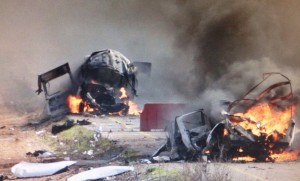
Two IDF soldiers were killed and seven others wounded in a Hezbollah rocket attack on a jeep on the Lebanon border. Photo: Ch.2 screenshot.
A lethal anti-tank rocket attack on IDF forces last Wednesday on the Lebanon border by Hezbollah was originally intended to be the opening salvo of a far-larger operation against Israel in February and March, and was not “merely” a revenge attack for an earlier Israeli strike which killed over 10 Hezbollah and Iranian military officials on Jan. 18th in Syria, Israel’s NRG News reported Sunday.
In conversation with an unnamed “European businessman,” said to hold close ties to both Hezbollah and Iranian officials, the article averred that the use of at least five highly advanced Kornet missiles by Hezbollah terrorists to hit a single patrol vehicle didn’t make sense tactically, and indicated that their presence in the area, in fact, meant a more serious operation against Israel was in the offing.
Prime Minister Benjamin Netanyahu warned that Israel would exact a heavy price for Hezbollah’s attack which took place in the Mt. Dov area and killed two soldiers and wounded seven others. In his comments on the attack near the nexus of the Israeli, Lebanese, and Syrian borders, Netanyahu warned that “Israel was prepared to operate on all fronts.”
The morning of the Hezbollah attack, the European said he called friends at Hezbollah’s headquarters in southern Beirut’s Dahiyeh quarter, but the phone rang unanswered. Later, he caught them by cellphone and was briefly told by “Ali,” that “We were asked to leave the offices yesterday. We were told to keep our calls short because the Israeli army was listening.”
From Ali’s tone, the European concluded that Hezbollah felt they were “on the verge of war,” a feeling which “came as no surprise to any party,” the businessman noted.
“Last week, after the assassination of Jihad Mughniyeh, I spoke to Iranian friends in Beirut. They are well connected – both in Beirut and in Tehran. They felt Israel knew very well who was in the convoy, and that Israel was aware of the growing trickle of Iranian Revolutionary Guards and Quds Forces on the Golan, and realized that something was brewing. From the Iranian perspective, Israel’s air strike on the convoy was intended to ‘mark a line in the sand.'”
The Guards’ commander said after Israel’s strike that they should expect “ruinous thunderbolts” in response to the attack, which killed Gen. Mohammed Ali Allah Dadi, along with noted Hezbollah operative, Jihad Mughniyeh, and some 10 others.