 Pod Save America Hosts Call on Democrats to Cut All Israel Military Aid, No Longer Accept AIPAC Funding
 Jews, Israelis Targeted in Austria Amid Surge in Antisemitic Incidents; Local Jewish Community Calls for Action
 ‘All of Our Strength’: Over 1,000 Pro-Israel Activists Gather in DC for Solidarity Conference
 ‘Devastated’: Wesley LePatner, Killed in Manhattan Mass Shooting, Was a Jewish Communal, Philanthropic Leader
 Sen. Angus King Vows to No Longer Vote for Israel Military Aid Until Gaza Conditions Improve
 Europe Won’t Pressure Israel to ‘Commit Suicide’ Amid Gaza Backlash, Palestinian State Push, Says Israeli FM
 Israel’s National Soccer Coach Attacked in Athens Before Soccer Fans Chant ‘F–K Israel, Free Palestine’ at Match
 New York Judge Sentences Neo-Nazi to 5 Years for Livestreaming Bomb Threats Against Jewish Hospitals
 US Pressures Lebanon to Issue Cabinet Decision to Disarm Hezbollah Before Talks Continue
 UK Plans to Recognize Palestinian State in September Unless Israel Meets Conditions, Starmer Says


Tribalism and the Wisdom of Sykes-Picot, in Hindsight
Error: Contact form not found.
 by David Werdiger


Map of the Middle East. Photo: Wikipedia.
The division of the former Ottoman Empire by the British and French following World War I appeared corrupt and driven by self-interest, and contributed to the ongoing conflict in the region. But with hindsight and the region now in turmoil, perhaps we should judge Sykes and Picot more favorably?
They reshaped the Middle East into a collection of regions/states that were each a diverse collection of tribes and ethnicities, ruled by the minority, as per the table below. The pattern is clear — a “divide and conquer” strategy, which all but guaranteed the repression of the majority ethnic group in each region/state.
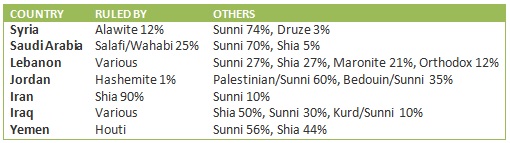
While Sykes-Picot seeded ongoing repression and violation of human rights for decades through the dictatorships that inevitably emerged, it achieved a relative state of stability for some 80 years. After the Great War, the greatest imperative was not human rights, it was avoiding another world war.
If, instead, divisions had been made largely along ethnic lines, that would likely have led to large-scale ethnic cleansing of the minorities in these newly formed “countries.” And since ethnic identity was aligned with a new national identity, this could have led to wars for regional dominance. The entire place would likely have erupted before too long.
In recent times, we have seen the attempted transition to democracy in the region.
The neoconservatives sought to transform Iraq by overthrowing Saddam Hussein in 2003, but the resultant leadership vacuum led to anarchy rather than democracy.
The so-called Arab Spring of the current decade was also hailed by starry-eyed pundits as the dawn of a new age of democracy, but again, we have seen those movements either fizzle, or be snuffed out.
The reason both failed so miserably comes down to the nature of Arab identity: the majority of the Arab world sees itself as tribal.
The journey of the West from tribalism, to feudalism, to monarchies and their empires, and finally to the modern democratic nation-state took hundreds of years, punctuated by the most bloody wars and revolutions. Could we really expect the Middle East to take a “short-cut” to democracy, either through external intervention, or social media?
We don’t know if Sykes and Picot understood the tribal nature of the Middle East, but their pragmatic approach worked far better than any of the more recent Western interventions.
What can we learn from them, and from the more recent mistakes in the region?
It is evident from the rise of Islamic State that tribal and religious identities trump any sense of national identity. National borders that have existed for decades are crumbling, and that egg cannot be unscrambled. Any stable solution to the conflict in ‘the place formerly known as Syria’ does not likely go through the Assad regime. National borders may be redrawn and new leaders may emerge to maintain stability. The development of democracy in the region still has a long time to run.
Given the low appetite of the West to directly engage, will we soon see the emergence of a move to “upgrade” ISIS to a genuine state actor with defined borders as a method of “containment”?
The sooner the West recognizes the nature of Arab tribal identity rather than superimposing its own sense of national identity and social democratic values on others, the sooner they will be equipped to deal with the full array of threats in the region.
David Werdiger is a public speaker, writer, and technology entrepreneur. You can connect with David on LinkedIn, Facebook, and Twitter.