 Pod Save America Hosts Call on Democrats to Cut All Israel Military Aid, No Longer Accept AIPAC Funding
 Jews, Israelis Targeted in Austria Amid Surge in Antisemitic Incidents; Local Jewish Community Calls for Action
 ‘All of Our Strength’: Over 1,000 Pro-Israel Activists Gather in DC for Solidarity Conference
 ‘Devastated’: Wesley LePatner, Killed in Manhattan Mass Shooting, Was a Jewish Communal, Philanthropic Leader
 Sen. Angus King Vows to No Longer Vote for Israel Military Aid Until Gaza Conditions Improve
 Europe Won’t Pressure Israel to ‘Commit Suicide’ Amid Gaza Backlash, Palestinian State Push, Says Israeli FM
 Israel’s National Soccer Coach Attacked in Athens Before Soccer Fans Chant ‘F–K Israel, Free Palestine’ at Match
 New York Judge Sentences Neo-Nazi to 5 Years for Livestreaming Bomb Threats Against Jewish Hospitals
 US Pressures Lebanon to Issue Cabinet Decision to Disarm Hezbollah Before Talks Continue
 UK Plans to Recognize Palestinian State in September Unless Israel Meets Conditions, Starmer Says


The Guardian and the Telegraph: Creating a ‘Safe Space’ for Anti-Zionists?
Error: Contact form not found.
 by Adam Levick


Jeremy Corbyn addresses Labour Friends of Israel, vexing one heckler for failing to mention “Israel” by name. Photo: Screenshot
British media reports on the ongoing antisemitism scandal plaguing the Labour Party have been largely unproblematic, and quite unsympathetic to those attempting to rationalize or defend expressions of anti-Jewish racism by party members.
However, the latest story, involving the suspension of former London Mayor Ken Livingstone for arguing that Adolf Hitler was a Zionist, inspired an official Guardian editorial on the row that indicated that editors do not understand — or aren’t willing to acknowledge — what the term “anti-Zionism” actually means. The editorial (‘The Guardian view on antisemitism: Stay vigilant on the left flank, April 28) included the following passages, which attempt to distinguish between legitimate criticism of Israel and antisemitism:
Most people committed to justice for the Palestinians are more than capable of distinguishing between opposition to the Israeli state and hatred of the Jews, but the placards sometimes seen on demos – equating a swastika with the star of David, for example – suggest that some campaigners don’t. The post-1967 occupation needs to be condemned, and it is not in and of itself illegitimate even to question the original creation of Israel. It is, however, never legitimate to discuss the conflict without taking seriously the rights and claims of the people on the Israeli as well as the Palestinian side.
While nobody would accuse critics of the occupation of being antisemitic, the editorial defends those who “question the original creation of Israel” — a muddled characterization of the views of those who consider themselves anti-Zionist.
Similarly, The Telegraph, in a recent article (“Anti-Semitism and anti-Zionism: what’s the difference?”, April 29) attempts to define “anti-Zionism” by a series of bullet points meant to provide an understanding of what the word “Zionism” means:
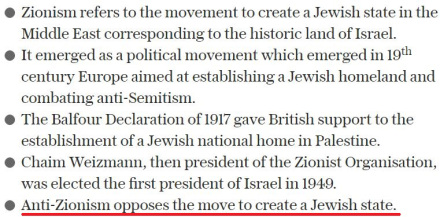
The Telegraph, as with the Guardian, strangely defines “anti-Zionism” through the prism of what the term meant prior to 1948, before the state of Israel actually existed.
However, anti-Zionism does not represent opposition to the historical process by which Israel was created 68 years go, and it is not a theoretical discussion. Rather, anti-Zionism today necessarily refers to opposition to the continued existence of the actual Jewish State within any borders — a position that the overwhelming majority of British Jews, and most Britons of all religions (per a recent YouGov poll), understandably consider a form of antisemitism.
If either paper wants to create a “safe space” for anti-Zionists, at the very least they can begin by being honest about what the term actually means today, and what the position would ultimately mean to millions of Jews in the existing Jewish state.