 Pod Save America Hosts Call on Democrats to Cut All Israel Military Aid, No Longer Accept AIPAC Funding
 Jews, Israelis Targeted in Austria Amid Surge in Antisemitic Incidents; Local Jewish Community Calls for Action
 ‘All of Our Strength’: Over 1,000 Pro-Israel Activists Gather in DC for Solidarity Conference
 ‘Devastated’: Wesley LePatner, Killed in Manhattan Mass Shooting, Was a Jewish Communal, Philanthropic Leader
 Sen. Angus King Vows to No Longer Vote for Israel Military Aid Until Gaza Conditions Improve
 Europe Won’t Pressure Israel to ‘Commit Suicide’ Amid Gaza Backlash, Palestinian State Push, Says Israeli FM
 Israel’s National Soccer Coach Attacked in Athens Before Soccer Fans Chant ‘F–K Israel, Free Palestine’ at Match
 New York Judge Sentences Neo-Nazi to 5 Years for Livestreaming Bomb Threats Against Jewish Hospitals
 US Pressures Lebanon to Issue Cabinet Decision to Disarm Hezbollah Before Talks Continue
 UK Plans to Recognize Palestinian State in September Unless Israel Meets Conditions, Starmer Says


Jews Must Be in Constant Dialogue With Our Past
Error: Contact form not found.
 by Pini Dunner

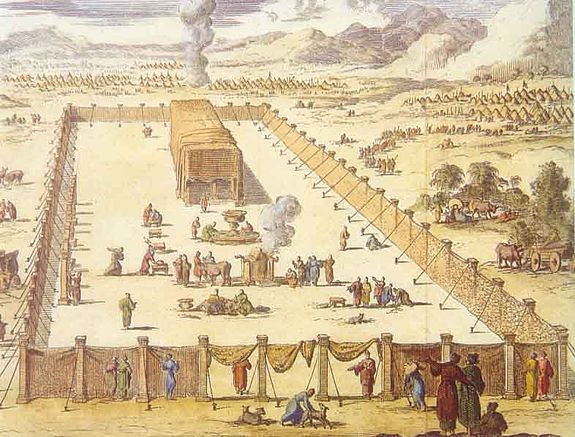
Terumah. Photo: Wikipedia.
One of the most significant pioneers of psychology in the 20th century was a German-Jewish immigrant to the US named Kurt Lewin. He was born in the obscure Prussian town of Mogilno, but his family later moved to Berlin, where Lewin attended prestigious schools and excelled in his studies. He studied at the University of Freiburg, and then at Munich University, where his PhD supervisor was Professor Carl Stumpf, the polymath genius who — among other things — proved the existence of the “Clever Hans” phenomenon.
After the Nazis came to power in 1933, Lewin — who had been teaching philosophy and psychology at the University of Berlin — moved to the United States. There, he worked at various universities and academic research centers, and conducted various groundbreaking studies, including the “change experiment” program, which resulted in the concept of “sensitivity training.”
I would particularly like to highlight Lewin’s involvement with the “Gestalt” school of psychology, which famously proposed that “the whole is other than the sum of its parts” (not “greater,” as it is always mistranslated), and also his advocacy for the “interaction” school of sociology.
In 1936, Lewin published a seminal book titled Principles of Topological Psychology. In it, he proposed the idea that it was a combination of the person and their environment that produced their reaction to a given situation — and therefore, that no two people would react in the same way to an event or situation.
Lewin introduced dynamism, even instability, into psychological evaluation — and posited that we are always trying to return to a state of equilibrium.
The thing is, Lewin’s idea was not actually as revolutionary as he might have thought. Why? Because we already knew it — from Jewish history.
Jewish nationhood began with the redemption of a slave population from ancient Egypt some 3,500 years ago, and the continued existence of this self-identifying group over millennia seemingly defies explanation. But perhaps, using Lewin’s equation, our survival can be understood as the success of a “whole that is other than the sum of its parts.”
Every group that has ever existed has had definitive historical moments that are crucial components of its identity. To commemorate these moments, all groups develop rituals and cultural triggers — in order to perpetuate their identity.
The Jewish people are no different from any other in this respect. The formative moments in our collective history – the redemption from Egypt, the miracle of the Red Sea and the revelation at Sinai – if they were to be effective, had to be imprinted on our psyche in order for our identity to be preserved.
The problem is that relying on anniversary events or the use of historical literature is ineffective, or at least unreliable. Unless the present is dynamic, no identity can maintain its hold on any group. And dynamism — the fact that we are in constant motion — is bound to negate the past, or at best reduce it to a revered relic.
This week’s portion, Terumah, describes the creation of a sanctuary that will be the ever-present focal point of God’s presence among us, a concept that was introduced to us at Sinai. Together with last week’s portion, Mishpatim — which delivers day-to-day objectives of social justice, but in such a way that only dynamic and fluid interpretation of them can keep those objectives relevant — these parshas hold the key to the success of Jewish nationhood and religious identity over thousands of years.
Creating an environment that genuinely reveres the past while effectively embracing the present is a very hard dance to learn. God’s promise to us, in Terumah, is: “If you make Me a sanctuary, I will reside within you.”
In other words, God has given us a momentous start, and the dynamic process to keep it alive. The rest is up to us.





