 Pod Save America Hosts Call on Democrats to Cut All Israel Military Aid, No Longer Accept AIPAC Funding
 Jews, Israelis Targeted in Austria Amid Surge in Antisemitic Incidents; Local Jewish Community Calls for Action
 ‘All of Our Strength’: Over 1,000 Pro-Israel Activists Gather in DC for Solidarity Conference
 ‘Devastated’: Wesley LePatner, Killed in Manhattan Mass Shooting, Was a Jewish Communal, Philanthropic Leader
 Sen. Angus King Vows to No Longer Vote for Israel Military Aid Until Gaza Conditions Improve
 Europe Won’t Pressure Israel to ‘Commit Suicide’ Amid Gaza Backlash, Palestinian State Push, Says Israeli FM
 Israel’s National Soccer Coach Attacked in Athens Before Soccer Fans Chant ‘F–K Israel, Free Palestine’ at Match
 New York Judge Sentences Neo-Nazi to 5 Years for Livestreaming Bomb Threats Against Jewish Hospitals
 US Pressures Lebanon to Issue Cabinet Decision to Disarm Hezbollah Before Talks Continue
 UK Plans to Recognize Palestinian State in September Unless Israel Meets Conditions, Starmer Says


Balfour Declaration Respresented ‘Hope for Mankind,’ Says Ex-Secretary of State Kissinger
Error: Contact form not found.
 by Algemeiner Staff

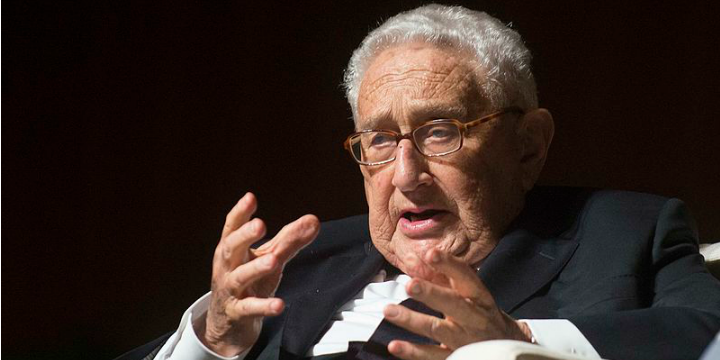
Former Secretary of State Henry Kissinger. Photo: Wikimedia Commons.
Former US Secretary of State Henry Kissinger has described the 1917 issuance of the Balfour Declaration — in which Britain promised the Jewish people a “national home” in Palestine — as an event of global historical importance.
In an op-ed published by The Jewish Chronicle to mark Thursday’s centenary of the declaration, Kissinger — the author of several books on statecraft and diplomacy — said that the late Lord Arthur Balfour’s undertaking had contributed to “peace in the world and hope for mankind.”
“The Balfour Declaration’s importance transcended its immediate objectives,” Kissinger wrote. “It became a founding document of an emerging world order.”
He continued:
If there is a “hinge of history” on which the modern concepts of world order turned, it was the years just before, during, and after the First World War. The Balfour Declaration is at the core of that transformation.
What made the Balfour Declaration so consequential? The period was shaped by the deterioration and collapse of dynastic empires. The 1912 Chinese revolution which overthrew the Qing dynasty initiated the process. The Ottoman Empire was described as the “sick man of Europe,” as it moved toward its collapse. By the time the war ended, the Tsarist, Austro-Hungarian, and German dynasties had also disappeared.
The modern international state system, inaugurated by the Treaty of Westphalia in 1648, sought to establish the state as the fundamental entity of world affairs. Dynasties are based on a concept of loyalty to a family. States reflect a legal concept. They function as legal entities and express a legitimacy. The transition was gradual. The Great War can be seen as a last contest between dynastic empires.
In the early years of the war, Britain saw Palestine — then part of the Ottoman Empire — as geostrategically important because of its proximity to Germany’s Berlin-Baghdad Railway, to the Suez Canal, to Arabian Gulf oil and as a bridge between Asia and Africa.
Kissinger noted:
The Balfour Declaration was issued with the State of Israel as the assumed eventuality. Balfour told Churchill that “by the Declaration they (the Foreign Office) always meant an eventual Jewish state.” This assumption was institutionalized in the Mandate System, which imposed upon the victorious powers, most notably the British Empire, the responsibility to prepare the peoples of the mandate for statehood.
He concluded:
The basic challenge of our period is twofold: to ensure the legitimacy of existing states as a basic premise; and to contribute to the settlement of their disputes by peaceful means.
In the end, then, the importance of the Balfour Declaration resides not only in establishing a homeland for a people, but in contributing to peace in the world and hope for mankind.