 Pod Save America Hosts Call on Democrats to Cut All Israel Military Aid, No Longer Accept AIPAC Funding
 Jews, Israelis Targeted in Austria Amid Surge in Antisemitic Incidents; Local Jewish Community Calls for Action
 ‘All of Our Strength’: Over 1,000 Pro-Israel Activists Gather in DC for Solidarity Conference
 ‘Devastated’: Wesley LePatner, Killed in Manhattan Mass Shooting, Was a Jewish Communal, Philanthropic Leader
 Sen. Angus King Vows to No Longer Vote for Israel Military Aid Until Gaza Conditions Improve
 Europe Won’t Pressure Israel to ‘Commit Suicide’ Amid Gaza Backlash, Palestinian State Push, Says Israeli FM
 Israel’s National Soccer Coach Attacked in Athens Before Soccer Fans Chant ‘F–K Israel, Free Palestine’ at Match
 New York Judge Sentences Neo-Nazi to 5 Years for Livestreaming Bomb Threats Against Jewish Hospitals
 US Pressures Lebanon to Issue Cabinet Decision to Disarm Hezbollah Before Talks Continue
 UK Plans to Recognize Palestinian State in September Unless Israel Meets Conditions, Starmer Says


Moving the Embassy Might Not Be a Big Deal After All
Error: Contact form not found.
 by Erris Langer Klapper

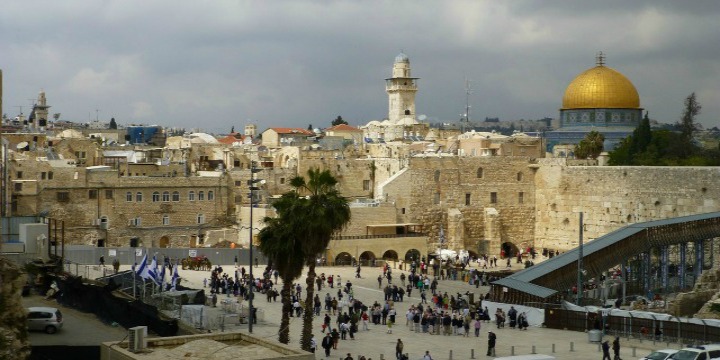
The Western Wall and Temple Mount in Jerusalem. Photo: Wikimedia Commons.
After the historic and long overdue announcement declaring Jerusalem as the capital of Israel, a friend asked me: “Why the controversy?”
“Isn’t Jerusalem already the capital of Israel?” he asked.
Well, yes. Yes it is.
I had no idea how I would begin to answer that loaded question. Would I start by telling him that moving the embassy is about 70 years overdue? Technically, that’s not exactly correct, so I’d have to start with some history.
Perhaps I should clarify that while Israel officially gained its independence 70 years ago, there has been a continuous Jewish presence there for thousands of years — despite foreign invaders and rule. Surely 3,000 years is long enough to wait for a homeland.
Would he be interested to know that the US embassy in Tel Aviv is the only US embassy in the world not located in a sovereign nation’s capital? Weird, huh?
I should probably add that both former presidents George W. Bush and Bill Clinton vowed to move the embassy, but never did — despite Congress approving such a move in 1995.
I guess I’d have to provide some history and context, and explain that the 1947 UN partition plan envisioned Jerusalem as an international city — but when Israel was attacked in 1948, the war left Jerusalem a divided city.
The famous Green Line granted Jordan control over the eastern half, and Israel control of the western half. In 1967, Israel was attacked yet again and regained control over the eastern half of the city, which happened to include the much-contested Old City.
Doesn’t every single autonomous country have the right to not only determine its capital, but also to expect that the international community respect that decision?
Many warned that Trump’s announcement would incite violence. But should we let threats of violence stop us from doing what’s right, and coerce us into bowing to pressure and extremist blackmail?
For 22 years, US presidents have shied away from following through on Congress’ approval of the embassy move — simply in the interest of appeasement and avoiding violence. But violence, incitement and terrorism have not stopped in the last 22 years — often, they’ve only grown worse. And since then — with the US embassy in Tel Aviv — we are no closer to a peaceful solution.
How much longer should Israel have to put up with obvious disparate treatment by world nations, and wait for a declaration that was long overdue?
Thinking that Trump’s announcement is what will delay the peace process is an unrealistic distraction from the complexities and realities of the region.
So while I ponder how to explain to my friend what all the controversy is about, I can’t help but feel that — in some ways — it’s no big deal at all. Keeping the embassy in Tel Aviv has not brought peace, and moving it to Jerusalem will not be the real obstacle to peace.
And if my friend asks me what the real obstacle is, I’ll have to deflect that discussion to another day — and keep hoping that peace will become a reality in my lifetime.