 Pod Save America Hosts Call on Democrats to Cut All Israel Military Aid, No Longer Accept AIPAC Funding
 Jews, Israelis Targeted in Austria Amid Surge in Antisemitic Incidents; Local Jewish Community Calls for Action
 ‘All of Our Strength’: Over 1,000 Pro-Israel Activists Gather in DC for Solidarity Conference
 ‘Devastated’: Wesley LePatner, Killed in Manhattan Mass Shooting, Was a Jewish Communal, Philanthropic Leader
 Sen. Angus King Vows to No Longer Vote for Israel Military Aid Until Gaza Conditions Improve
 Europe Won’t Pressure Israel to ‘Commit Suicide’ Amid Gaza Backlash, Palestinian State Push, Says Israeli FM
 Israel’s National Soccer Coach Attacked in Athens Before Soccer Fans Chant ‘F–K Israel, Free Palestine’ at Match
 New York Judge Sentences Neo-Nazi to 5 Years for Livestreaming Bomb Threats Against Jewish Hospitals
 US Pressures Lebanon to Issue Cabinet Decision to Disarm Hezbollah Before Talks Continue
 UK Plans to Recognize Palestinian State in September Unless Israel Meets Conditions, Starmer Says


Aharon Appelfeld, Acclaimed Israeli Novelist and Holocaust Survivor, Dies at 85
Error: Contact form not found.
 by Reuters and Algemeiner Staff

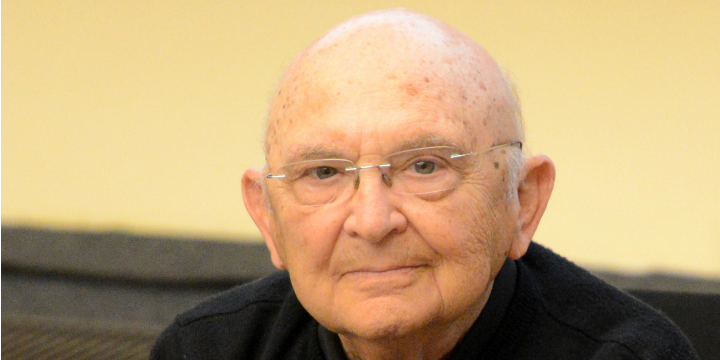
Aharon Appelfeld. Photo: Wikimedia Commons.
Aharon Appelfeld, a prolific Israeli novelist and Holocaust survivor whose works examined the lost world of European Jews and the new lives they pursued in Israel, died on Thursday. He was 85.
Writing in Hebrew, the Romanian-born Appelfeld penned more than 40 books and was one of Israel’s most widely translated authors.
Appelfeld’s Blooms of Darkness, the tale of an 11-year-old boy hidden from the Nazis by a prostitute, won the Independent Foreign Fiction Prize in London in 2012. Appelfeld was also awarded the State of Israel Prize for Literature in 1983 and was a Man Booker International Prize finalist in 2013.
Israeli President Reuven Rivlin, on Twitter, expressed sorrow “about the passing of our beloved writer.”
Amos Oz, one of Israel’s most prominent novelists, said on Army Radio that Appelfed shied away from graphic depictions of the Holocaust, choosing instead to describe its effect on the lives of his characters.
“Appelfeld never wrote about gas chambers, never wrote about executions, about mass graves, atrocities and experiments on human beings. He wrote about survivors before and after. He wrote about people who did not know what was about to happen to them and about people who already knew everything but hardly spoke about it,” Oz said.
“He didn’t want, or he was unable, to write depictions of the horrors — he said that too. They are beyond the ability of human language to express them. You have to approach them indirectly, tiptoeing from afar,” said Oz, once Appelfeld’s student in a kibbutz.
Appelfeld was a young boy when his mother was killed by the Nazis. He and his father were sent to a concentration camp in Transnistria in an area of Ukraine then under control of the German-allied Romanian forces. Aged 10 at the time, he escaped and spent three years hiding in forests in Ukraine.
“I survived in the fields and forests. Sometimes I worked as a shepherd or taking care of broken-down horses,” he told The New York Times in 1986. “I lived with marginal people during the war — prostitutes, horse thieves, witches, fortune tellers. They gave me my real education.”
After the war, he immigrated to Israel — he learned Hebrew beforehand — and when he was 28 he discovered that his father had survived and they were reunited in Israel.
“Even though I spent time on kibbutzim that tried to change me, I did not change. I remained, basically, the Jewish refugee child who survived,” he said in an interview with Israel’s Haaretz newspaper in 2015.
American-Jewish author Philip Roth once described Appelfeld as a “displaced writer of displaced fiction, who made displacement and disorientation a subject uniquely his own.”
Works by Appelfeld translated into English include Badenheim 1939 (1978), a tale set in a fictional Austrian resort on the eve of World War Two, and The Immortal Bartfuss (1988), a fictional portrait of a troubled survivor in Israel.