 Pod Save America Hosts Call on Democrats to Cut All Israel Military Aid, No Longer Accept AIPAC Funding
 Jews, Israelis Targeted in Austria Amid Surge in Antisemitic Incidents; Local Jewish Community Calls for Action
 ‘All of Our Strength’: Over 1,000 Pro-Israel Activists Gather in DC for Solidarity Conference
 ‘Devastated’: Wesley LePatner, Killed in Manhattan Mass Shooting, Was a Jewish Communal, Philanthropic Leader
 Sen. Angus King Vows to No Longer Vote for Israel Military Aid Until Gaza Conditions Improve
 Europe Won’t Pressure Israel to ‘Commit Suicide’ Amid Gaza Backlash, Palestinian State Push, Says Israeli FM
 Israel’s National Soccer Coach Attacked in Athens Before Soccer Fans Chant ‘F–K Israel, Free Palestine’ at Match
 New York Judge Sentences Neo-Nazi to 5 Years for Livestreaming Bomb Threats Against Jewish Hospitals
 US Pressures Lebanon to Issue Cabinet Decision to Disarm Hezbollah Before Talks Continue
 UK Plans to Recognize Palestinian State in September Unless Israel Meets Conditions, Starmer Says


Photo With New York Times Israel Article Suggests Reporter Got It Wrong
Error: Contact form not found.
 by Ira Stoll

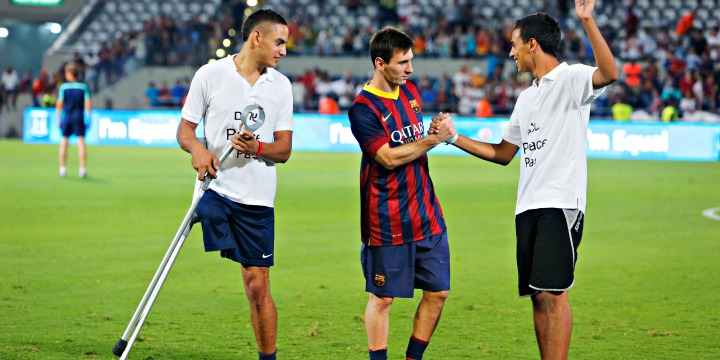
Argentine soccer legend Lionel Messi with Asael Shalbo (l), an Israeli, and Mohammad Roman (r), a Palestinian, after a joint training session for Jewish and Arab youths at Tel Aviv’s Bloomfield Stadium in August 2013. Photo: Reuters/Nir Elias.
Here’s a case of flawed reporting on the Israeli-Arab conflict from, of all cases, the sports section of the New York Times.
“Argentina-Israel Soccer Game Canceled Over Playing In Jerusalem,” is the headline over the dispatch from Buenos Aires by Daniel Politi.
It reports, in part, “President Trump this spring moved the United States Embassy there from Tel Aviv and recognized Jerusalem as Israel’s capital, angering Palestinians who hope to see the eastern part of the city become the capital of a future Palestinian state.”
My print edition of the Times illustrated the article with a Getty Images photograph of a sign in Hebron. The sign included a picture of the star Argentine soccer player Lionel Messi with the words, “Warning. You are about to enter an occupied land! Stand up for human rights! Jerusalem is the capital of Palestine.”
The sign in the photo doesn’t say “eastern Jerusalem.” It just says “Jerusalem,” suggesting that to the degree Palestinians are indeed “angry” about this, it isn’t merely because of their own hopes for the eastern part of the city, but because they want to deny Israel sovereignty over any of the city.
The Times goes on, and quotes people going on, about the potential “security issues,” and “fear” by the Argentine soccer players that “their lives were at risk.” It doesn’t remark on the irony of Argentinians feeling at risk in Israel. Jews and Israelis in Argentina — and the prosecutor investigating their murders — had not just an imaginary risk, but actual risks. Twenty-nine people were killed in the 1992 bombing of the Israeli embassy in Argentina, 85 people were killed in the 1994 bombing of the AMIA Jewish community center in Buenos Aires. And in 2015, prosecutor Alberto Nisman, who was investigating Iran’s role in the AMIA bombing and what Argentine politicians knew about it, was murdered.
So the idea that the Argentines are afraid to go to Israel is really something. If anyone should be afraid to go anywhere, it’s not to Israel, but to Argentina. The soccer players are probably safer in Israel. Not that the Times mentions any of that context.
More of Ira Stoll’s media critique, a regular Algemeiner feature, can be found here.