 Pod Save America Hosts Call on Democrats to Cut All Israel Military Aid, No Longer Accept AIPAC Funding
 Jews, Israelis Targeted in Austria Amid Surge in Antisemitic Incidents; Local Jewish Community Calls for Action
 ‘All of Our Strength’: Over 1,000 Pro-Israel Activists Gather in DC for Solidarity Conference
 ‘Devastated’: Wesley LePatner, Killed in Manhattan Mass Shooting, Was a Jewish Communal, Philanthropic Leader
 Sen. Angus King Vows to No Longer Vote for Israel Military Aid Until Gaza Conditions Improve
 Europe Won’t Pressure Israel to ‘Commit Suicide’ Amid Gaza Backlash, Palestinian State Push, Says Israeli FM
 Israel’s National Soccer Coach Attacked in Athens Before Soccer Fans Chant ‘F–K Israel, Free Palestine’ at Match
 New York Judge Sentences Neo-Nazi to 5 Years for Livestreaming Bomb Threats Against Jewish Hospitals
 US Pressures Lebanon to Issue Cabinet Decision to Disarm Hezbollah Before Talks Continue
 UK Plans to Recognize Palestinian State in September Unless Israel Meets Conditions, Starmer Says


Analyzing the Austrian Chancellor’s Visit to Israel
Error: Contact form not found.
 by Manfred Gerstenfeld

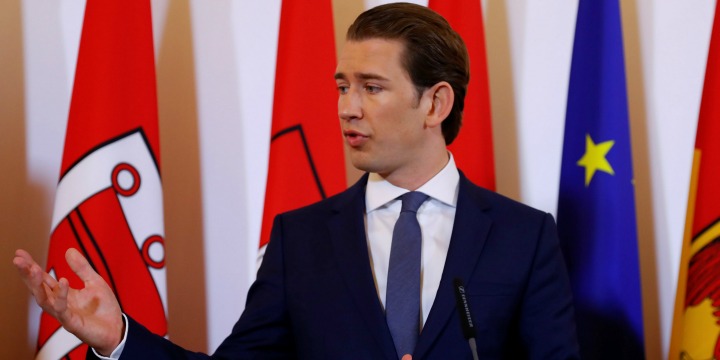
Austrian Chancellor Sebastian Kurz attends a news conference in Vienna, Austria June 8, 2018. Photo: REUTERS/Leonhard Foeger.
Far too little attention has been paid to the importance of Sebastian Kurz’s first visit as Austrian chancellor to Israel. This 31-year-old politician is the leader of the right-of-center Austrian People’s Party (ÖVP). And if his statements and actions were typical for all visiting heads of European countries, Israel’s position in Europe would be much stronger.
At Yad Vashem, Kurz admitted the heavy responsibility of Austria and the Austrians for “shameful crimes committed during the Shoah.” He paid a private visit to the Western Wall. He also encouraged the populist Freedom Party of Austria (FPÖ), the junior partner of the ÖVP, to take a stand against antisemitism in order to join the government. Still, Israel remains skeptical of the FPÖ, since it has neo-Nazi roots.
During his visit, Kurz didn’t ask for Israel to establish contacts with the FPÖ ministers. And he was right not to. Israel is not applying a double standard here, because it also does not receive Swedish socialist Foreign Minister Margot Wallström, who is part-time antisemitic and anti-Israel.
During his visit, Kurz did not explicitly mention Muslim antisemitism, but said, “I can assure you that Austria will fight all forms of antisemitism in Europe with determination — be it an existing one or newly imported antisemitism.” Kurz’s statements are all the more important because he is looking for a higher Austrian profile in the EU than many of his predecessors.
Austria, having become part of Germany in 1938, willingly participated in the Holocaust, and many of its post-war leaders seriously distorted the country’s horrific history, presenting the country as the first victim of German Nazism. It was Austrian Chancellor Franz Vranitzky — the socialist party (SPÖ) leader — who admitted the truth for the first time in 1991.
One of Austria’s greatest post-war scandals was the responsibility of Alois Mock, an earlier ÖVP leader. He proposed former UN Secretary General Kurt Waldheim as the party’s candidate for the 1986 Austrian presidential elections. It was then already known that Waldheim had belonged to a Nazi student organization and a mounted riders group of the paramilitary SA Nazi organization.
Waldheim left out crucial elements of his war-time service in his biography. During one period, for example, he had been an adjudant to the Austrian General Alexander Löhr in Yugoslavia, who was executed in 1947 as a war criminal. Nor did Waldheim mention his posting in Saloniki during the period when the large Jewish population there was rounded up and sent to a death camp. He later said that he had not noticed this happening. Nonetheless, Waldheim was elected by the Austrian people. During his presidency, he would often speak about morals and values.
But post-war problems concerning Jews in Austria were not limited to the ÖVP. Socialist Chancellor Bruno Kreisky was also at the forefront of rehabilitating former Nazis. In my view, he was a self-hating Jew. All this gives perspective on the radically different positions currently expressed by Kurz.
There is one related aspect that should also be mentioned. The World Jewish Congress (WJC) led the campaign against Waldheim and was responsible for many disclosures about his past. This small organization — greatly maligned by Mock — ran a masterly campaign. The WJC later succeeded in ensuring that Waldheim was not allowed to enter the US. He also was not invited to visit by other Western countries during his presidency. The successful WJC campaign contrasts greatly with the frequent clumsiness of the Israeli government’s actions against its detractors.
Dr. Manfred Gerstenfeld is the emeritus chairman of the Jerusalem Center for Public Affairs think tank. The author was given the Lifetime Achievement Award by the Journal for the Study of Antisemitism and the International Leadership Award by the Simon Wiesenthal Center.