 Pod Save America Hosts Call on Democrats to Cut All Israel Military Aid, No Longer Accept AIPAC Funding
 Jews, Israelis Targeted in Austria Amid Surge in Antisemitic Incidents; Local Jewish Community Calls for Action
 ‘All of Our Strength’: Over 1,000 Pro-Israel Activists Gather in DC for Solidarity Conference
 ‘Devastated’: Wesley LePatner, Killed in Manhattan Mass Shooting, Was a Jewish Communal, Philanthropic Leader
 Sen. Angus King Vows to No Longer Vote for Israel Military Aid Until Gaza Conditions Improve
 Europe Won’t Pressure Israel to ‘Commit Suicide’ Amid Gaza Backlash, Palestinian State Push, Says Israeli FM
 Israel’s National Soccer Coach Attacked in Athens Before Soccer Fans Chant ‘F–K Israel, Free Palestine’ at Match
 New York Judge Sentences Neo-Nazi to 5 Years for Livestreaming Bomb Threats Against Jewish Hospitals
 US Pressures Lebanon to Issue Cabinet Decision to Disarm Hezbollah Before Talks Continue
 UK Plans to Recognize Palestinian State in September Unless Israel Meets Conditions, Starmer Says


How the Syrian War Could Still Threaten Israel
Error: Contact form not found.
 by Yoav Limor / JNS.org

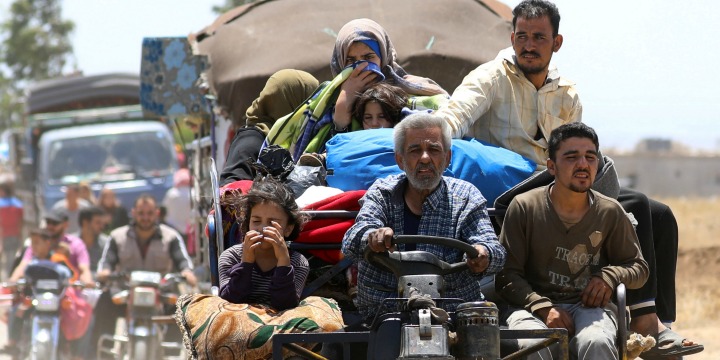
Internally displaced people from Deraa province arrive in Quneitra, Syria, near the border with Israel’s Golan Heights, June 29, 2018. Photo: Reuters / Alaa Al-Faqir / File.
JNS.org – The headlines trickling down from Israel’s northern sector near Syrian are far more dramatic than the situation on the ground: The Syrian army has yet to launch a full-scale offensive on rebel forces along the border; the influx of Syrian refugees has yet to turn into an uncontrollable flood; and the reinforcement of IDF troops on the Israel-Syria border is still relatively minor.
But make no mistake. The situation on the northern border is highly volatile, and could quickly go south. Recent bombardments indicate that Syrian President Bashar Assad plans to retake control of the Daraa area on the Jordanian border, and then turn his attention to the rebel pockets on the Syrian Golan Heights, a stone’s throw away from the border with Israel.
It is likely, however, that he will not launch a major offensive before the end of the World Cup, or at least not before Russia is eliminated from the tournament. In any event, the Helsinki summit between Donald Trump and Vladimir Putin, which will focus on Syria, has been set for July 16.
In the meantime, Assad is trying to pressure the rebels, and perhaps drive them to flee or surrender. The rebels, for their part, are trying to improve their positions, and the changes in their deployment can be clearly seen along the border with Israel — likely driven by the assumption that Syria will be wary of acting too close to the frontier so as not to risk a confrontation with Israel.
It is doubtful that this possibility will deter Syria, if nothing else because of the clear message Israel has sent it: that it will enforce the 1974 cease-fire agreement. In other words, Israel has made it clear that the fighting is an internal Syrian issue and Israel will not fight for any rebel or refugee.
To avoid appearing completely passive, Israel deployed armored and artillery forces along its border with Syria on Sunday, with aim of deterring the Syrian army from violating the 1974 agreement, by ordering the mass deployment of troops on the Golan Heights. But this move also sought to warn Iran against entertaining the idea of exploiting the Syrian army’s reoccupation of the territory to plant its militias near the Israeli border.
Recent conversations between Israeli Defense Minister Avigdor Lieberman and his Russian counterpart Sergei Shoigu, and the meeting held by IDF Chief of Staff Lt. Gen. Gadi Eizenkot with US Chairman of the Joint Chiefs of Staff Gen. Joseph Dunford in Washington sought to coordinate this issue and clarify Israel’s position — yes to the return of the Syrian army to the Golan Heights; no to any Iranian presence in the area, even if it means a military confrontation.
Israeli defense officials believe that the Syrian army’s takeover of the area will be fast, albeit not necessarily easy. Therefore, it is unlikely that the IDF would be able to remain on the fence, figuratively and literally, should intense fighting erupt on the Golan Heights, certainly if rebel groups take desperate measures to provoke the IDF into action, and against the backdrop of the masses of refugees who may seek sanctuary in Israel.
The Israeli leadership has already made it clear that it will supply Syrian refugees with humanitarian aid, but will not grant them entry into its territory. But as the fighting intensifies and with it the flood of horrific images from Syria, the call to do something more will surely grow louder.
It is in Israel’s interest to get through the next few weeks without military entanglement in the north. Once the dust settles, Israel will once again be dealing with one person in charge.
Assad may emerge from the fighting weaker but, he still enjoys Russia and Iran’s backing. The latter is sure to look for every way possible to undermine the stability that has prevailed along the border for four decades. Israel is bracing for this possibility, knowing that the volatility in the area will peak in the near future.
Yoav Limor is a veteran Israeli journalist and columnist for Israel Hayom.





