 Pod Save America Hosts Call on Democrats to Cut All Israel Military Aid, No Longer Accept AIPAC Funding
 Jews, Israelis Targeted in Austria Amid Surge in Antisemitic Incidents; Local Jewish Community Calls for Action
 ‘All of Our Strength’: Over 1,000 Pro-Israel Activists Gather in DC for Solidarity Conference
 ‘Devastated’: Wesley LePatner, Killed in Manhattan Mass Shooting, Was a Jewish Communal, Philanthropic Leader
 Sen. Angus King Vows to No Longer Vote for Israel Military Aid Until Gaza Conditions Improve
 Europe Won’t Pressure Israel to ‘Commit Suicide’ Amid Gaza Backlash, Palestinian State Push, Says Israeli FM
 Israel’s National Soccer Coach Attacked in Athens Before Soccer Fans Chant ‘F–K Israel, Free Palestine’ at Match
 New York Judge Sentences Neo-Nazi to 5 Years for Livestreaming Bomb Threats Against Jewish Hospitals
 US Pressures Lebanon to Issue Cabinet Decision to Disarm Hezbollah Before Talks Continue
 UK Plans to Recognize Palestinian State in September Unless Israel Meets Conditions, Starmer Says


Amid Condemnation of Israel at Triannual Convention, Episcopal Church Rejects Divestment Resolution
Error: Contact form not found.
 by Algemeiner Staff

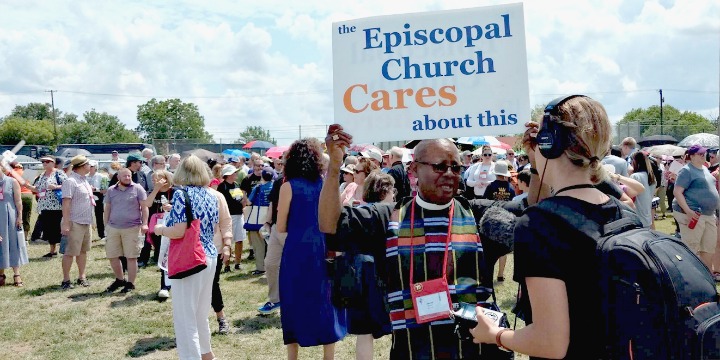
The Episcopal Church’s 2018 General Convention in Austin, Texas. Photo: Episcopal Diocese of North Carolina.
Amid a slew of anti-Israel resolutions at the 2018 General Convention of the Episcopal Church this week, a proposal to divest from Israel’s “occupation” of the West Bank and eastern Jerusalem was roundly rejected by the church’s governing House of Bishops.
Wednesday’s vote at the Convention in Austin, Tx., put “to rest for at least another three years one of the church’s most divisive issues,” the Episcopal News Service (ENS) reported.
The proposal to divest from Israel was initially adopted by a hefty 74 percent vote in the church’s House of Deputies – in effect, a lower chamber whose resolutions are then considered by the House of Bishops. Among the 300 Episcopal bishops, however, the response was far less enthused, with 62 percent of members rejecting the divestment call.
Significantly, some pro-Palestinian bishops admitted to having second thoughts about divestment as a strategy.
Speaking to the ENS, Bishop J. Scott Barker of Nebraska acknowledged “the unendurable weight shouldered by the Palestinians who live under Israeli occupation” but also warned against the “widespread” insistence among Palestinians that Israel has no right to exist.
“I would be all for proactive investment in the Palestinian territories … but actions to boycott, divest from or sanction Israel alone as the antagonist in this story no longer makes sense to me,” Barker said. “That for me is an oversimplification of a complex reality.”
But while Jewish organizations praised the church’s rejection of the divestment initiative, concern remains over the other resolutions targeting Israel. One highlighted Israel’s alleged abuse of Palestinian children, another its alleged denial of Palestinian civil rights. In a further separate resolution, Episcopal Church members were urged to campaign for public awareness of “how the policies of the Israeli government toward Palestinians contribute to a state of militarization and apartheid.”
Emily Soloff, the American Jewish Committee’s associate director of interreligious and intergroup relations, said in a statement that while her organization “commended” the Episcopal Church for rejecting divestment, “we are concerned that unbalanced anti-Israel voices were championed through several highly problematic resolutions.”
Yet Israel’s defenders were visible and audible on the convention floor. At a House of Deputies debate on a resolution condemning Israel for allegedly deploying “lethal force” against “Palestinian civilians,” William Murchison, a deputy from the Diocese of Dallas, spoke out forcefully on the Jewish state’s behalf.
“The mood of the house is to beat up on Israel, to beat it to a pulp, and to make excuses for its adversaries and its sworn enemies,” Murchison said. “The Israelis are under threat from Hamas and Hezbollah, but do we hear anything from the Episcopal Church calling attention to or alarm to those threats?”