 Pod Save America Hosts Call on Democrats to Cut All Israel Military Aid, No Longer Accept AIPAC Funding
 Jews, Israelis Targeted in Austria Amid Surge in Antisemitic Incidents; Local Jewish Community Calls for Action
 ‘All of Our Strength’: Over 1,000 Pro-Israel Activists Gather in DC for Solidarity Conference
 ‘Devastated’: Wesley LePatner, Killed in Manhattan Mass Shooting, Was a Jewish Communal, Philanthropic Leader
 Sen. Angus King Vows to No Longer Vote for Israel Military Aid Until Gaza Conditions Improve
 Europe Won’t Pressure Israel to ‘Commit Suicide’ Amid Gaza Backlash, Palestinian State Push, Says Israeli FM
 Israel’s National Soccer Coach Attacked in Athens Before Soccer Fans Chant ‘F–K Israel, Free Palestine’ at Match
 New York Judge Sentences Neo-Nazi to 5 Years for Livestreaming Bomb Threats Against Jewish Hospitals
 US Pressures Lebanon to Issue Cabinet Decision to Disarm Hezbollah Before Talks Continue
 UK Plans to Recognize Palestinian State in September Unless Israel Meets Conditions, Starmer Says


Russian Hacking in the US — and the Middle East
Error: Contact form not found.
 by James M. Dorsey

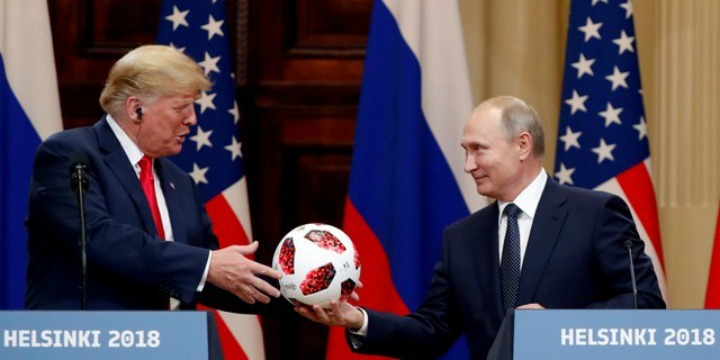
US President Donald Trump receives a soccer ball from Russian President Vladimir Putin as they hold a joint news conference. Photo: REUTERS/Grigory Dukor.
US Special Counsel Robert Mueller’s indictment of 12 Russian intelligence agents provided details on the website DCLeaks, which was allegedly registered by Russian intelligence officers. The website is now infamous for releasing hacked emails from individuals affiliated with the election campaign of Democratic presidential candidate Hillary Clinton.
“Starting in or around June 2016 and continuing through the 2016 US presidential election, the Conspirators used DCLeaks to release emails stolen from individuals affiliated with the Clinton Campaign,” the indictment reads.
The indictment focuses exclusively on hacking related to the US election that brought Donald Trump to office. It makes no mention of hacking related to the 13-month-old Gulf crisis, which pits a UAE-Saudi-led alliance against Qatar.
Yet the indictment’s repeated references to DCLeaks raises the question whether there might also be a Russian link to the hacking last year of the email of Yousef al-Otaiba, the UAE’s ambassador to the US.
Otaiba’s revealing and potentially damaging emails, which seemed to help Qatar in its public diplomacy campaign, were distributed to major media and analysts, including this writer, by an entity that identified itself as Global Leaks.
Questions about a potential link between Global Leaks, DCLeaks, and Russia stem not only from Global Leak’s use of a Russian provider that offers free email service, but also by the group’s own reference to DCLeaks. The group’s initial email had “DCLeaks” in its subject line.
It remains unclear whether the use of a Russian provider was coincidental, or whether the reference to DCLeaks was meant to mislead or create a false impression.
Global Leaks initially identified itself in an email as “a new group which is bringing to limelight human right violations, terror funding, illegal lobbying in US/UK to limelight of people to help make USA and UK great again and bring justice to rich sponsors of crime and terror.”
When pressed about its identity, the group said that “we believe that (the) Gulf in general has been crippling the American policy by involving us in their regional objectives. Lately it’s been (the) UAE who has bought America and traditionally it was their bigger neighbor (Saudi Arabia). If we had to hurt UAE, we have so much of documents given by source that it will not only hurt their image and economy but also legally and will for sure result in UN sanctions at the least. But that is not our goal.”
“Our goal is plain and simple, back off in playing with American interests and law, don’t manipulate our system, don’t use money as a tool to hurt our foreign policy. … It may be a coincidence that most things [we are leaking] do relate to UAE but in times to come if they continue and not stop these acts, we will release all the documents which may hurt all the countries including Bahrain and Qatar,” the group added.
Global Leaks’ allegation that the UAE was seeking to suck the US into Gulf affairs predated reports that Mueller, the special counsel — in addition to investigating the Russia angle — was also looking into whether George Nader, a highly paid Lebanese-American adviser to UAE Crown Prince Muhammad bin Zayed, had funneled funds to the Trump campaign.
Mueller is also investigating a meeting in the Seychelles between Blackwater founder Erik Prince and Kirill Dmitriev, CEO of the Russian Direct Investment Fund — the country’s sovereign wealth fund — which was brokered by the UAE. Prince and Dmitriev have denied that the meeting had anything to do with Donald Trump.
Trump has not publicly addressed reports that his election campaign may have received Gulf funding. But at a news conference with Russian President Vladimir Putin last week, Trump declined to endorse his government’s assessment that Russia interfered in the 2016 presidential election, saying that he doesn’t see any reason why Russia would be responsible.
British public relations watchdog Spinwatch Public Interest Investigations said in a report published last week detailing UAE lobbying efforts, that ever since the 2011 Arab Spring, the Emirates had tasked public relations companies in the US and Britain with linking members of Qatar’s ruling family to terrorism. The lobbying effort also aimed to get the Qatar-backed Muslim Brotherhood banned.
US intelligence officials said that last year the UAE orchestrated the hacking of Qatari government news and social media sites in order to post incendiary false quotes attributed to Qatar’s emir, Sheikh Tamim Bin Hamad al-Thani. The hacking provided the pretext for the UAE-Saudi-led economic and diplomatic boycott of the Gulf state. The UAE has denied this assertion.
US and Qatari officials said earlier that Russian hackers for hire had executed the attack on the Qatari websites. Cybersecurity experts said at the time that the hackers worked for various Gulf states. They said that the methods used in the hacking of the Qatari website and the hacking of Otaiba’s email were similar.
“They seem to be hackers-for-hire, freelancing for all sorts of different clients, and adapting their skills as needed,” said security expert Collin Anderson.
Two cybersecurity firms, ThreatConnect and Fidelis Cybersecurity, said in 2016 that they had indications that the hackers who hit the Democratic National Committee were preparing a fake version of the UAE Ministry of Foreign Affairs website that could be used in phishing attacks.
The UAE-Qatari cyberwar was indeed likely enabled by Russian hackers working for their own account rather than in coordination with the Russian government. It is, however, equally possible that the same hackers put their services at the disposal of Russia.
None of what is known about the murky world of Russian hackers is conclusive, let alone produces a smoking gun. The various strands of Mueller’s investigation, however, suggest grounds to query not only Russian cyber efforts to influence the US election but also the involvement of Russian nationals in the cyber war in the Gulf and potential links between the two operations.
Dr. James M. Dorsey, a non-resident Senior Associate at the BESA Center, is a senior fellow at the S. Rajaratnam School of International Studies at Singapore’s Nanyang Technological University and co-director of the University of Würzburg’s Institute for Fan Culture. BESA Center Perspectives Papers, such as this one, are published through the generosity of the Greg Rosshandler Family.