 Pod Save America Hosts Call on Democrats to Cut All Israel Military Aid, No Longer Accept AIPAC Funding
 Jews, Israelis Targeted in Austria Amid Surge in Antisemitic Incidents; Local Jewish Community Calls for Action
 ‘All of Our Strength’: Over 1,000 Pro-Israel Activists Gather in DC for Solidarity Conference
 ‘Devastated’: Wesley LePatner, Killed in Manhattan Mass Shooting, Was a Jewish Communal, Philanthropic Leader
 Sen. Angus King Vows to No Longer Vote for Israel Military Aid Until Gaza Conditions Improve
 Europe Won’t Pressure Israel to ‘Commit Suicide’ Amid Gaza Backlash, Palestinian State Push, Says Israeli FM
 Israel’s National Soccer Coach Attacked in Athens Before Soccer Fans Chant ‘F–K Israel, Free Palestine’ at Match
 New York Judge Sentences Neo-Nazi to 5 Years for Livestreaming Bomb Threats Against Jewish Hospitals
 US Pressures Lebanon to Issue Cabinet Decision to Disarm Hezbollah Before Talks Continue
 UK Plans to Recognize Palestinian State in September Unless Israel Meets Conditions, Starmer Says


The End of the Syrian War — and the Coming War for the Spoils
Error: Contact form not found.
 by Alon Ben-Meir

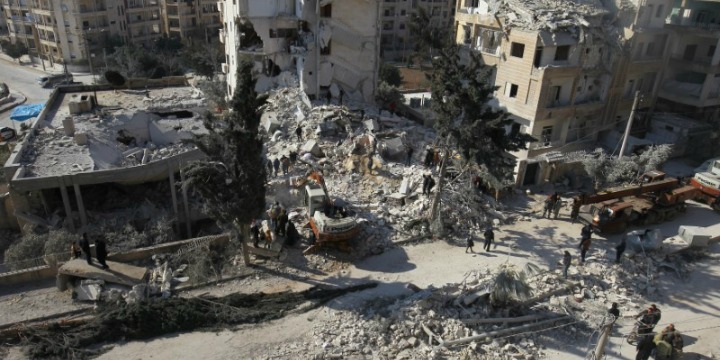
People inspect the damage at a site hit by airstrikes in the rebel-held city of Idlib, Syria on February 7, 2017. Photo: REUTERS/Ammar Abdullah.
Syria’s bloody war is nearing an end with the takeover of the city of Idlib by dictator Bashar al-Assad’s forces and his allies, and I do not expect that Syria will soon enter a period of calm and the victors amicably divide the spoils of war. Russia, Iran, Turkey, and the US have conflicting strategic interests in Syria that are on a collision course.
Russia has and will continue to play a leading role that will, to a great extent, shape Syria’s post-war future. Beyond Syria, however, Russia is determined to fill the vacuum left by the Obama administration, and to project its power and influence throughout the Middle East, which will precipitate new regional frictions and rivalries.
Iran is determined to entrench itself militarily in Syria and consolidate a corridor from the Gulf to the Mediterranean. This will continue to invite Israeli attacks (regardless of the transfer of the Russian S-300 air defense system to Syria) in order to prevent Tehran from achieving its strategic objective; this may well make Syria the prime battleground between Israel and Iran.
Turkey, which supported the rebels, wants to end the conflict over Idlib peacefully, dreading a new wave of refugees. Turkey is also seeking to prevent the Syrian Kurds from establishing autonomous rule, fearing that its own Kurdish population would want to replicate this. The violent conflict between Turkey and the Kurdish PKK group — and with the military arm of the Syrian Kurds’ YPG group — will continue unabated in and outside Syrian territory.
The US has a significant strategic interest in the region, and is committed to the security of its allies throughout the Middle East. Although the US should not be the policeman of the world, Syria occupies a special place in that it is strategically located and its volatility will continue to destabilize the region. The US’s escalating tension with Iran, the growing discord with Russia, and the deepening gulf with Turkey prompted Trump to reverse his initial decision to withdraw American forces from Syria, warning Damascus and its allies Russia and Iran that if they assault Idlib, “the consequences will be dire.”
That said, regardless of how the conflict over Idlib is settled, it would be a disastrous mistake if the US leaves Syria to the whims of Putin, Rouhani, and Erdogan. Trump should further augment, rather than withdraw US forces from Syria, push for a diplomatic solution, and play a direct role in shaping the ultimate outcome.
Dr. Alon Ben-Meir is a professor of international relations at the Center for Global Affairs at NYU. He teaches courses on international negotiation and Middle Eastern studies. He can be reached at alon@alonben-meir.com.