 Pod Save America Hosts Call on Democrats to Cut All Israel Military Aid, No Longer Accept AIPAC Funding
 Jews, Israelis Targeted in Austria Amid Surge in Antisemitic Incidents; Local Jewish Community Calls for Action
 ‘All of Our Strength’: Over 1,000 Pro-Israel Activists Gather in DC for Solidarity Conference
 ‘Devastated’: Wesley LePatner, Killed in Manhattan Mass Shooting, Was a Jewish Communal, Philanthropic Leader
 Sen. Angus King Vows to No Longer Vote for Israel Military Aid Until Gaza Conditions Improve
 Europe Won’t Pressure Israel to ‘Commit Suicide’ Amid Gaza Backlash, Palestinian State Push, Says Israeli FM
 Israel’s National Soccer Coach Attacked in Athens Before Soccer Fans Chant ‘F–K Israel, Free Palestine’ at Match
 New York Judge Sentences Neo-Nazi to 5 Years for Livestreaming Bomb Threats Against Jewish Hospitals
 US Pressures Lebanon to Issue Cabinet Decision to Disarm Hezbollah Before Talks Continue
 UK Plans to Recognize Palestinian State in September Unless Israel Meets Conditions, Starmer Says


Iran Still Weighing Nuclear Deal Exit, Foreign Minister Zarif Says
Error: Contact form not found.
 by Algemeiner Staff

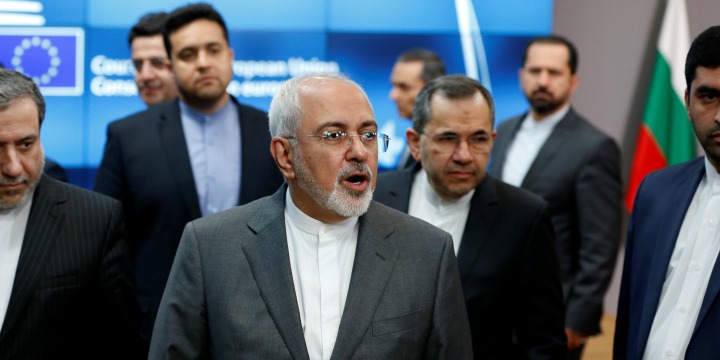
Iranian Foreign Minister Mohammad Javad Zarif, May 15, 2018. Photo: Reuters / Francois Lenoir.
Iran’s foreign minister on Monday would not guarantee that the Tehran regime would remain a party to the 2015 nuclear deal, following the US President Donald Trump’s decision to withdraw from the deal in May.
In an interview with Japanese news agency Kyodo News, Iranian Foreign Minister Mohammad Javad Zarif said his country would independently determine whether the economic and political benefits of remaining in the deal outweigh the costs.
“We will make that decision based on our own evaluation of our national security and interests,” Zarif said. “We are not working against any deadline.”
The US withdrawal from the JCPOA — the technical name for the 2015 deal — was accompanied by a renewal of tough sanctions on Tehran, with a new round that targets the Iranian oil industry scheduled to take effect on Nov. 4. Iran has warned that if the remaining parties to the JCPOA — the UK, Germany, France, Russia and China — fail to offset the impact of the sanctions, it may quit the deal.
Zarif did not rule out the prospect of direct negotiations with the Trump administration, without expressing any hope that such talks would eventually proceed.
“We do not have preconditions, but we can say that what is required for dialogue is mutual respect, not mutual confidence,” Zarif said. “Usually people who engage in negotiation do not necessarily have trust and confidence in each other, but it requires mutual respect.”
Zarif charged that the Trump administration had undermined all its international agreements by leaving the JCPOA. “The United States has failed to respect its legal obligations, its treaty obligations,” he said. “Unfortunately, the way that the United States has acted has created conditions that would basically undermine the utility of negotiation.”
Zarif did not deviate from the official line that Iran will carry on “business as usual” with its global trading partners after Nov. 4.
“For the time being, we are selling our oil (and) we are able to maintain our economy,” he said. “Many countries have shown readiness to do business with Iran.”
Besides the three European countries, other countries that attach great importance to the nuclear deal, including Russia, China and Japan, “are ready to implement their part,” Zarif said.