 Pod Save America Hosts Call on Democrats to Cut All Israel Military Aid, No Longer Accept AIPAC Funding
 Jews, Israelis Targeted in Austria Amid Surge in Antisemitic Incidents; Local Jewish Community Calls for Action
 ‘All of Our Strength’: Over 1,000 Pro-Israel Activists Gather in DC for Solidarity Conference
 ‘Devastated’: Wesley LePatner, Killed in Manhattan Mass Shooting, Was a Jewish Communal, Philanthropic Leader
 Sen. Angus King Vows to No Longer Vote for Israel Military Aid Until Gaza Conditions Improve
 Europe Won’t Pressure Israel to ‘Commit Suicide’ Amid Gaza Backlash, Palestinian State Push, Says Israeli FM
 Israel’s National Soccer Coach Attacked in Athens Before Soccer Fans Chant ‘F–K Israel, Free Palestine’ at Match
 New York Judge Sentences Neo-Nazi to 5 Years for Livestreaming Bomb Threats Against Jewish Hospitals
 US Pressures Lebanon to Issue Cabinet Decision to Disarm Hezbollah Before Talks Continue
 UK Plans to Recognize Palestinian State in September Unless Israel Meets Conditions, Starmer Says


A Jordanian Move Spells Weakness
Error: Contact form not found.
 by Eyal Zisser / Israel Hayom / JNS.org

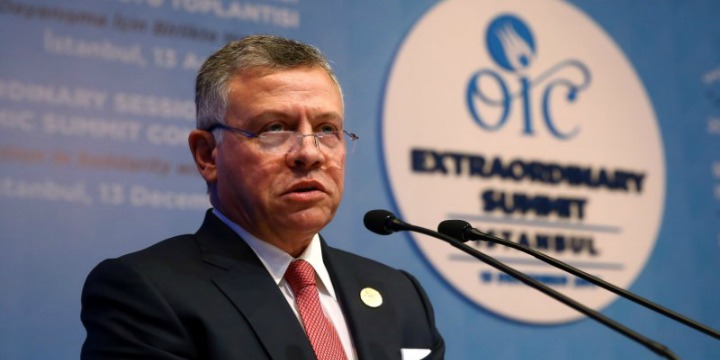
Jordanian King Abdullah II. Photo: Reuters / Kayhan Ozer / Pool.
JNS.org – The late Israeli Prime Minister Yitzhak Rabin saw the 1994 peace treaty with Jordan as one of his most important diplomatic achievements, if not the most important one. Unlike the skepticism he expressed over the Oslo Accords and then-PLO chairman Yasser Arafat’s commitment to them, Rabin was sure that Jordan’s King Hussein would live up to his word.
There is something symbolic in the fact that on the anniversary of Rabin’s assassination according to the Hebrew calendar, current Jordanian King Abdullah announced that he would not renew one of the annexes his father signed 24 years ago, leasing agricultural borderlands to Israel.
The Jordanian announcement is neither a big surprise, nor a move that has far-reaching strategic significance. After all, these are Jordanian lands, and it stands to reason that Jordan would have reimposed its sovereignty over them at some point, as no country in the Middle East would ever agree to relinquish territories over time.
Saudi Arabia did the same with respect to the Tiran and Sanafir islands, which were administered by Egypt for years before Riyadh reimposed its sovereignty over them in 2017.
The problem, therefore, is not the move per se, but the manner and timing with which the Jordanians chose to declare they were essentially disavowing the spirit of the 1994 peace agreement and turning their backs on the partnership forged between Rabin and Hussein.
This was not a complete surprise. After all, the Jordanians are very hostile towards Israel compared to populations in other Arab countries and, regrettably, the Jordanian regime does not even try to deal with this hostility. Facing a myriad of domestic challenges, the regime prefers to allow public opinion to lash out at Israel and hopes this will soften the criticism leveled at it on other issues.
At the same time, no Arab country is as dependent on Israel as Jordan, certainly in terms of energy and water resources, and on questions of national security.
Moreover, no Arab state maintains such tight, albeit clandestine, strategic cooperation with Israel as Jordan does. Israel welcomes this cooperation; its importance is immeasurably greater than the acres of agricultural land over which Jordan now seeks to regain control.
Overall, this is not a move that truly harms Israel’s interests, which is why Jerusalem is showing patience towards the hostile winds blowing in its direction from Jordan.
Nevertheless, the Jordanian move is as much a show of Abdullah’s weakness as signing the peace deal was a show of his father’s strength. Israel should maintain the same strategic cooperation with Jordan as it always has; still, our eyes have been opened.
Eyal Zisser is a lecturer in the Middle East History Department at Tel Aviv University.