 Pod Save America Hosts Call on Democrats to Cut All Israel Military Aid, No Longer Accept AIPAC Funding
 Jews, Israelis Targeted in Austria Amid Surge in Antisemitic Incidents; Local Jewish Community Calls for Action
 ‘All of Our Strength’: Over 1,000 Pro-Israel Activists Gather in DC for Solidarity Conference
 ‘Devastated’: Wesley LePatner, Killed in Manhattan Mass Shooting, Was a Jewish Communal, Philanthropic Leader
 Sen. Angus King Vows to No Longer Vote for Israel Military Aid Until Gaza Conditions Improve
 Europe Won’t Pressure Israel to ‘Commit Suicide’ Amid Gaza Backlash, Palestinian State Push, Says Israeli FM
 Israel’s National Soccer Coach Attacked in Athens Before Soccer Fans Chant ‘F–K Israel, Free Palestine’ at Match
 New York Judge Sentences Neo-Nazi to 5 Years for Livestreaming Bomb Threats Against Jewish Hospitals
 US Pressures Lebanon to Issue Cabinet Decision to Disarm Hezbollah Before Talks Continue
 UK Plans to Recognize Palestinian State in September Unless Israel Meets Conditions, Starmer Says


Survey Confirms That Antisemitism Is an Integral Part of European Culture
Error: Contact form not found.
 by Manfred Gerstenfeld

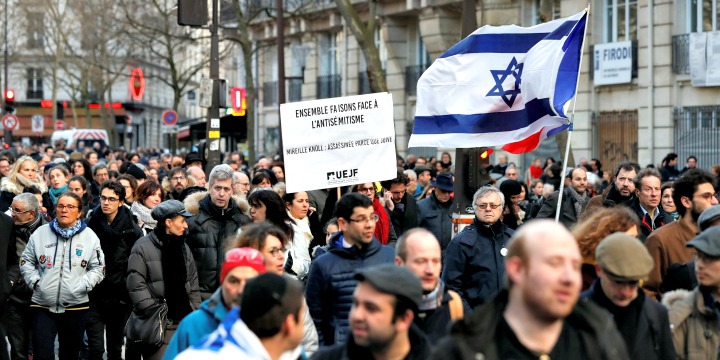
Demonstrators in Paris gather in memory of Mireille Knoll, a Holocaust survivor brutally murdered in an antisemitic assault. Photo: Reuters / Gonzalo Fuentes.
Branded as the largest survey ever on antisemitism, the Fundamental Rights Agency just released its study on antisemitism in 12 European Union countries titled. The report is titled, “Experiences and Perceptions of Antisemitism.” Many in the media have quoted from it without any critique.
Before analyzing the report, however, one should stress that the methodology of the report does not meet the statistical criteria for representativeness. The researchers leave no doubt about that in the document. Why? Because a variety of Jewish organizations mainly used their mailing lists to obtain responses to the questionnaire.
This logically leads to the conclusion that far more “involved” or religious Jews filled out the survey, rather than assimilated or non-practicing ones. And it is also not far-reaching to assume that among “involved Jews,” those very concerned about antisemitism were more inclined to complete the questionnaire than those who were less concerned.
Ignoring this methodological shortcoming leads to misinterpreting the findings, as many media outlets have done. While the qualitative outcome of the survey might be considered correct, some of the percentage figures quoted are probably on the high side.
Still, the qualitative findings of the report are extremely important. And the main takeaway is this: there is a very large presence of antisemitism in Europe and in European culture.
Even if many Europeans are not antisemites, antisemitism has always been part of European culture. It didn’t show up much for a few decades after the Holocaust, but in this century, it is very visible.
In the introduction of the study, the authors say that the European Union (EU) and its member states are required by law to do everything in their power to combat antisemitism, and to safeguard the dignity of Jewish people. The study concludes, however, that antisemitic harassment in EU countries is so common that it has become normalized.
The great majority of survey respondents said that antisemitism increased in their country during the five years before the survey. They rated antisemitism on the Internet and social media as the biggest social and political problem. This was closely followed by antisemitism in public spaces, the media, and political life.
Antisemitism wasn’t considered to be politically correct in Western European countries after the Holocaust, and many Europeans still don’t want to admit that the classic hatred of Jews has often morphed into anti-Israelism. The study, however, leaves little doubt about this. Respondents reported that the most common antisemitic statement encountered by Jews in Europe is that Israelis behave like Nazis toward the Palestinians. This should not come as a surprise. A 2011 study by the University of Bielefeld based on a statistically representative poll in seven European countries found that more than 40% of the surveyed population agreed with the extremely false statement that Israel behaves like Nazis.
So where does the non-representative character of the study affect its findings most? Thirty-eight percent of Jews interviewed considered emigrating in the five years preceding the survey because they did not feel safe. This figure seems high. The same is true about the finding that 34% of respondents avoid visiting Jewish events or sites because they do not feel safe.
As far as verbal harassment is concerned, the two most frequently mentioned categories of perpetrators were “someone they didn’t know” or “someone with an extremist Muslim view.” That was followed by “someone with a left-wing political view,” which was mentioned more frequently than someone with a right-wing political view.
One positive element was highlighted in the survey: About half of the respondents said that their national governments make efforts to protect Jewish communities. Indeed, far more effort is being made by governments to put police or military forces in front of synagogues or other Jewish institutions than was the case five years ago.
Even if not fully representative, this study is a damning statement about Europe’s hypocrisy, its pervasive antisemitism, its non-selective immigration policies that bring in many Jew-haters, its widespread anti-Israelism, and the huge discrepancy between the rhetoric of European leaders and their actions.