 Pod Save America Hosts Call on Democrats to Cut All Israel Military Aid, No Longer Accept AIPAC Funding
 Jews, Israelis Targeted in Austria Amid Surge in Antisemitic Incidents; Local Jewish Community Calls for Action
 ‘All of Our Strength’: Over 1,000 Pro-Israel Activists Gather in DC for Solidarity Conference
 ‘Devastated’: Wesley LePatner, Killed in Manhattan Mass Shooting, Was a Jewish Communal, Philanthropic Leader
 Sen. Angus King Vows to No Longer Vote for Israel Military Aid Until Gaza Conditions Improve
 Europe Won’t Pressure Israel to ‘Commit Suicide’ Amid Gaza Backlash, Palestinian State Push, Says Israeli FM
 Israel’s National Soccer Coach Attacked in Athens Before Soccer Fans Chant ‘F–K Israel, Free Palestine’ at Match
 New York Judge Sentences Neo-Nazi to 5 Years for Livestreaming Bomb Threats Against Jewish Hospitals
 US Pressures Lebanon to Issue Cabinet Decision to Disarm Hezbollah Before Talks Continue
 UK Plans to Recognize Palestinian State in September Unless Israel Meets Conditions, Starmer Says


Iran Satellite Launch, Which US Warned Against, Fails
Error: Contact form not found.
 by Reuters and Algemeiner Staff

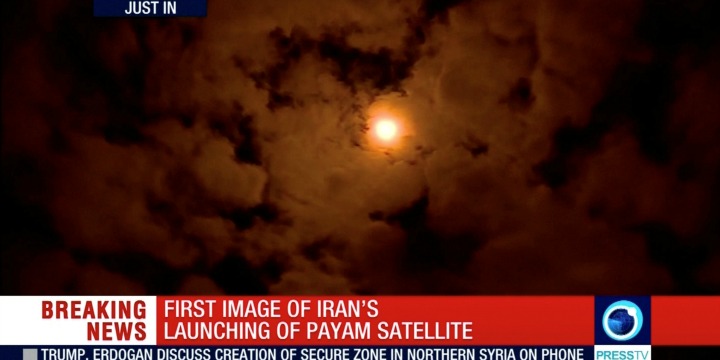
The Payam satellite is seen in the sky after it was launched in Iran, Jan. 15, 2019, in this still image taken from video. Photo: Reuters TV / via Reuters.
Iran‘s bid to put a satellite into orbit, in defiance of US warnings, failed on Tuesday after the rocket carrying it did not reach escape velocity, as the country’s telecoms minister said a second launch would go ahead.
Authorities in Washington this month warned Tehran against undertaking three planned launches that they said would, by using long-range ballistic missile technology, violate the UN Security Council resolution that enshrined Iran‘s 2015 nuclear deal with world powers.
The US is concerned that that technology can also be used to launch warheads.
Iran, which considers its space program a matter of national pride, has said its space vehicle launches and missile tests are not violations and will continue.
Telecoms Minister Mohammad Javad Azari-Jahromi said Tuesday’s satellite, named Payam, was mounted with four cameras. It was intended to be used for imaging and communications purposes and orbit at an altitude of 500 kilometers (310 miles), according to a report on the ministry’s website.
He said the satellite failed at the third stage because the rocket “did not reach adequate speed.”
“I would have liked to make everybody happy with good news but sometimes life doesn’t go forward the way we anticipate,” he said on Twitter.
Another satellite, named Doosti, was waiting to be launched.
“We should not come up short or stop,” Azari-Jahromi wrote. “It’s exactly in these circumstances that we Iranians are different than other people in spirit and bravery.”
Under the nuclear deal — which Washington pulled out of last spring before reimposing sanctions — the country is “called upon” to refrain from work for up to eight years on ballistic missiles designed to deliver nuclear weapons.
President Hassan Rouhani said Washington was waging an economic war against Tehran in order to get concessions on the missile program, but “is not able to build a wall around Iran.”
The country launched its first domestically built satellite, the OMID (Hope) research and telecoms satellite, in 2009 on the 30th anniversary of the Islamic revolution. The 40th anniversary falls in February.