 Pod Save America Hosts Call on Democrats to Cut All Israel Military Aid, No Longer Accept AIPAC Funding
 Jews, Israelis Targeted in Austria Amid Surge in Antisemitic Incidents; Local Jewish Community Calls for Action
 ‘All of Our Strength’: Over 1,000 Pro-Israel Activists Gather in DC for Solidarity Conference
 ‘Devastated’: Wesley LePatner, Killed in Manhattan Mass Shooting, Was a Jewish Communal, Philanthropic Leader
 Sen. Angus King Vows to No Longer Vote for Israel Military Aid Until Gaza Conditions Improve
 Europe Won’t Pressure Israel to ‘Commit Suicide’ Amid Gaza Backlash, Palestinian State Push, Says Israeli FM
 Israel’s National Soccer Coach Attacked in Athens Before Soccer Fans Chant ‘F–K Israel, Free Palestine’ at Match
 New York Judge Sentences Neo-Nazi to 5 Years for Livestreaming Bomb Threats Against Jewish Hospitals
 US Pressures Lebanon to Issue Cabinet Decision to Disarm Hezbollah Before Talks Continue
 UK Plans to Recognize Palestinian State in September Unless Israel Meets Conditions, Starmer Says


Would Martin Luther King, Jr. Participate in This Year’s Women’s March?
Error: Contact form not found.
 by Reuven Taff

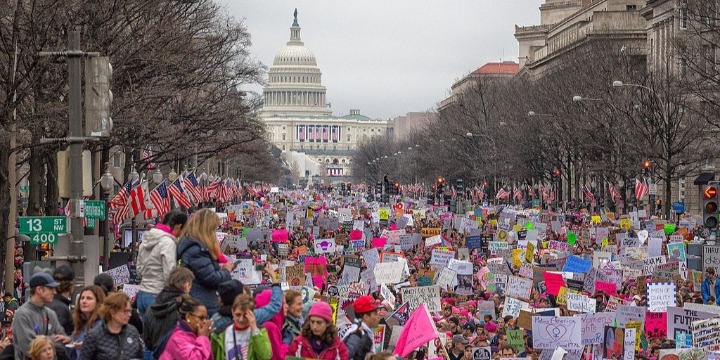
Protesters attend the Women’s March on Washington in January, 2017. Photo: Mobilus In Mobili.
Every year as we approach the weekend honoring the memory of the late Reverend Martin Luther King, Jr., I always think about Dr. King’s close relationship with Abraham Joshua Heschel.
While I never had the opportunity to meet Dr. Heschel, he was an iconic figure in our country — a rabbi and theologian deeply involved in the social issues of the day. He is famously known for marching arm-in-arm from Selma to Montgomery with King in March of 1965, and standing up for equal rights for all African-Americans. When Heschel was asked by a reporter at the conclusion of the march if he prayed while marching, he responded, “I prayed with my legs.”
If Heschel and King were alive today, I highly doubt that they would be among those praying with their legs at another march this Saturday in Washington, DC — the 2019 Women’s March. This is because over the last few months, leaders of the National Women’s March have become the focus of controversy, creating a storm that has disrupted the central tenets of the march: standing up for women’s rights and the rights of all people.
In late 2018, the March became the center of controversy over associations between some of its organizers and Nation of Islam leader Louis Farrakhan, a black nationalist who foments antisemitism, promotes an anti-white theology, and has made public statements that are homophobic. In February 2018, one of the Women’s March leaders, Tamika Mallory, attended a Nation of Islam Savior’s Day event where Farrakhan spoke of the “Satanic Jew,” declaring that “the powerful Jews are my enemy.” Mallory and another Women’s March leader, Linda Sarsour, failed to condemn Farrakhan for his bigotry, hatred, and antisemitism. When another leader of the March, Carmen Perez, was criticized for her support of Farrakhan, Perez responded that there are “no perfect leaders.”
In November 2018, Teresa Shook, one of the founders of the March, called for March organizers Bob Bland, Mallory, Sarsour, and Perez to resign, saying that “they have allowed anti-Semitism, anti-LBGTQIA sentiment and hateful, racist rhetoric to become a part of the platform by their refusal to separate themselves from groups that espouse these racist, hateful beliefs.” Many others have withdrawn their support from the Women’s March because of these issues.
I was very supportive of the previous two marches; the cause of speaking out and standing up for women’s rights, especially in times when those rights are being challenged or threatened, is indeed a noble one. I was proud that several mothers and their daughters who are members of my congregation in Sacramento flew to Washington in 2017 to participate in the first March.
But sadly, I cannot support the 2019 March, nor can I condone anyone’s participation when the March’s leaders refuse to condemn antisemitism and bigotry. And I truly think that if Martin Luther King, Jr. were alive, he would join his brother-in-arms Rabbi Heschel and insist that the leaders of this significant event step down. They are imposing their own personal agenda upon millions of women and others who want to exercise their right to march for equality without being subjected to the personal biases of some of these organizers who are using their bully pulpit to perpetuate hate and division. Don’t we have enough of that in our country?
While many local marches in cities all over the nation will be held, some local communities are disassociating from the national Women’s March. But the leaders of all local marches should publicly demand that the leaders of the national March (who have refused to repudiate their hate-related statements and associations with Farrakhan) resign their positions. The failure of local march leaders to make that demand is essentially giving those national leaders a pass. And if local leaders fail to make that demand, then anyone marching in a local community women’s march is essentially, by association, siding with the likes of Bland, Mallory, Sarsour, and Perez.
As a theologian who studied the relationship between God and humankind, Heschel believed that when one understands the spark of the divine that exists within each person, he or she cannot harbor hatred for fellow human beings. King and Heschel never uttered a word of hate in their speeches or rallies. The leaders of the national Women’s March would be wise to apply the lessons taught by Dr. King and Rabbi Heschel. The women’s movement for equality deserves leaders without bias or prejudice to carry forth the organization’s mission of creating an environment of transformative societal change.
Reuven Taff, a past president of the Greater Sacramento Board of Rabbis, serves as rabbi and spiritual leader of the Mosaic Law Congregation in Sacramento, California. Contact him at rabbi@mosaiclaw.org.